

Within the H37Cr data we have identified 91 stars in common with our data set. 88 of them were actually used after exclusion of three outliers (see Sect. 3.1). Figure 1 (click here)a shows the distribution of their internal proper motion errors, while Fig. 1 (click here)b shows the internal errors of our proper motions (see below). The median error of H37Cr is 0.9mas/a, which is typical for the average accuracy of the final Hipparcos catalogue. Not all stars from the Hipparcos Input Catalogue for which we measured absolute proper motions have data in H37Cr. The reason is that results for stars which were recognized or suspected as double/multiple should not enter into the link solutions, and were consequently not distributed to the various link groups. See Brosche et al. (1995b) for the incidence of optical doubles among Hipparcos stars and the possible danger of unresolved doubles.

Figure 1:
Internal errors of the proper motions of 88 stars used to determine the
rotation of the Hipparcos proper motions to an inertial system.
The full lines show the errors in  , the broken lines those in
  .
a) Hipparcos proper motions.
b) Absolute proper motions from photographic plates determined in our
link project. The errors do not contain the contribution from the extragalactic
calibration in each field
.
a) Hipparcos proper motions.
b) Absolute proper motions from photographic plates determined in our
link project. The errors do not contain the contribution from the extragalactic
calibration in each field
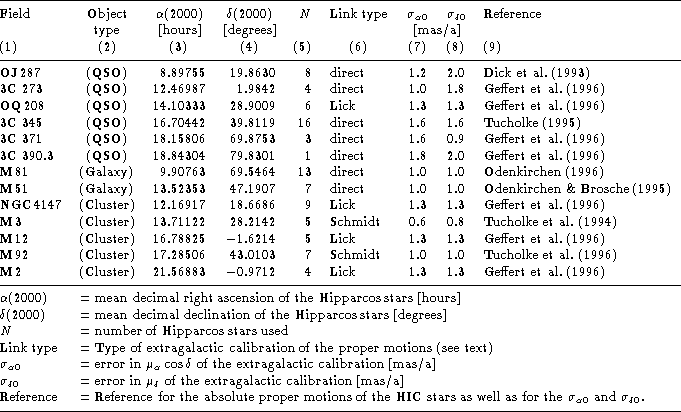
Table 1: The Bonn extragalactic link fields
In Table 1 (click here) we give an overview over the 13 link fields.
Column 1 is the name of the field, bearing the name of the
extragalactic object or the star cluster in the field centre, followed
by the type of object. Here, QSO stands collectively for pointlike
optical counterparts of extragalactic radio sources, such as QSO's,
BLLac objects or N galaxies. Columns 3 and 4 show the mean decimal
right ascension and declination of the Hipparcos stars in the
field. Column 5 gives the number of Hipparcos stars used for the
extragalactic link. Column 6 shows the type of extragalactic
calibration in each field. Here ``direct'' means calibration by the
fictitious proper motions of the extragalactic object(s) in the
field. ``Schmidt'' or ``Lick'' are given for fields where the proper
motions have been calibrated by measurements of field stars with
respect to galaxies from Schmidt or Lick plates, respectively. Columns
7 and 8 give the estimated errors  and
and
 of the extragalactic calibration. The last column
gives the references, where the absolute proper motions and their
extragalactic calibration have been published.
of the extragalactic calibration. The last column
gives the references, where the absolute proper motions and their
extragalactic calibration have been published.
In the fields of OJ287, 3C 273, OQ208, 3C 371, and 3C 390.3, between 60 and 75 selected stars (all BD stars and some faint stars around the radio sources) were measured. In the remaining fields, all stars were measured, so no Hipparcos star was missed. Relative proper motions were derived by an iterative central-overlap algorithm, as described by LeCampion et al. (1992); Tucholke et al. (1994), or Odenkirchen & Brosche (1995). For most fields, our proper motions and their extragalactic calibration have already been published. We now briefly describe the different data sets.
Brosche et al. (1991) measured proper motions in the fields of the
extragalactic radio sources 3C 273, OQ208, 3C 371, and 3C 390.3. These
proper motions were derived using the AGK3 as reference
catalogue. Meanwhile the PPM catalogue (Röser & Bastian 1991)
presents a better realization of the current fundamental
system. Therefore the proper motions in the four fields were rederived
with respect to the PPM. Improved fictitious proper motions for the
four optical counterparts in the PPM system were listed in Geffert
et al. (1993). Updated values for the four fields including new
photographic plates are published by Geffert et al. (1996).
Proper motions of Hipparcos stars in the PPM system in the field of
the BLLac object OJ287 were given by Dick et al.
(1993) . Meanwhile additional plates have been taken also
for OJ287. The absolute proper motions used here stem from new
reductions including this recent observational material. We mention that
the B magnitudes of these sources range from 13 to 15, some of them
being (violently) variable.
. Meanwhile additional plates have been taken also
for OJ287. The absolute proper motions used here stem from new
reductions including this recent observational material. We mention that
the B magnitudes of these sources range from 13 to 15, some of them
being (violently) variable.
Odenkirchen & Brosche (1995) present absolute proper motions of stars in the field of the prominent spiral galaxy M51. The use of bright galaxies like M51 leads to a higher probability of finding suitable first-epoch plates, but necessitates sophisticated methods for astrometric centering of the galaxies (or parts of them), as discussed in full detail by Odenkirchen & Brosche (1995). The results in the field of the galaxy M81 were obtained in an analogous way (Odenkirchen 1995, 1996).
Photographic plates from Schmidt telescopes show large numbers of galaxies, so that an accurate zero point for absolute proper motions can be derived even from the relatively small epoch differences (20 to 35 years) available. Tucholke et al. (1994) corrected their relative proper motions in the field of the globular cluster M3 to absolute ones by comparison with the absolute proper motions from Schmidt plates by Scholz et al. (1993). In an analogous way, Tucholke et al. (1996) tie their relative proper motions in the field of the globular cluster M92 to absolute proper motions from Schmidt plates by Scholz et al. (1994).
The proper motions in the fields of the globular clusters NGC4147, M12 and M2 were calibrated by field stars, whose absolute proper motions were measured from plates of the Lick NPM project and additional plates from the same telescope (Geffert et al. 1996).
In the field around the QSO 3C 345 we used Tautenburg Schmidt plates with an epoch difference of up to 23 years (Tucholke 1995). The proper motions were calibrated by about 90 carefully inspected galaxies and QSO's. This observational material results in larger individual errors, but allowed to use a higher number of Hipparcos stars due to the large field of the Schmidt telescope.
Figure 1 (click here)b shows the distribution of the internal errors of the proper motions of Hipparcos stars from our measurements. The median error is 1.0mas/a in both coordinates. Note that this number does not include the errors of the extragalactic calibration in each field, which are given in Cols. 7 and 8 of Table 1 (click here).