

We have used various R-matrix techniques for the calculation of collision
strengths: the semi-relativistic TCC and the full
intermediate coupling BP method. It is interesting to compare the
collision strengths as a function of colliding electron energy obtained with
the different approaches. This comparison demonstrates the
influence of the consistent treatment of relativistic effects in the system
target + electron on the effective
collision strengths. Here we focus on selected KrIII, IV, V
transitions from the ground state to excited states within the 4p ground configurations.
The collision strength of the  fine-structure
transition in KrIII is dominated by complex resonance structures at low
electron energies (Fig. 1 (click here)a). The position and shape of the
resonances close to threshold clearly affect the effective collision
strengths especially at low temperatures. In the BP calculation the
threshold is not at zero energy due to fine-structure splitting whereas
in the TCC method the fine-structure thresholds are assumed
to be degenerate.
The effect of the full relativistic approach is well reflected in the
effective collision strength (Fig. 2 (click here)a). In particular, for a temperature
of 2000 K BP yields an effective collision strength which is 30% lower
compared to TCC. The difference
reduces with increasing temperature (10% at 10000 K)
and both methods agree in the high temperature limit as expected.
fine-structure
transition in KrIII is dominated by complex resonance structures at low
electron energies (Fig. 1 (click here)a). The position and shape of the
resonances close to threshold clearly affect the effective collision
strengths especially at low temperatures. In the BP calculation the
threshold is not at zero energy due to fine-structure splitting whereas
in the TCC method the fine-structure thresholds are assumed
to be degenerate.
The effect of the full relativistic approach is well reflected in the
effective collision strength (Fig. 2 (click here)a). In particular, for a temperature
of 2000 K BP yields an effective collision strength which is 30% lower
compared to TCC. The difference
reduces with increasing temperature (10% at 10000 K)
and both methods agree in the high temperature limit as expected.
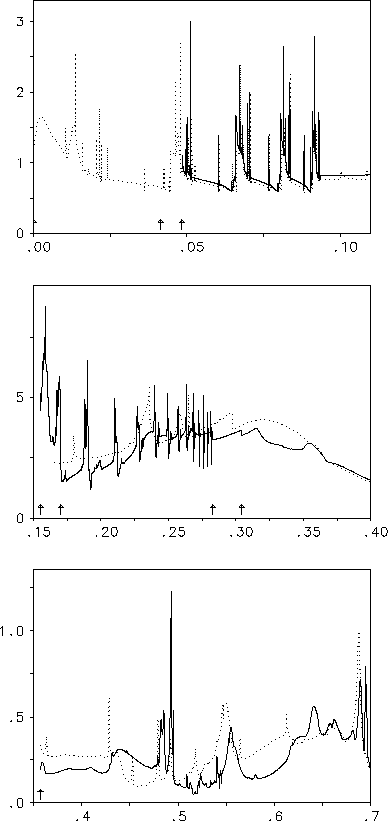
Figure 1: Collision strength  as a function of
the incoming electron energy (Ryd) in the near
threshold region of the a) KrIII\
as a function of
the incoming electron energy (Ryd) in the near
threshold region of the a) KrIII\
 P
P
 P
P , b) KrIV\
 S
S
 D
D and
c) KrV
and
c) KrV  P
P
 S
S transitions (full
curve: BP, dotted: TCC method). The arrows on the
energy axis mark the target fine-structure threshold
energies
transitions (full
curve: BP, dotted: TCC method). The arrows on the
energy axis mark the target fine-structure threshold
energies
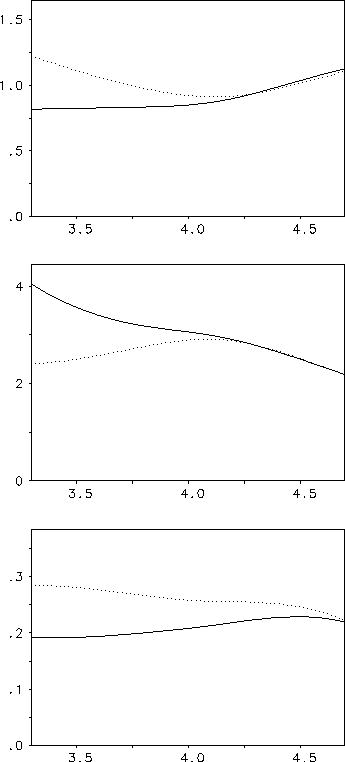
Figure 2: Effective collision strength  as a function of
 for the transitions
a) KrIII
for the transitions
a) KrIII  P
P
 P
P ,
b) KrIV
,
b) KrIV  S
S
 D
D and
c) KrV
and
c) KrV  P
P
 S
S (full curve: BP, dotted: TCC method)
As to the  S
S
 D
D transition in KrIV\
the BP calculation exhibits a remarkable Rydberg series of resonances in the
collision strength at low energies (Fig. 1 (click here)b). The series is converging
to the
transition in KrIV\
the BP calculation exhibits a remarkable Rydberg series of resonances in the
collision strength at low energies (Fig. 1 (click here)b). The series is converging
to the  P
P threshold and superimposed on a broad resonance associated with bound
channels in the J=4 partial wave of even symmetry.
Again the effect of fine-structure splitting can be clearly seen at the
excitation threshold. Hence it is not surprising that the BP effective
collision strength exceeds the TCC result by almost a factor of 2
at a temperature of 2000 K (Fig. 2 (click here)b). However, the deviations rapidly
diminish with increasing temperature such that the TCC results approach the
BP values for
threshold and superimposed on a broad resonance associated with bound
channels in the J=4 partial wave of even symmetry.
Again the effect of fine-structure splitting can be clearly seen at the
excitation threshold. Hence it is not surprising that the BP effective
collision strength exceeds the TCC result by almost a factor of 2
at a temperature of 2000 K (Fig. 2 (click here)b). However, the deviations rapidly
diminish with increasing temperature such that the TCC results approach the
BP values for  .
.
Finally, Fig. 1 (click here)c demonstrates the collision strength for
the  P
P
 S
S transition in KrV where
similarly to the case of KrIV
the lowering of the collisional background close to
threshold is prominent in the BP calculation.
Moreover the comparison exhibits an
important feature of the BP calculations, the shift of resonances due
to relativistic spin-orbit effects on collisional complex terms.
Accordingly the BP effective collision strength is much lower
(35% at 2000 K) as compared to TCC (Fig. 2 (click here)c).
transition in KrV where
similarly to the case of KrIV
the lowering of the collisional background close to
threshold is prominent in the BP calculation.
Moreover the comparison exhibits an
important feature of the BP calculations, the shift of resonances due
to relativistic spin-orbit effects on collisional complex terms.
Accordingly the BP effective collision strength is much lower
(35% at 2000 K) as compared to TCC (Fig. 2 (click here)c).
To our knowledge experimentally measured collision strengths are not available
for any krypton ions. Were the krypton abundances in NGC 7027
known we could infer the effective collision
strengths from the parameters  in Tables 10-13 of PB94
which have been determined from the observed line intensities.
It has been shown in PB94 that
in Tables 10-13 of PB94
which have been determined from the observed line intensities.
It has been shown in PB94 that

with  being the actual nebular abundance of the ion emitting the
line and
being the actual nebular abundance of the ion emitting the
line and
 the solar system elemental abundance relative to hydrogen.
 is the effective collision strength for the transition from
the ground state to the upper level j of the line
is the effective collision strength for the transition from
the ground state to the upper level j of the line  .
Since abundances are not known a priori
we consider proper ratios of
.
Since abundances are not known a priori
we consider proper ratios of  parameters, e.g.\

for transitions in the KrIV\
 S-
S- D multiplet at 5868.0 Å (1-2) and 5346.1 Å (1-3).
The labelling of the transitions in braces refers to the indices of the
fine structure energy levels in Table 5 (click here). For a nebular temperature of
13500 K (see Table 2 (click here) in PB94) the TCC and BP calculations yield
D multiplet at 5868.0 Å (1-2) and 5346.1 Å (1-3).
The labelling of the transitions in braces refers to the indices of the
fine structure energy levels in Table 5 (click here). For a nebular temperature of
13500 K (see Table 2 (click here) in PB94) the TCC and BP calculations yield
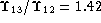 which is well within the error
limit of the measurements (
which is well within the error
limit of the measurements ( of Péquignot & Baluteau. We note that agreement could not be achieved
with a non-relativistic approach where the collision strengths for excitation
from the
of Péquignot & Baluteau. We note that agreement could not be achieved
with a non-relativistic approach where the collision strengths for excitation
from the  S
S ground state to the individual
 D
D fine-structure levels are obtained from LS
coupling data using statistical weights and thus satisfy the relation
fine-structure levels are obtained from LS
coupling data using statistical weights and thus satisfy the relation
 . This result clearly demonstrates the
importance of relativistic effects on the electron excitation of krypton
ions.
. This result clearly demonstrates the
importance of relativistic effects on the electron excitation of krypton
ions.
On the other hand
the  parameters prove to be useful for determining
the krypton abundance in NGC 7027. In their analysis (PB94)
Péquignot & Baluteau tentatively presumed
that collision strengths are similar for homologous forbidden transitions in
Ar
parameters prove to be useful for determining
the krypton abundance in NGC 7027. In their analysis (PB94)
Péquignot & Baluteau tentatively presumed
that collision strengths are similar for homologous forbidden transitions in
Ar and Kr
 ions. However, by comparing our collision strengths
for KrIII-V with the results of previous calculations for
ArIII-V (Johnson & Kingston 1990; Zeippen et al.
1987; Mendoza 1983)
we found that some effective collision strengths for Kr
ions. However, by comparing our collision strengths
for KrIII-V with the results of previous calculations for
ArIII-V (Johnson & Kingston 1990; Zeippen et al.
1987; Mendoza 1983)
we found that some effective collision strengths for Kr are
larger by more than a factor of 2 compared to Ar
are
larger by more than a factor of 2 compared to Ar . Consequently it is
interesting to reanalyse the spectral data of PB94 and apply our new
collision strengths for krypton ions.
. Consequently it is
interesting to reanalyse the spectral data of PB94 and apply our new
collision strengths for krypton ions.
We follow the method of PB94 except that we do not neglect the
individual behaviour of the complex ions in collisional
processes. Then for homologous
transitions in argon and krypton ions we consider the ratio

and using (6) we rewrite (8) as

We emphasize that  denotes the ratio of ionic
abundances in NGC 7027 and
denotes the ratio of ionic
abundances in NGC 7027 and  is the ratio of solar
system elemental abundances. In Table 6 (click here)
is the ratio of solar
system elemental abundances. In Table 6 (click here)  derived from the
 values in Tables 10-13 of PB94 are listed for selected
homologous transitions in Ar
values in Tables 10-13 of PB94 are listed for selected
homologous transitions in Ar and Kr
 (n=2,3,4) ions.
The transitions have been chosen such that for a specific ion number the
uncertainty of
(n=2,3,4) ions.
The transitions have been chosen such that for a specific ion number the
uncertainty of  quoted in PB94 is minimal.
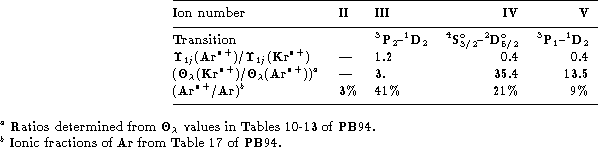
Table 6: Homologous transitions in Ar and Kr
 ions used for
determining the krypton abundance in NGC 7027
ions used for
determining the krypton abundance in NGC 7027
The nebular abundance of krypton  in units of the solar
system abundance
in units of the solar
system abundance  (see Table 3 (click here) in PB94) is then
given as
(see Table 3 (click here) in PB94) is then
given as

where  is the ionization fraction of argon
obtained from recent photoionization models of NGC 7027 (see Table 17 in
PB94). The ratios of effective collision strengths
is the ionization fraction of argon
obtained from recent photoionization models of NGC 7027 (see Table 17 in
PB94). The ratios of effective collision strengths
 have been calculated for electron temperatures according to Table 2 (click here) in PB94.
The ``ionization correction factor'' icf (see Table 17 in PB94) accounts for
contributions of unobserved highly ionized Ar
have been calculated for electron temperatures according to Table 2 (click here) in PB94.
The ``ionization correction factor'' icf (see Table 17 in PB94) accounts for
contributions of unobserved highly ionized Ar and Kr
 ions to the sum in (10). No data are available for Ar
 and
Kr
and
Kr , thus
  is set arbitrarily to unity as these ions are negligible.
Using (10) and the values of  ,
,  and
and  listed in Table 6 (click here) we
find that krypton is overabundant in NGC 7027 by a factor of
listed in Table 6 (click here) we
find that krypton is overabundant in NGC 7027 by a factor of  relative to the solar system value. We note that our result is lower
by a factor of
relative to the solar system value. We note that our result is lower
by a factor of  compared to the estimate of PB94. This is
mainly due to the use of our calculated collision strength for the
KrIV
compared to the estimate of PB94. This is
mainly due to the use of our calculated collision strength for the
KrIV  S
S
 D
D transition which exceeds that of the homologous transition in ArIV\
by more than a factor of 2.
transition which exceeds that of the homologous transition in ArIV\
by more than a factor of 2.