Since a consistent treatment of relativistic effects in both the target
and scattered electron wavefunction is computationally
demanding it is necessary to keep the dimensions of the problem to a
reasonably small level. Thus the total wavefunction for the system
target + electron was calculated in a 6- (KrIII ), 7- (KrIV ) and
8-state (KrV ) close-coupling representation. In Table 1 (click here) we list the
spectroscopic target configurations along with a number of correlation
configurations included essentially for improving the target energies.
For transitions within the 4p
 ground
configurations these target representations allow for sufficient
collisional coupling with higher target states for the electron
temperatures (and energies) under consideration.
The SUPERSTRUCTURE package (Eissner et al. 1974;
Nussbaumer & Storey 1978) has been employed to optimize the
one-electron orbitals nl.
The corresponding adjustable scaling parameters
ground
configurations these target representations allow for sufficient
collisional coupling with higher target states for the electron
temperatures (and energies) under consideration.
The SUPERSTRUCTURE package (Eissner et al. 1974;
Nussbaumer & Storey 1978) has been employed to optimize the
one-electron orbitals nl.
The corresponding adjustable scaling parameters  in the
statistical-model potential are to be found in Table 2 (click here). Subsequently Table 3 (click here)
shows the calculated fine-structure energy levels together with the observed
values taken from Sugar & Musgrove (1991). Except for the
lowest states
the relative difference between theory and experiment is generally much less
than 10%. The case
of the KrIII and KrV
in the
statistical-model potential are to be found in Table 2 (click here). Subsequently Table 3 (click here)
shows the calculated fine-structure energy levels together with the observed
values taken from Sugar & Musgrove (1991). Except for the
lowest states
the relative difference between theory and experiment is generally much less
than 10%. The case
of the KrIII and KrV  P ground term fine-structure states is
marginal since the absolute deviations in the fine-structure energy
splittings are similar to those of higher states. With regard to the
first excited
P ground term fine-structure states is
marginal since the absolute deviations in the fine-structure energy
splittings are similar to those of higher states. With regard to the
first excited  D
D term in KrIV the agreement could
be further improved through the inclusion of, for example, 4f pseudo-orbitals.
However, the corresponding pseudo-resonances in the collision strengths
are located close to threshold and could significantly contribute to the
thermally averaged collision strengths leading to inaccurate results.
Finally, for selected transitions
SUPERSTRUCTURE gf values calculated in the length
and velocity formulations are given in Table 4 (click here). The agreement is reasonable
considering the rather coarse description of the complex targets.
We note that in the scattering calculations
the theoretical energy levels have been replaced by those measured such
that the target thresholds are adjusted to the correct values.
term in KrIV the agreement could
be further improved through the inclusion of, for example, 4f pseudo-orbitals.
However, the corresponding pseudo-resonances in the collision strengths
are located close to threshold and could significantly contribute to the
thermally averaged collision strengths leading to inaccurate results.
Finally, for selected transitions
SUPERSTRUCTURE gf values calculated in the length
and velocity formulations are given in Table 4 (click here). The agreement is reasonable
considering the rather coarse description of the complex targets.
We note that in the scattering calculations
the theoretical energy levels have been replaced by those measured such
that the target thresholds are adjusted to the correct values.
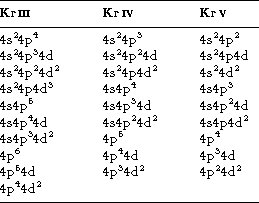
Table 1: Configurations included in the target representations.
All configurations include 
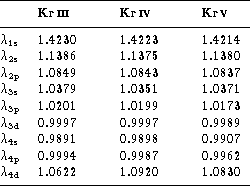
Table 2: Values for the adjustable scaling parameters  in the statistical-model potential used to calculate the one-electron
orbitals
in the statistical-model potential used to calculate the one-electron
orbitals
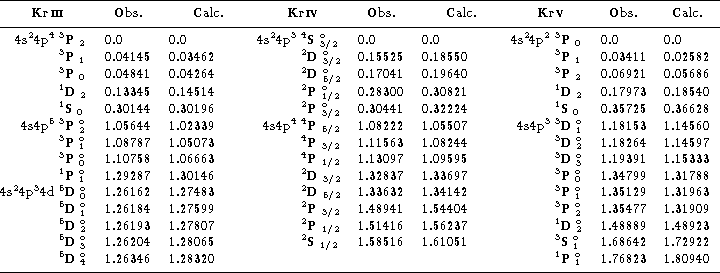
Table 3: Observed (Sugar & Musgrove 1991) and calculated
KrIII , KrIV and KrV fine-structure energy levels in Ryd
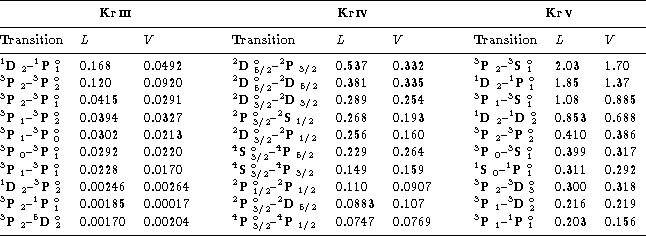
Table 4: Comparison of selected SUPERSTRUCTURE gf values calculated in the
length
(L) and velocity (V) formulations for the KrIII , KrIV and KrV ions
The scattering calculations have been performed using two different
approaches of various sophistication for the collisional problem with the
inclusion of relativistic effects. These methods are based on:
(a) purely algebraic recoupling of LS target terms to an LSJ
coupling scheme and J-J coupling between target terms using term
coupling coefficients (TCC 's) and (b)
full intermediate coupling calculation using the BP Hamiltonian for
electron-ion scattering. We begin with approximation (a)
which has been discussed in Paper I.
Here the solution of the collisional problem is efficiently
achieved in LS-coupling by means of the Iron Project version of the
R-matrix package (IP93) where the hamiltonian is taken to be the
non-finestructure part  of the low-Z Breit-Pauli hamiltonian

with  being the usual non-relativistic Hamiltonian.
  and
and  denote the one-body mass correction and Darwin term
respectively. These relativistic operators yield important energy corrections
to the N-electron target and (N+1)-electron intermediate bound states.
Then the calculation of collision strengths for transitions between
fine-structure target levels essentially involves
an algebraic transformation of the transmission matrices
(T=1-S) to intermediate coupling.
Following Saraph (1978) relativistic effects are
included to first order through a further transformation of the
T-matrices using term-coupling coefficients. The latter are obtained as
by-products in a BP run of the
RAL version of the Iron Project R-matrix package (Eissner, private communication).
As the TCC method neglects
the fine-structure energy splitting of the target terms the effective
collision strengths prove to be useful for higher temperatures such that
the dominant contributions to the thermal average arise from collision
energies above the fine-structure thresholds.
denote the one-body mass correction and Darwin term
respectively. These relativistic operators yield important energy corrections
to the N-electron target and (N+1)-electron intermediate bound states.
Then the calculation of collision strengths for transitions between
fine-structure target levels essentially involves
an algebraic transformation of the transmission matrices
(T=1-S) to intermediate coupling.
Following Saraph (1978) relativistic effects are
included to first order through a further transformation of the
T-matrices using term-coupling coefficients. The latter are obtained as
by-products in a BP run of the
RAL version of the Iron Project R-matrix package (Eissner, private communication).
As the TCC method neglects
the fine-structure energy splitting of the target terms the effective
collision strengths prove to be useful for higher temperatures such that
the dominant contributions to the thermal average arise from collision
energies above the fine-structure thresholds.
The more elaborate technique (b) used in this paper is based on the
BP formulation of the R-matrix method (IP93).
Here a consistent treatment of relativistic effects in both the target and
scattered electron wavefunction is enabled through the use of the low-Z
BP Hamiltonian

which beside the non-finestructure part  (see Eq. (1)) contains
the spin-orbit interaction
(see Eq. (1)) contains
the spin-orbit interaction  . The latter does not preserve LS
symmetry but is diagonal in the total angular momentum J=L+S. Accordingly the
matrix elements of the BP Hamiltonian are most conveniently evaluated in a
pair coupling scheme with explicit consideration of all scattering channels
including fine structure. Thus the size of the Hamiltonian matrices and,
consequently, the computing time greatly exceed that of the TCC\
calculations. The numerical solution is handled using the
QUB version of the Iron Project R-matrix package (IP93)
followed by a run of the Opacity Project asymptotic region code STGF
(Berrington et al. 1987).
. The latter does not preserve LS
symmetry but is diagonal in the total angular momentum J=L+S. Accordingly the
matrix elements of the BP Hamiltonian are most conveniently evaluated in a
pair coupling scheme with explicit consideration of all scattering channels
including fine structure. Thus the size of the Hamiltonian matrices and,
consequently, the computing time greatly exceed that of the TCC\
calculations. The numerical solution is handled using the
QUB version of the Iron Project R-matrix package (IP93)
followed by a run of the Opacity Project asymptotic region code STGF
(Berrington et al. 1987).
Partial waves have been included for all total angular momenta and parity
symmetries with  which ensure sufficient convergence of the
collision strengths for forbidden transitions within the target ground
configuration. Due to the rather narrow resonance structure of the
collision strengths we have
set up the energy mesh in terms of the effective quantum number
which ensure sufficient convergence of the
collision strengths for forbidden transitions within the target ground
configuration. Due to the rather narrow resonance structure of the
collision strengths we have
set up the energy mesh in terms of the effective quantum number  relative to the next higher target threshold. It has been found that
a step width
relative to the next higher target threshold. It has been found that
a step width  gives good resolution of the resonances.
Close to thresholds where the effective quantum number exceeds a value
of
gives good resolution of the resonances.
Close to thresholds where the effective quantum number exceeds a value
of  Gailitis averaging (Gailitis
1963) of the resonances is performed and
a constant interval length
Gailitis averaging (Gailitis
1963) of the resonances is performed and
a constant interval length  in (z-scaled) energy is used.
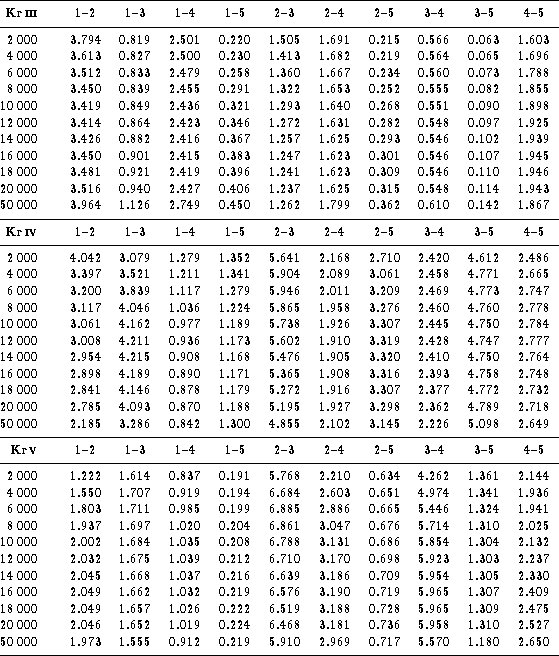
Table 5: Effective collision strengths for KrIII, IV, V.
The left-hand column indicates the values of the electron temperature (Kelvin).
In the row containing the ion symbol the indices of the initial and final
levels are coded as follows: