The tables are available only electronically from the Centre de
Données astronomique de Strasbourg (CDS) . They cover the
Lyman, Balmer, Paschen, and Brackett series up to n=22 for a slightly
extended grid of T and
. They cover the
Lyman, Balmer, Paschen, and Brackett series up to n=22 for a slightly
extended grid of T and  than the 1973 tables. The tables contain
the logarithm of the normalized Stark profile
than the 1973 tables. The tables contain
the logarithm of the normalized Stark profile  with
with

where
the distance  from the line center is in Ångströms
and the normal field strength
from the line center is in Ångströms
and the normal field strength  (in esu) is given as

Normalization was such that

Unlike the original tables the grid is rectangular for
easy interpolation and covers the range  K;
K;
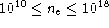 cm
cm ; and
; and  (
( for
some higher lines)
for
some higher lines)  , all in the same
steps as the original tables:
, all in the same
steps as the original tables:  ,
,  ,
,  . Note that the scaling of the Lyman
lines results in a slightly different
. Note that the scaling of the Lyman
lines results in a slightly different  for the
higher lines.
for the
higher lines.
The code was not able to compute profiles for the higher lines of a
series for high  and low T. This simply reflects the fact that
the upper level does no longer exist for such high densities. However,
for practical applications it is much easier to deal with a rectangular
table instead of having the number of points vary with
and low T. This simply reflects the fact that
the upper level does no longer exist for such high densities. However,
for practical applications it is much easier to deal with a rectangular
table instead of having the number of points vary with  and T.
To ease the use of the tables we simply copied the last correctly
produced profile to the lower temperature and indicate this fact with a
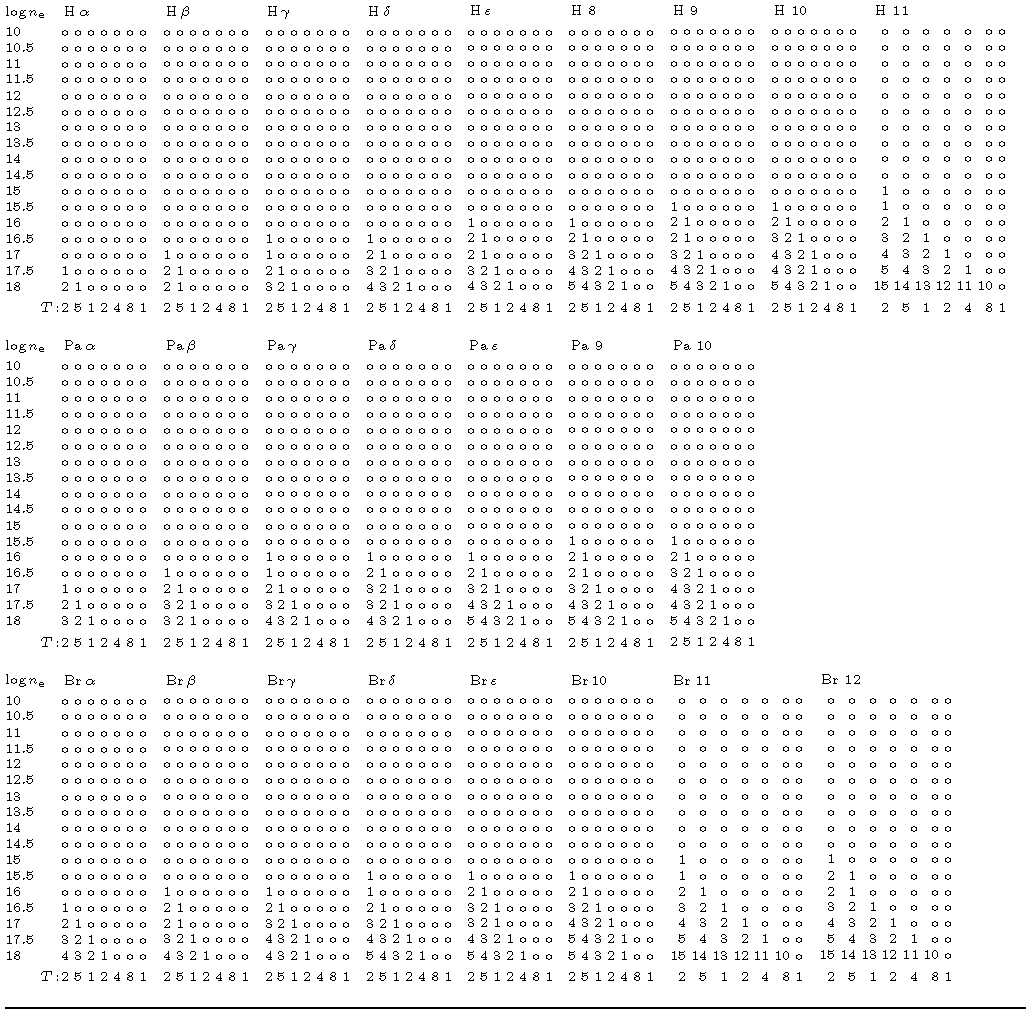
flag (see Table 3 (click here)). This allows easy interpolation and
reading of the table with a single Fortran read statement. But we
caution the reader that such profiles are not physically meaningful.
and T.
To ease the use of the tables we simply copied the last correctly
produced profile to the lower temperature and indicate this fact with a
flag (see Table 3 (click here)). This allows easy interpolation and
reading of the table with a single Fortran read statement. But we
caution the reader that such profiles are not physically meaningful.
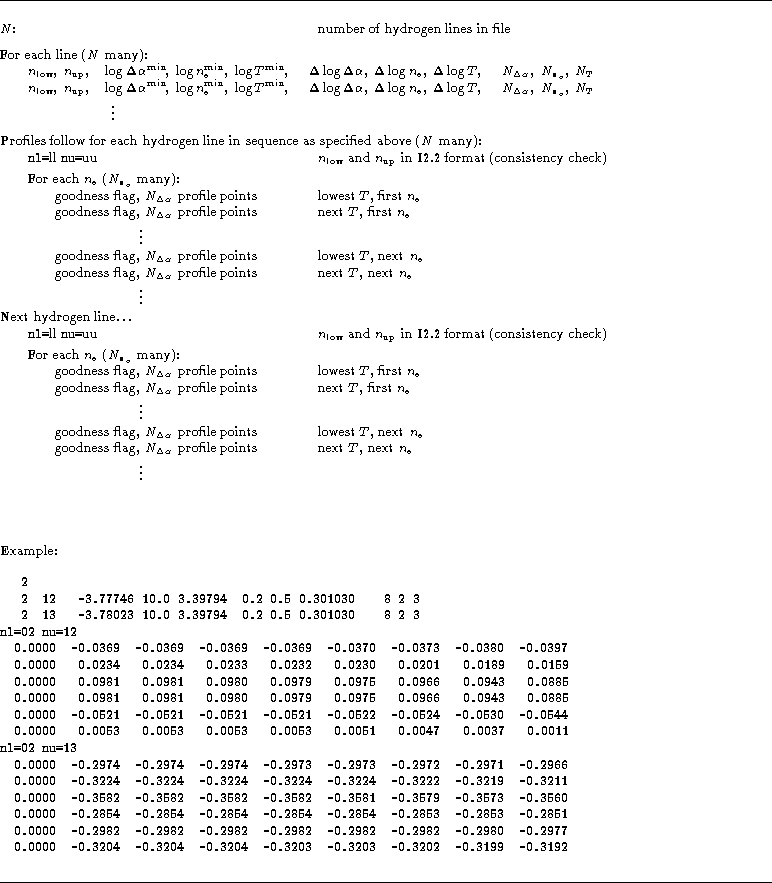
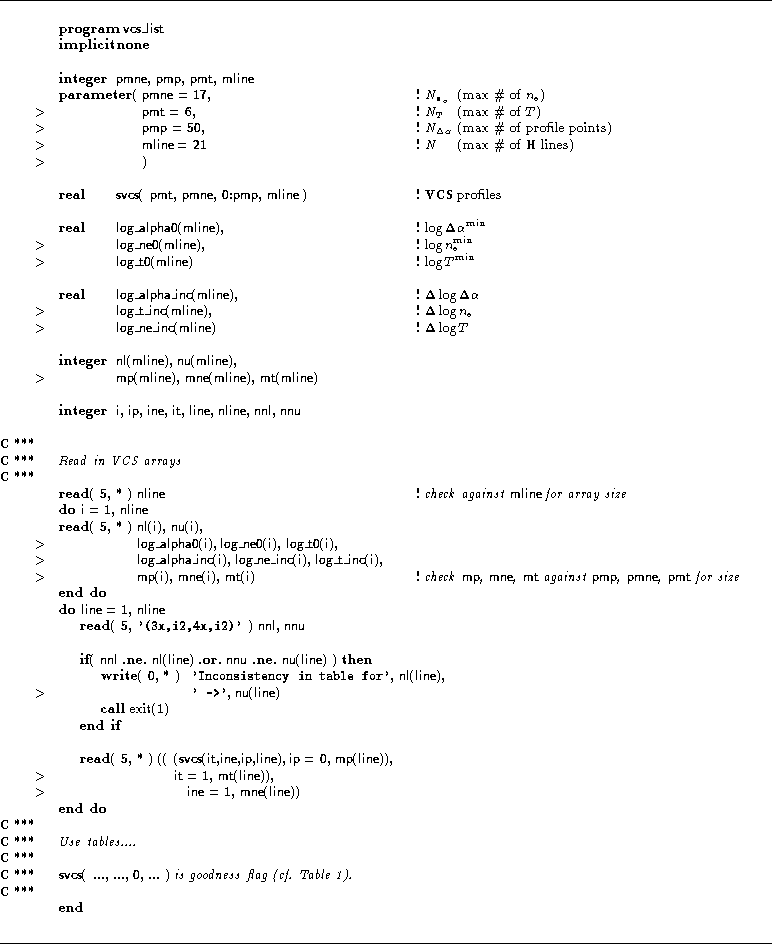
The pure Stark profiles and the broadened profiles are given in separate files. The file layout is given in Table 1 (click here) and a minimal Fortran illustration for how to read it is given in Table 2 (click here).
Note added in proofs:
After the paper had been accepted for publication it was realized
that the unbroadened profiles were computed not close enough to the line
center. As a result, the cores and small parts of the wings of the
Doppler-broadened profiles were too shallow. This was most serious for
 . We have therefore extended the affected profiles further
down towards the line center. In correction to Sect. 3,
. We have therefore extended the affected profiles further
down towards the line center. In correction to Sect. 3,  ,
,  , and
, and  are all
computed down to
are all
computed down to  . This removes the remaining
differences between our tables and VCS'. The Doppler-broadened profiles
are tabulated only with as many points as are neccessary to recover the
line center. Consequently, the smallest tabulated
. This removes the remaining
differences between our tables and VCS'. The Doppler-broadened profiles
are tabulated only with as many points as are neccessary to recover the
line center. Consequently, the smallest tabulated  varies
from line to line; the first point is also valid for all smaller values
of
varies
from line to line; the first point is also valid for all smaller values
of  . A table with
  for all
lines can be found on the ftp servers. The information is of course
contained in the actual profile tables as defined in Table 1 (click here).
for all
lines can be found on the ftp servers. The information is of course
contained in the actual profile tables as defined in Table 1 (click here).
Table 1: File layout. The ``goodness flag" is defined as follows: 0:
profile ok; -1: copied from next higher T, -2: copied from 2nd next
higher T etc.; -10: copied from next lower  , -20: copied from 2nd
next lower
, -20: copied from 2nd
next lower  etc; -23: copied from 2nd next lower
  , then
copied down three T steps
, then
copied down three T steps
Table 2: Fortran illustration for reading table
Table 3: Overview of explicitly computed tables and goodness flag.
The higher profiles not displayed here are scaled Lyman
profiles (see text). Shown is the absolute value of the goodness flag
as defined in Table 1 (click here). The abbreviated temperatures stand for
2500, 5000, 10000, 20000, 40000, 80000, 160000 K,
respectively
Acknowledgements
I thank Tony Lynas-Gray for bringing to my attention the existence of the code and for having it installed and put at my disposal. I am also thankful to Dieter Engelhardt, Ralf Napiwotzki, and Thomas Rauch for useful discussions. The computations were carried out in parallel on several Starlink-provided SparcStations at the Institute of Astronomy, Cambridge. Financial support from the Leverhulme foundation under grant F627C is thankfully acknowledged.