

We took the computer code from Vidal et al. (1971) and applied the modifications from Vidal et al. (1973) for the B constant. We reworked the code slightly (essentially array dimensions) to allow for higher quantum numbers. No modifications were applied that change any of the physics or the mathematical descriptions. We therefore refer the reader to the original work (in particular VCS 1971) for details on validity and limitations of the VCS method and its implementation. For the present paper we tried to stay as close as possible to the original work. A few points, however, shall be raised here.
Both VCS and MMM description have the limitation of not taking into
account quasi molecules that form with the perturbers during the
collision with the hydrogen atoms. These quasi molecules produce
so-called satellite lines at large distances from the line center. The
collision of neutral hydrogen with other neutral hydrogen atoms, for
example, leads to the temporary formation of an H molecule, which is
responsible for the ``1600Å-feature", a conspicuous broad depression
in the UV flux of white dwarfs and
molecule, which is
responsible for the ``1600Å-feature", a conspicuous broad depression
in the UV flux of white dwarfs and  Boo stars (Koester et al.\
1985; Nelan & Wegner 1985; Holweger et al. 1994). For the feature to
be visible it is necessary that Ly
Boo stars (Koester et al.\
1985; Nelan & Wegner 1985; Holweger et al. 1994). For the feature to
be visible it is necessary that Ly  is strong enough at about
1600Å (white dwarfs, A stars) and that it is not obscured by metal
lines (low-metallicity effect of
is strong enough at about
1600Å (white dwarfs, A stars) and that it is not obscured by metal
lines (low-metallicity effect of  Boo stars). Similar
perturbations with protons produce sharper features, of which there is a
very strong one near 1400Å. That ``line" is very visible in white
dwarfs but like the 1600Å feature can be masked by metal lines in
A-type stars (cf. Fig. 4 in Holweger et al.) although to a lesser
extent. This suggests that the importance of quasi molecules is
restricted to high gravity/low metallicity objects and apparently also
to Ly
Boo stars). Similar
perturbations with protons produce sharper features, of which there is a
very strong one near 1400Å. That ``line" is very visible in white
dwarfs but like the 1600Å feature can be masked by metal lines in
A-type stars (cf. Fig. 4 in Holweger et al.) although to a lesser
extent. This suggests that the importance of quasi molecules is
restricted to high gravity/low metallicity objects and apparently also
to Ly  . Even though a VCS type profile is completely wrong
under such conditions, for most objects satellite features will not be
important and MMM or VCS profiles will adequately reproduce the line
shape.
. Even though a VCS type profile is completely wrong
under such conditions, for most objects satellite features will not be
important and MMM or VCS profiles will adequately reproduce the line
shape.
Our tables reach to lower electron densities (see Sect. 3 (click here))
than the original work. For the lowest values of  and T
influences of the neglected fine structure are to be expected. For
astrophysical purposes, however, this should not pose a problem as
Doppler broadening will dominate; but care must be taken if the pure
Stark profiles are investigated. For the higher lines one should be
aware that those lines are no longer isolated. Therefore, quenching
effects, which have not been taken into account, will play a role. For
most practical cases it is good enough to simply add the contributions
of neighboring lines (cf. VCS 1973). Specifically for white dwarfs
Bergeron (1993) devised an approximate correction for quenching effects
to be used with existing VCS tables.
and T
influences of the neglected fine structure are to be expected. For
astrophysical purposes, however, this should not pose a problem as
Doppler broadening will dominate; but care must be taken if the pure
Stark profiles are investigated. For the higher lines one should be
aware that those lines are no longer isolated. Therefore, quenching
effects, which have not been taken into account, will play a role. For
most practical cases it is good enough to simply add the contributions
of neighboring lines (cf. VCS 1973). Specifically for white dwarfs
Bergeron (1993) devised an approximate correction for quenching effects
to be used with existing VCS tables.
Following VCS (1971), perturbations of the lower state sublevels by
the electrons (lower state interaction) were only included for the first
three lines in a series (i.e.,  to
to  ); for intermediate
series members the Stark effect for only the static ions on the lower
level was taken into account. For the highest lines, i.e., for n>11,
10, 13 for the Balmer, Paschen, Brackett series, respectively, the lower
state was completely ignored, i.e., we did not compute those profiles
but took the Lyman profile with the same upper n instead. According
to VCS (1971), this introduces an error less than that due to the
underlying physical assumptions. In Fig. 1 (click here) we show a case for
n=10. The maximum error in this case is 7% for the Paschen line,
which confirms the results by VCS. The Lyman profiles were scaled to
the higher series as
); for intermediate
series members the Stark effect for only the static ions on the lower
level was taken into account. For the highest lines, i.e., for n>11,
10, 13 for the Balmer, Paschen, Brackett series, respectively, the lower
state was completely ignored, i.e., we did not compute those profiles
but took the Lyman profile with the same upper n instead. According
to VCS (1971), this introduces an error less than that due to the
underlying physical assumptions. In Fig. 1 (click here) we show a case for
n=10. The maximum error in this case is 7% for the Paschen line,
which confirms the results by VCS. The Lyman profiles were scaled to
the higher series as

where S is the normalized Stark
profile,  the distance from the line center in units of
the normal field strength
the distance from the line center in units of
the normal field strength  ,
,  the central vacuum
wavelength of the respective line, and the index Ly denotes the
corresponding quantity for the Lyman line with the same upper n.
the central vacuum
wavelength of the respective line, and the index Ly denotes the
corresponding quantity for the Lyman line with the same upper n.
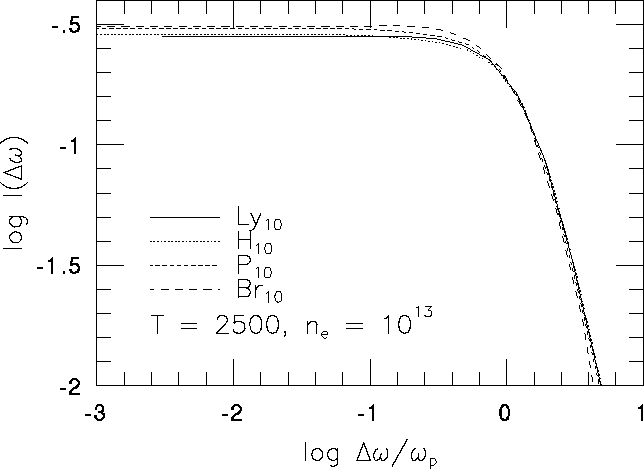
Figure 1: Stark profiles for Lyman through Brackett for n=10 as function of the plasma
frequency. Profiles normalized for 
The code turned out to be numerically somewhat unstable, in particular at the transition region to the asymptotic wing. Tentatively, we replaced several routines with counterparts from the commercial NAG library but while this made the code more stable it hardly changed any results. Eventually, we only replaced the Weddle integration routine (a variant of Simpson's Rule) with a potentially more accurate Romberg-type integration (a variable stepsize extrapolation method). Again, this is not significant for the results but only removes a few ``wiggles" in the transition region. These experiments give confidence in the results and that the code is working properly. With these modifications we could easily reproduce the pure Stark profiles of the 1973 VCS tables within a few tenths of a percent.
Eventually, the profiles were convolved with Doppler profiles of the
corresponding temperature. Note that the convolution destroys the
scalability of the higher Lyman profiles as the Doppler width scales
differently ( ) than the Stark profile
(
) than the Stark profile
( ). The convolution was done by solving
the convolution integral directly with an adaptive step size integration
routine (q1dax in double precision) from the publically available
CMLIB/Q1DA package. Unlike the case of the pure Stark profiles, our
Doppler-broadened profiles are slightly different than the original VCS
(1973) tables for the regions where our tables overlap with Vidal et
al.'s. The reason for this is not easy to assess as Vidal et al. do
not specify any details of their broadening procedure. Part of the
difference is due to how close to the line center a profile has been
computed. VCS sometimes go closer than we do. The maximum distance
from the line center (
). The convolution was done by solving
the convolution integral directly with an adaptive step size integration
routine (q1dax in double precision) from the publically available
CMLIB/Q1DA package. Unlike the case of the pure Stark profiles, our
Doppler-broadened profiles are slightly different than the original VCS
(1973) tables for the regions where our tables overlap with Vidal et
al.'s. The reason for this is not easy to assess as Vidal et al. do
not specify any details of their broadening procedure. Part of the
difference is due to how close to the line center a profile has been
computed. VCS sometimes go closer than we do. The maximum distance
from the line center ( ) has been chosen such
that the Doppler broadened profile can safely be extrapolated with a
) has been chosen such
that the Doppler broadened profile can safely be extrapolated with a
 law, should that be necessary. Of course, the
caveat of neglected satellite features (Sect. 2.1 (click here)) applies.
law, should that be necessary. Of course, the
caveat of neglected satellite features (Sect. 2.1 (click here)) applies.
The required computer time is still too high for direct inclusion of
the code into, e.g., a line analysis program. While a single point of a
Balmer line profile can be computed on a 70MHz Sun SparcStation within
 , depending on the distance to the line center, the
computer time grows enormously for the higher series; the whole tables
for Br
, depending on the distance to the line center, the
computer time grows enormously for the higher series; the whole tables
for Br took about 2 weeks of CPU time. The interpolation in
precomputed tables is therefore still required, even for the Lyman
series, which is the quickest to compute.
took about 2 weeks of CPU time. The interpolation in
precomputed tables is therefore still required, even for the Lyman
series, which is the quickest to compute.
As outlined in the introduction part of the tables presented here are
also covered by the MMM tables of Stehlé. As a further guide for the
potential user of the tables and to further investigate the points made
in the introduction we computed sample spectra of H for a
model atmosphere of
for a
model atmosphere of  K and
K and  with
solar composition. Three profiles were computed: one with the tables
from Stehlé, one with our tables and a third one with our tables but
where we extracted only a subset from our tables which corresponds
exactly to the size of the Stehlé tables. The resulting profiles are
displayed in Fig. 2 (click here). To assess the differences between VCS and
MMM the profiles computed with tables of the same size have to be
compared. As can be seen from the dashed and solid lines in
Fig. 2 (click here) the differences are indeed very small. The effects of the
small table size, on the other hand, are significantly bigger as the
dashed and dotted lines demonstrate. Similar results were obtained for
a 10000K/
with
solar composition. Three profiles were computed: one with the tables
from Stehlé, one with our tables and a third one with our tables but
where we extracted only a subset from our tables which corresponds
exactly to the size of the Stehlé tables. The resulting profiles are
displayed in Fig. 2 (click here). To assess the differences between VCS and
MMM the profiles computed with tables of the same size have to be
compared. As can be seen from the dashed and solid lines in
Fig. 2 (click here) the differences are indeed very small. The effects of the
small table size, on the other hand, are significantly bigger as the
dashed and dotted lines demonstrate. Similar results were obtained for
a 10000K/ model, representative for an A star.
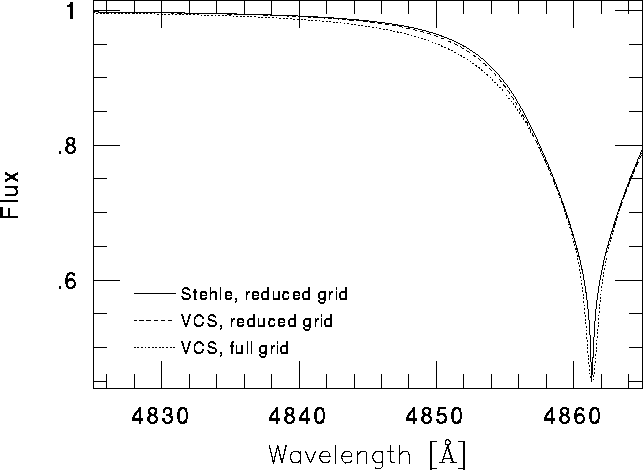
Figure 2: H profiles for
  ,
,  .
Shown are profiles computed with our tables (dotted line) and with the tables from
Stehlé (solid line). Also shown is a profile computed with our tables but with the
parameter grid set identical to that of Stehlé (dashed line)
.
Shown are profiles computed with our tables (dotted line) and with the tables from
Stehlé (solid line). Also shown is a profile computed with our tables but with the
parameter grid set identical to that of Stehlé (dashed line)