

The miniature hyper telescope was tested on the sky (Fig. 4).
This image was obtained on the star Capella (a close binary which is completely
unresolved here) by taking two separate exposures of 100 s in the Fizeau
and densified-pupil mode of the hyper-telescope. It is of
interest to calculate the intensification achieved in the densified-pupil case
comparing the 2 images of Fig. 4. We start off calculating the
theoretical intensity gain, in the central peak, for the 2 instrumental configurations.
For an unresolved star the photon count in the central peak is
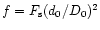 ,
where
,
where  is the photon count from a single, unresolved star, d0the output sub-pupil diameter and D0 the output pupil diameter (Labeyrie 1996).
In the case of our interferometer the value of
d0/D0 is
1/70 with the micro-lenses removed (Fizeau) and 1/7 with the micro-lenses
in place (densified pupil). Substituting these values in the previous equation
and dividing the densified pupil photon count by the Fizeau photon count we
find a value of
is the photon count from a single, unresolved star, d0the output sub-pupil diameter and D0 the output pupil diameter (Labeyrie 1996).
In the case of our interferometer the value of
d0/D0 is
1/70 with the micro-lenses removed (Fizeau) and 1/7 with the micro-lenses
in place (densified pupil). Substituting these values in the previous equation
and dividing the densified pupil photon count by the Fizeau photon count we
find a value of
 for the intensification.
![\begin{figure}
\par\includegraphics[width=8cm,clip]{9868.6}\end{figure}](/articles/aas/full/2000/20/ds9868/img22.gif) |
Figure 5:
White light image of the double star
 Gemproduced by the miniature hyper-telescope. The central peak
is seen to be double in accordance to the calculated position angle and separation
of the binary star (sketched at top-right). Attenuated and dispersed side
lobes are also visible around the central peak owing to the incomplete
pupil densification and to a slight pointing offset of the telescope. The ghost
images shown in Fig. 4 are outside the picture Gemproduced by the miniature hyper-telescope. The central peak
is seen to be double in accordance to the calculated position angle and separation
of the binary star (sketched at top-right). Attenuated and dispersed side
lobes are also visible around the central peak owing to the incomplete
pupil densification and to a slight pointing offset of the telescope. The ghost
images shown in Fig. 4 are outside the picture |
We then calculate the intensification factor from the images used for generating
the plots of Fig. 4. For the densified pupil image and
the Fizeau image, the intensity f was measured by integrating
the central peak. The measurements were repeated for the Fizeau and densified
configuration, using several recorded images. The comparison of the obtained
values showed an intensity gain of
 of the densified
with respect to the Fizeau configuration. When we take into account the stray
light introduced in the measurement, caused by the instrument not being properly
baffled we obtain a value of
of the densified
with respect to the Fizeau configuration. When we take into account the stray
light introduced in the measurement, caused by the instrument not being properly
baffled we obtain a value of
 ,
closer to the theoretical
value. The stray light produced a constant offset in both the Fizeau and densified
pupil image. The value of this offset was calculated from the Fizeau image by
fitting to the measured data an Airy function corresponding to the diffraction
function of the
,
closer to the theoretical
value. The stray light produced a constant offset in both the Fizeau and densified
pupil image. The value of this offset was calculated from the Fizeau image by
fitting to the measured data an Airy function corresponding to the diffraction
function of the
 entrance apertures (Fig. 4).
After the first minimum
at
entrance apertures (Fig. 4).
After the first minimum
at
 the function is nearly constant and its
corresponding value can be subtracted from the intensity calculation of the Fizeau and densified pupil images. We
verified that the discrepancy between the Airy fit and the data, towards the end of the plot, was due to the detector
response threshold at low light intensity levels. This effect was found in several
other images. The data plot is also affected by photon and atmospheric noise.
The remaining discrepancy between the theoretical and the measured intensification
is probably caused by the residual optical path errors introduced by the micro-lenses
unequal thickness, the atmosphere and the misalignment of the micro-lenses with
respect to the Fizeau mask.
the function is nearly constant and its
corresponding value can be subtracted from the intensity calculation of the Fizeau and densified pupil images. We
verified that the discrepancy between the Airy fit and the data, towards the end of the plot, was due to the detector
response threshold at low light intensity levels. This effect was found in several
other images. The data plot is also affected by photon and atmospheric noise.
The remaining discrepancy between the theoretical and the measured intensification
is probably caused by the residual optical path errors introduced by the micro-lenses
unequal thickness, the atmosphere and the misalignment of the micro-lenses with
respect to the Fizeau mask.
Given its miniature size, narrow field and modest collecting area (
 ),
comparable to that of a naked human eye, the hyper-telescope was tested on bright
binary stars. Figure 5 shows the image obtained on
),
comparable to that of a naked human eye, the hyper-telescope was tested on bright
binary stars. Figure 5 shows the image obtained on  Gem
the night of December the 3rd 1999 with a
Gem
the night of December the 3rd 1999 with a
 exposure. This image
is compared to the calculated position angle and separation of the system for
exposure. This image
is compared to the calculated position angle and separation of the system for
 in Fig. 5.
The orbital parameters of the star were obtained from the Washington Double
Star catalog. The angular separation  and the position angle
  were calculated using the peak pattern produced by the array. The period of
the peaks is in fact equal to
were calculated using the peak pattern produced by the array. The period of
the peaks is in fact equal to
 ;
we found a value
;
we found a value
 for the angular separation. The position angle
measured on the
photo centres of the double star image produced a value of
for the angular separation. The position angle
measured on the
photo centres of the double star image produced a value of
 .
This values agree with the calculated separation
.
This values agree with the calculated separation
 and position angle

Copyright The European Southern Observatory (ESO)
![\begin{figure}
\par\includegraphics[width=8cm,clip]{9868.4} \includegraphics[width=8cm,clip]{9868.5}\end{figure}](/articles/aas/full/2000/20/ds9868/img20.gif)
![\begin{figure}
\par\includegraphics[width=13.5cm,clip]{9868.7}\end{figure}](/articles/aas/full/2000/20/ds9868/img30.gif)