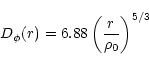
This section describes the wavefront decomposition into Zernike polynomials, the phase structure function of the wavefront, the generalization of the Fried parameter and the phase correlation length behavior.
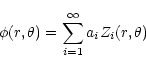
Optical wavefronts are two dimensional functions that can
be decomposed into Zernike polynomials which are
separable in angle and radius and form an orthogonal basis.
We will use the definition given by
Noll (1976):
 |
(1) |
 |
(2) |

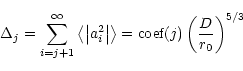
 denotes an ensemble average
and coef(j) is the corresponding coefficient given by Noll. The maximum
number of modes that can be corrected is related with the
number of actuators in the system.
denotes an ensemble average
and coef(j) is the corresponding coefficient given by Noll. The maximum
number of modes that can be corrected is related with the
number of actuators in the system.
The phase structure function is defined as:
![\begin{displaymath}%
D_\phi\left( \vec{r}-\vec{r'}\right)=
\left\langle\left[ \phi(\vec{r})-\phi(\vec{r'})\right]^2\right\rangle.
\end{displaymath}](/articles/aas/full/2000/15/h2262/img5.gif) |
(3) |
 |
(4) |
 .
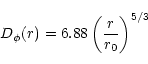
However, for small separation distances the curve still
follows the 5/3 power law
(Rigaut et al. 1997;
Hardy 1998)
and can be fitted using the
following expression:
.
However, for small separation distances the curve still
follows the 5/3 power law
(Rigaut et al. 1997;
Hardy 1998)
and can be fitted using the
following expression:
 ,
the generalized Fried parameter, increases with
the compensation degree.
Figure 1
shows this behavior of the structure function
for uncompensated wave fronts (short-dashed curve)
obtained from simulation,
and for 6 (solid curve), 21 (circles),
41 (long-dashed curve) and 81 (triangles) corrected modes.
This behaviour of the structure function is not restricted
to those systems that correct pure Zernike modes. A first region described by
Eq. (5) that saturates to
for distances greater than the correlation
length has been found in noisy systems and in curvature-based systems
(Cagigal & Canales 2000a).
,
the generalized Fried parameter, increases with
the compensation degree.
Figure 1
shows this behavior of the structure function
for uncompensated wave fronts (short-dashed curve)
obtained from simulation,
and for 6 (solid curve), 21 (circles),
41 (long-dashed curve) and 81 (triangles) corrected modes.
This behaviour of the structure function is not restricted
to those systems that correct pure Zernike modes. A first region described by
Eq. (5) that saturates to
for distances greater than the correlation
length has been found in noisy systems and in curvature-based systems
(Cagigal & Canales 2000a).
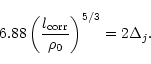
The phase correlation length in the wavefront,
 ,
can be obtained from the structure function
(Valley & Wandzura 1979).
It is defined as the
distance value for which the structure function leaves the 5/3 power
behavior and reaches the constant value .
In
this point it is fulfilled that:
,
can be obtained from the structure function
(Valley & Wandzura 1979).
It is defined as the
distance value for which the structure function leaves the 5/3 power
behavior and reaches the constant value .
In
this point it is fulfilled that:
 |
(6) |
 and
are determined by the number of corrected polynomials and by the
value of the ratio D/r0. However, the correlation length
is completely determined by the number of corrected
polynomials (in D units) as it can be deduced from previous works
(Valley & Wandzura 1979).
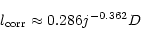
The behaviour of
was described in a previous paper
(Cagigal & Canales 2000a)
by fitting a generic curve to the values obtained from the
simulated structure functions. The fitted curve is
given by:
and
are determined by the number of corrected polynomials and by the
value of the ratio D/r0. However, the correlation length
is completely determined by the number of corrected
polynomials (in D units) as it can be deduced from previous works
(Valley & Wandzura 1979).
The behaviour of
was described in a previous paper
(Cagigal & Canales 2000a)
by fitting a generic curve to the values obtained from the
simulated structure functions. The fitted curve is
given by:
 |
(7) |
![\begin{figure}
\includegraphics[width=8cm,clip]{fig1.eps}\end{figure}](/articles/aas/full/2000/15/h2262/img14.gif) |
Figure 1: Structure function of the wavefront phase for D/r0=38.4and 1 (short-dashed curve), 6 (solid curve), 21 (circles), 41 (long dashed curve) and 81 (triangles) corrected modes |
Copyright The European Southern Observatory (ESO)