

Here we present two sets of tables. The first includes the tables of the autocorrelation functions for dipolar emission (one photon) and for two-photon absorption obtained in the simulations. The second are the tables of the emission and polarization profiles calculated from the autocorrelation functions obtained in the simulations.
For each case considered in the simulation we present four files: 1) The autocorrelation function of the dipolar emission processes in the transition from level n=2 to level n=1. 2) The autocorrelation function of the two photon absorption process in the transition from the n=1 to the n=2 level. 3) Stark broadened spectral profiles of the Lyman alpha dipolar emission with fine structure. 4) Stark broadened profiles that could be obtained in a two-photon polarization spectroscopy experiment for the same transition, along with fine structure.
As the simulation processes include ion dynamics effects,
each one of these files has the results that
correspond to five different values of the reduced
mass  of the emitter-perturber pair. More precisely,
each file includes the results corresponding
to
= 0.5, 0.8, 0.9, 1.0 and 2.0 (measured in units of
proton mass).
of the emitter-perturber pair. More precisely,
each file includes the results corresponding
to
= 0.5, 0.8, 0.9, 1.0 and 2.0 (measured in units of
proton mass).
The tables are ordered according to the parameter
 that characterizes the simulations. For the same
value of
the tables are organized in increasing
values of the electron density.
that characterizes the simulations. For the same
value of
the tables are organized in increasing
values of the electron density.
The autocorrelation function files have, then, eleven columns,
the first one corresponding to the time step (in seconds),
followed by five pairs of columns corresponding
to the five values of .
Each pair is
formed by the
 and
and
 parts of the
autocorrelation function. The name of the files are
rXXnYYYY.c1p or rXXnYYYY.c2p,
where XX and YYYY correspond, respectively, to
parts of the
autocorrelation function. The name of the files are
rXXnYYYY.c1p or rXXnYYYY.c2p,
where XX and YYYY correspond, respectively, to
 and to
 ,
and
,
and
 being the values of the parameter
and of the
electron density for which the calculation was made.
The c1p and c2p mean, respectively, correlation
function for one photon emission and correlation function
for two-photon absorption.
An example of a correlation function file is given in
Table 1.
being the values of the parameter
and of the
electron density for which the calculation was made.
The c1p and c2p mean, respectively, correlation
function for one photon emission and correlation function
for two-photon absorption.
An example of a correlation function file is given in
Table 1.
| log |
|
||||||||
 |
0.10 | 0.15 | 0.20 | 0.25 | 0.30 | 0.40 | 0.50 | 0.60 | 0.70 |
| 19.67 | 29041 | 12907 | 7260 | 4647 | - | - | - | - | - |
| 20.00 | 37508 | 16670 | 9377 | 6001 | 4168 | - | - | - | - |
| 20.33 | 48444 | 21531 | 12111 | 7751 | 5383 | - | - | - | - |
| 20.67 | 62568 | 27808 | 15642 | 10011 | 6952 | 3910 | - | - | - |
| 21.00 | 80809 | 35915 | 20202 | 12929 | 8979 | 5051 | 3232 | 2245 | - |
| 21.33 | 104369 | 46386 | 26092 | 16699 | 11597 | 6523 | 4175 | 2899 | - |
| 21.67 | - | 59910 | 33699 | 21568 | 14978 | 8425 | 5392 | 3744 | - |
| 22.00 | - | 77377 | 43525 | 27856 | 19344 | 10881 | 6964 | 4836 | 3553 |
| 22.33 | - | - | 56214 | 35977 | 24984 | 14054 | 8994 | 6246 | 4589 |
| 22.67 | - | - | - | 46466 | 32268 | 18151 | 11617 | 8067 | 5927 |
| 23.00 | - | - | - | 60013 | 41676 | 23443 | 15003 | 10419 | 7655 |
The profile files have six columns, where the first one is the
displacement in wavelength measured in meters from the
wavelength that corresponds to the transition from the center of
the fine structure sublevels of the level n=2 to the
level n=1. The
other five columns show the areanormalized profiles obtained
for the five values of .
The tabulated profiles give only
the central part of the
transition (to more or less
 of the peak intensity), because the plasma
model employed in the simulation does not allow
calculations far away from the center of the line.
The name of the profiles files are
rXXnYYYY.d1p or rXXnYYYY.p2p, where XX
and YYYY have the same meaning as before, and
the d1p and p2p mean, respectively, one photon
dipolar emission profile and two-photon polarization profile.
An example of a profile file is given in
Table 2.
of the peak intensity), because the plasma
model employed in the simulation does not allow
calculations far away from the center of the line.
The name of the profiles files are
rXXnYYYY.d1p or rXXnYYYY.p2p, where XX
and YYYY have the same meaning as before, and
the d1p and p2p mean, respectively, one photon
dipolar emission profile and two-photon polarization profile.
An example of a profile file is given in
Table 2.
Table 3 summarizes the cases considered in the simulations
and indicates the equilibrium temperature of the plasma
for each value of
and .
The values of
and
given in the
tables are those obtained directly from the computer
simulations. However,
the profiles given in the tables have been
calculated from a smoothed autocorrelation function.
These smooth functions have been obtained
fitting their last channels to functions like
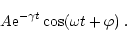 |
(10) |
In addition, this fit avoids the appearance of a
 convolved in the Fourier transform.
Acknowledgements
This work has been financed by the Universidad de Valladolid, by the DGICYT (project PB97-0472) and the Junta de Castilla y León (project VA03/00B).
Copyright The European Southern Observatory (ESO)