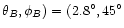
We first consider an angle
 between telescope
and spin axes and a beam location
with (
between telescope
and spin axes and a beam location
with (
 ). Here
  is the
angle from the optical axis: this is a typical value for the 100 GHz
(with a
is the
angle from the optical axis: this is a typical value for the 100 GHz
(with a
 m aperture off-axis Gregorian telescope)
horns while the 30 GHz beams are placed at larger
values. This
assumption is therefore conservative with respect to the destriping efficiency,
since in this case the region of crossings between scan circles is smaller
and closer to Ecliptic poles. The angle
m aperture off-axis Gregorian telescope)
horns while the 30 GHz beams are placed at larger
values. This
assumption is therefore conservative with respect to the destriping efficiency,
since in this case the region of crossings between scan circles is smaller
and closer to Ecliptic poles. The angle  is the beam center
displacement from the axis given by the intersection between the sky field of
view plane and the plane containing the telescope and spin axes (see Burigana
et al.[1998]). Our choice of
is the beam center
displacement from the axis given by the intersection between the sky field of
view plane and the plane containing the telescope and spin axes (see Burigana
et al.[1998]). Our choice of
 is intermediate
between 0
is intermediate
between 0 (or 180)
and 90
which are equivalent
for the destriping respectively to an on-axis beam (with crossings
only at Ecliptic poles for
)
and a beam which spreads
crossings over the wider possible region. The adopted beam location is
therefore a non-degenerate case although non optimal.
(or 180)
and 90
which are equivalent
for the destriping respectively to an on-axis beam (with crossings
only at Ecliptic poles for
)
and a beam which spreads
crossings over the wider possible region. The adopted beam location is
therefore a non-degenerate case although non optimal.
We evaluated the impact of 1/f noise both in terms of added rms noise and of angular power spectrum.
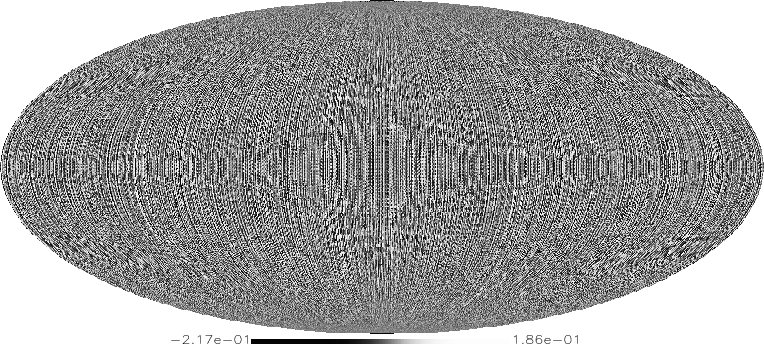 |
Figure 3: Baselines recovered from destriping algorithm for the case reported in Fig. 1 |
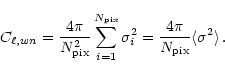
The white noise power spectrum can be derived analytically knowing the
total number of pixels in the sky and pixel sensitivity:
In the top panel of Fig. 2 we show the square root of
the power spectrum
(which is roughly proportional to rms contribution of
temperature per  -bin)
before applying the destriping
technique: the solid line is the white noise level as derived from
Eq. (5) and the superimposed spectrum is derived from
a simulation with only white noise included. The agreement is very good
which confirms the accuracy of our simulator and map-making algorithm.
The gray line is the global noise spectrum (white and 1/f noise together).
The spectrum is clearly non-white: blobs are present. The excess of
noise in terms of both rms and
-bin)
before applying the destriping
technique: the solid line is the white noise level as derived from
Eq. (5) and the superimposed spectrum is derived from
a simulation with only white noise included. The agreement is very good
which confirms the accuracy of our simulator and map-making algorithm.
The gray line is the global noise spectrum (white and 1/f noise together).
The spectrum is clearly non-white: blobs are present. The excess of
noise in terms of both rms and
 is about 40%
of white noise level.
Figure 3 shows the recovered baselines and
Fig. 4 shows the noise map after applying our destriping code:
stripes are no more evident.
This situation can be quantified by
computing the noise power spectrum of the destripped map, as shown
in the bottom panel of Fig. 2. Now the spectrum is considerably
flatter
and no more blobs are present, with an overall noise excess
of 1-2% over the white noise level. This confirms the efficiency of
the destriping algorithm, under the above mentioned simplifying
assumptions.
On the other hand it is clear from the bottom panel of Fig. 2 that
at large scales,
corresponding to
is about 40%
of white noise level.
Figure 3 shows the recovered baselines and
Fig. 4 shows the noise map after applying our destriping code:
stripes are no more evident.
This situation can be quantified by
computing the noise power spectrum of the destripped map, as shown
in the bottom panel of Fig. 2. Now the spectrum is considerably
flatter
and no more blobs are present, with an overall noise excess
of 1-2% over the white noise level. This confirms the efficiency of
the destriping algorithm, under the above mentioned simplifying
assumptions.
On the other hand it is clear from the bottom panel of Fig. 2 that
at large scales,
corresponding to
 ,
a non-negligible residual
contribution is present in the noise spectrum. A lower knee
frequency (achievable with the reference loads at 4 K) is necessary to
further reduce the effect.
,
a non-negligible residual
contribution is present in the noise spectrum. A lower knee
frequency (achievable with the reference loads at 4 K) is necessary to
further reduce the effect.
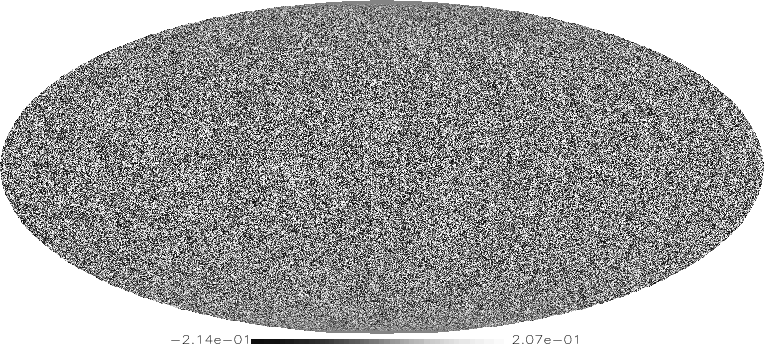 |
Figure 4: Noise map after destriping for the same case illustrated in Fig. 1: stripes are no more visible |
We also investigated if different scanning strategies may help in destriping efficiency. Possible periodic motion of the spin-axis away from the Ecliptic plane have the effect of broadening the region of crossings between different circles. This goes in the direction of removing possible degeneracies in the destriping system. We implemented both sinusoidal oscillations and precessions: the first does not preserve the spacecraft solar illumination and this is likely to induce thermal effects and drifts in the data.
The second is then preferable, since it keeps the solar angle
constant as the satellite moves the spin-axis.
For both the motions we performed 10 complete oscillations per year of mission
with 10
amplitude.
The results before and after destriping are nearly the same for the two cases
and Fig. 5
reports noise power spectra for the precession motion:
before
destriping blobs are still present and disappear after destriping. The excess of
noise is  40% and 1-2% before and after destriping respectively.
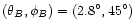
We consider also a case of an on-axis beam
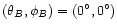 with
.
This situation is representative of
horns which, in the focal plane arrangement, are
placed close to the scanning direction: from the destriping point of view
these horns are indeed equivalent to on-axis horns
and intersections between different scan circles are nearly only at Ecliptic
poles. This represents a degenerate situation with respect to destriping
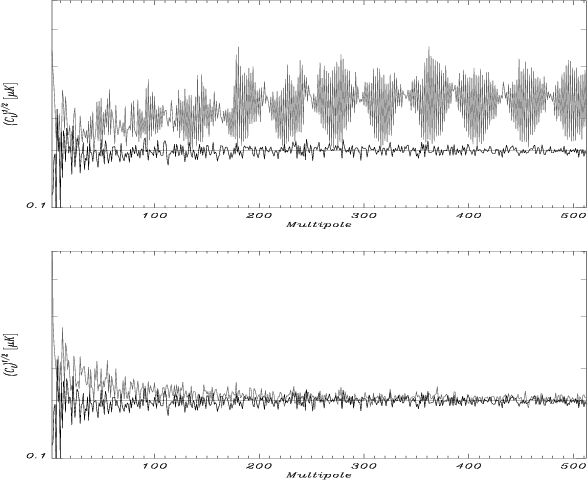
efficiency. Figure 6
shows noise power
spectra for this on-axis case
before and after destriping:
the geometry of the
simulation is changed and the same for blob shape which is not well
defined. Here the level of added noise is
with
.
This situation is representative of
horns which, in the focal plane arrangement, are
placed close to the scanning direction: from the destriping point of view
these horns are indeed equivalent to on-axis horns
and intersections between different scan circles are nearly only at Ecliptic
poles. This represents a degenerate situation with respect to destriping
efficiency. Figure 6
shows noise power
spectra for this on-axis case
before and after destriping:
the geometry of the
simulation is changed and the same for blob shape which is not well
defined. Here the level of added noise is  .
After destriping
we are left with an excess of noise of the order of 5% of the white
noise and the noise spectrum is considerable less flat than before.
Such excess noise and a non-flat
spectrum around
.
After destriping
we are left with an excess of noise of the order of 5% of the white
noise and the noise spectrum is considerable less flat than before.
Such excess noise and a non-flat
spectrum around
 (where the first CMB Doppler peak
is expected) after destriping is clearly not acceptable for
the feeds aligned with the scan direction. Moving the spin axis
is a way to remove this degeneracy, as well as to complete the sky
coverage for all channels.
(where the first CMB Doppler peak
is expected) after destriping is clearly not acceptable for
the feeds aligned with the scan direction. Moving the spin axis
is a way to remove this degeneracy, as well as to complete the sky
coverage for all channels.
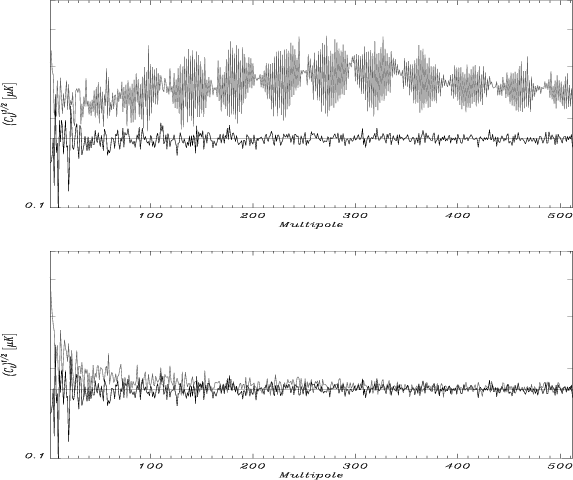 |
Figure 5:
Top panel: noise power spectra at 30 GHz before destriping.
Simulation parameters
are the same of Fig. 2 except for the scanning strategy which includes
here precession (see the text). The added noise is  % of the
white noise level. White noise spectra are also reported for comparison.
Bottom panel: noise power spectra after destriping.
Again, the added noise is now only 1-2%
of the white noise level % of the
white noise level. White noise spectra are also reported for comparison.
Bottom panel: noise power spectra after destriping.
Again, the added noise is now only 1-2%
of the white noise level |
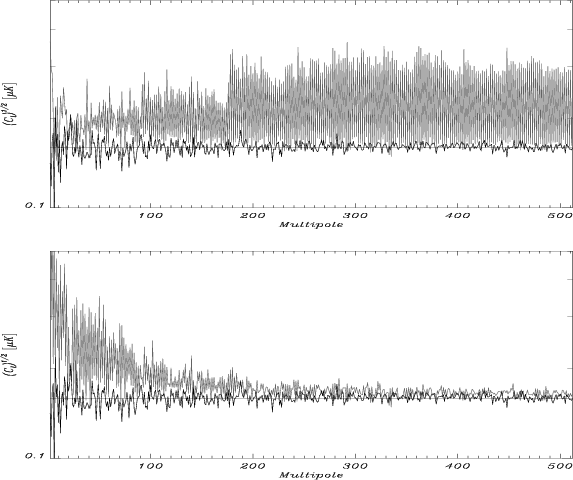 |
Figure 6:
Top panel: noise power spectra at 30 GHz before destriping.
Simulation parameters
are the same of Fig. 2 but the beam position is now
.
The added noise is  % of the
white noise level. White noise spectra are also reported for comparison.
Bottom panel: noise power spectra after destriping.
The added noise is now
larger than previous cases, being 5% of the white noise level % of the
white noise level. White noise spectra are also reported for comparison.
Bottom panel: noise power spectra after destriping.
The added noise is now
larger than previous cases, being 5% of the white noise level |
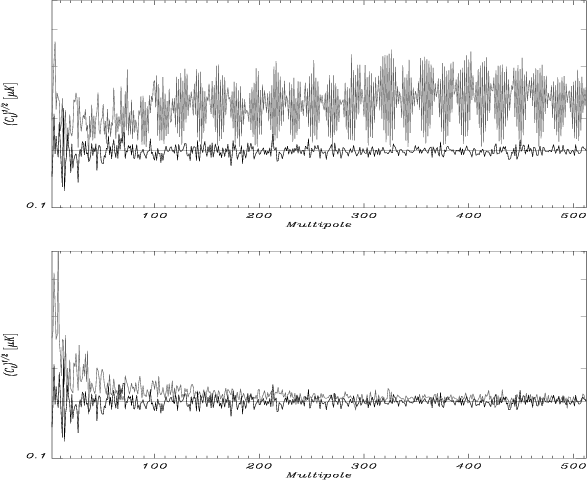 |
Figure 7:
Top panel: noise power spectra at 30 GHz before destriping.
Simulation parameters
are the same of Fig. 6 but the angle  is now
set to 85.
The added noise is % of the
white noise level. White noise spectra are also reported for comparison.
Bottom panel: noise power spectra after destriping. The added noise is now
only 2% of the white noise level
is now
set to 85.
The added noise is % of the
white noise level. White noise spectra are also reported for comparison.
Bottom panel: noise power spectra after destriping. The added noise is now
only 2% of the white noise level |
Keeping fixed the beam position we move the angle
from 90
to
85:
this of course leaves small regions around Ecliptic poles which are
not observed but has the advantage to enlarge the scan circle crossing region.
Figure 7
shows noise power spectra before and
after destriping for this 85,
on-axis case: now blobs
are clearly visible with dimensions in -space different
from Fig. 2
due to different geometrical configuration. These blobs are
completely removed after destriping leaving a level of added noise after
destriping of only
 2% over the white noise.
This is essentially what we obtained for the off-axis configuration.
2% over the white noise.
This is essentially what we obtained for the off-axis configuration.
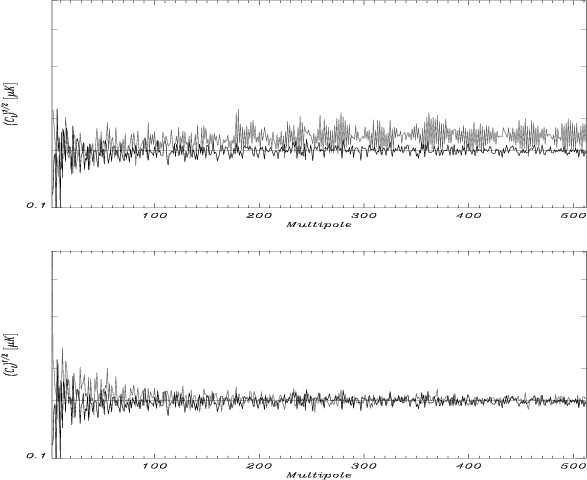 |
Figure 8:
Top panel: noise power spectra at 30 GHz before destriping.
Simulation parameters are the same of Fig. 2 but now
 Hz. The added noise is now only 9%
of the white noise level. White noise spectra are also reported for comparison.
Bottom panel: noise power spectra after destriping.
The added noise is now only 0.5% larger the white noise level
Hz. The added noise is now only 9%
of the white noise level. White noise spectra are also reported for comparison.
Bottom panel: noise power spectra after destriping.
The added noise is now only 0.5% larger the white noise level |
 Hz, a "reference'' value close to that predicted by Seiffert et al.
([1997])
for a reference load at 20 K.
Hz, a "reference'' value close to that predicted by Seiffert et al.
([1997])
for a reference load at 20 K.
To decrease the residual effect, a
4 K reference load is being designed.
In this configuration
the theoretical knee frequency would be less than 10 mHz. We chose to run a
simulation with
Hz with the usual off-axis configuration with
.
As for the other cases we report noise power spectra
before and after destriping in Fig. 8.
It is interesting to note that now the level of added noise is 9% before
destriping and reduces only to 0.5% after applying destriping algorithm.
 artefacts due to 1/f noise
We now give a short theoretical argument for the expected morphology of the
power spectra of the simulated striping pattern. For scanning
without wobbling or precession, two angular scales fully determine
the structure of the striping pattern on the sky. One is the half
opening angle
 of the ecliptic equator which
the spin axis traces on the sky as PLANCK
completes a full orbit about the Sun. This makes the noise pattern
symmetric under parity, on average.
The other scale is the half opening angle of the scanning rings
of the ecliptic equator which
the spin axis traces on the sky as PLANCK
completes a full orbit about the Sun. This makes the noise pattern
symmetric under parity, on average.
The other scale is the half opening angle of the scanning rings
 .
.
The combination of these two nearby scales leads to beats in the
,
which are visually apparent as the "blob''
in the top panels of Figs. 2, 5, 6, 7, 8.
Treating this effect in the same way as the appearance of
fringes in an interference pattern
we can calculate the width in
of each blob as
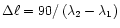 .
This is in quantitative agreement with our numerically computed
spectra. It also explains the absence of beats in the top panel of
Fig. 6, where
.
This is in quantitative agreement with our numerically computed
spectra. It also explains the absence of beats in the top panel of
Fig. 6, where
 and the power spectrum can be
understood as a single blob with infinite
and the power spectrum can be
understood as a single blob with infinite
 .
.
For scanning strategies with some kind of "wobble''
the correlation function will still be approximately symmetric if
the amplitude of the wobble is small compared to
 and the above statements remain approximately true although
a weakly symmetry breaking can be seen in the top panel of Fig. 5,
where the beats do
not reach all the way down to the white noise level.
and the above statements remain approximately true although
a weakly symmetry breaking can be seen in the top panel of Fig. 5,
where the beats do
not reach all the way down to the white noise level.
The offset of the blobs compared to the white noise level is given by the rms excess power due to the 1/f noise component.
Copyright The European Southern Observatory (ESO)
 ,
,