As reported in Mandolesi et al.([1998]), the selected orbit for
PLANCK satellite will be a Lissajous orbit around the L2 Lagrangian point
of the Sun-Earth system. The spacecraft spins at 1 rpm and the spin
axis is kept on the Ecliptic plane at constant solar angle by
repointing of 2.5' every hour. The field of view of the two
instruments is between
 from the spin-axis
direction.
Hence PLANCK will trace large circles in the sky: these circles
cross each other in regions close to the Ecliptic poles. The
shape and width of these regions depend upon the angle
from the spin-axis
direction.
Hence PLANCK will trace large circles in the sky: these circles
cross each other in regions close to the Ecliptic poles. The
shape and width of these regions depend upon the angle  ,
the
scanning strategy and beam location in the focal plane.
The value of the angle
has not yet been fully defined,
as well as the scanning strategy, which may or may not include a
periodic motion of the spin-axis away from the Ecliptic plane.
These options depend on a trade-off between different
systematic effects (striping, thermal effects, straylight), which have to
be carefully addressed.
,
the
scanning strategy and beam location in the focal plane.
The value of the angle
has not yet been fully defined,
as well as the scanning strategy, which may or may not include a
periodic motion of the spin-axis away from the Ecliptic plane.
These options depend on a trade-off between different
systematic effects (striping, thermal effects, straylight), which have to
be carefully addressed.
between the spin and
pointing axis.
For each beam position on the focal plane our code outputs the complete
data stream. We consider here a reduced version of the actual baseline
for the scanning strategy (actual parameters in parentheses):
spin-axis shift of 5' every 2 hours (instead
of 2.5' every hour) and three samplings per FWHM of 30' at 30 GHz
(instead of 12 samplings every 30', i.e. 4 samplings
every 10', the FWHM at 100 GHz; see Mandolesi et al.[1998]).
These modifications allow us to explore
a large region of the parameter space, beam position,  ,
scanning
strategy and pointing angle ,
in reasonable time.
Furthermore we do not consider the single minute data stream
but we take the average over the 120 circles forming a given 2-hours
set. In what follows we run simulations for the 30 GHz channel.
,
scanning
strategy and pointing angle ,
in reasonable time.
Furthermore we do not consider the single minute data stream
but we take the average over the 120 circles forming a given 2-hours
set. In what follows we run simulations for the 30 GHz channel.
Wright ([1996]) has shown that possible data filtering on a given
scan circle may help in reducing the impact of 1/f noise. This is
useful for values of knee frequency
typical for "total power''
receivers which are
much higher that those considered here and therefore we chose not to
include this technique here.
In general both the white noise sensitivity and the knee-frequency
depend on the actual temperature in the sky Txseen by the horn. Our synthetic model for microwave sky emission
includes a standard CDM prediction
for CMB fluctuations plus a model of galactic emission. This model has the
spatial template from the dust emission (Schlegel et al.[1998])
but has been normalized to include contribution from synchrotron,
free-free and dust according to COBE-DMR results (Kogut et al.
[1996]). The major foreground
contamination at 30 GHz comes from synchrotron and free-free. We
then choose to overestimate the overall synchrotron fluctuations by a factor
of  10, leading to a maximum
Galaxy emission of
10, leading to a maximum
Galaxy emission of  mK.
This is the worst case scenario with respect to destriping
efficiency (see Sects. 3.3 and 3.4).
mK.
This is the worst case scenario with respect to destriping
efficiency (see Sects. 3.3 and 3.4).
Of course the impact on the receiver sensitivity of the sky
temperature Tx, dominated by the CMB monopole, T0, is not critical
even including in Tx a typical environment temperature of about 1 K
and the pessimistic Galaxy model adopted here,
being in any case Tx
a small fraction of the noise temperature
 K.
K.
We convolve input maps with a pure symmetric gaussian beam with the nominal FWHM (33') of the 30 GHz PLANCK-LFI channel: therefore main-beam distortions and stray-light contamination are not considered here.
We have the possibility to generate different kinds of noise spectra.
We work in Fourier space and generate the real and imaginary part of
Fourier coefficients of our noise signal.
After generating a realisation of the real and imaginary part of the
Fourier coefficients with spectrum defined in Eq. (1),
we FFT (Fast Fourier Transform; Cooley & Tukey [1997]; Heideman
et al.[1984])
them and obtain a real noise stream which has to be normalized to the white
noise level.
We use the theoretical value of
 Hz
at 30 GHz assuming a 20 K load temperature (see Sect. 2).
We chose to generate one year of a mission by combination of 16 hour long
noise stream (
Hz
at 30 GHz assuming a 20 K load temperature (see Sect. 2).
We chose to generate one year of a mission by combination of 16 hour long
noise stream (
 data points) which correspond to 8
spin axis positions: this seems a
reasonable compromise among our present knowledge of real hardware behaviour
and the required computational time with respect noise stream length.
The actual time for a generation of a noise stream 16
hours long and one year of mission even in our reduced scanning strategy
is
data points) which correspond to 8
spin axis positions: this seems a
reasonable compromise among our present knowledge of real hardware behaviour
and the required computational time with respect noise stream length.
The actual time for a generation of a noise stream 16
hours long and one year of mission even in our reduced scanning strategy
is  10 hours on a Silicon Graphics machine with 2 Gb of RAM
and clock speed of 225 MHz. We also verified that the most time
consuming operation in our code is just the FFT 1/f noise generation.
Better performances (Wandelt et al.[1999]; Wandelt & Górski
[1999])
may be obtained using noise generation technique
in real space (e.g. Beccaria et al.[1996] and
Cuoco & Curci [1997] and references therein).
10 hours on a Silicon Graphics machine with 2 Gb of RAM
and clock speed of 225 MHz. We also verified that the most time
consuming operation in our code is just the FFT 1/f noise generation.
Better performances (Wandelt et al.[1999]; Wandelt & Górski
[1999])
may be obtained using noise generation technique
in real space (e.g. Beccaria et al.[1996] and
Cuoco & Curci [1997] and references therein).
 (for one year
of mission
(for one year
of mission  in our reduced baseline as in Sect. 3.1)
and a number of columns equal to the number of integrations,
weakly dependent on ,
along one scan circle (here
in our reduced baseline as in Sect. 3.1)
and a number of columns equal to the number of integrations,
weakly dependent on ,
along one scan circle (here
 ).
The input and output maps are in HEALPix pixelisation scheme (Górski
et al.[1998],
http:
).
The input and output maps are in HEALPix pixelisation scheme (Górski
et al.[1998],
http:
 www.tac.dk
 ~healpix);
we use an input map with a resolution of about 3.5'corresponding to 12 million equal area pixels on the full sky.
For each circle, the code outputs are the pixel number
~healpix);
we use an input map with a resolution of about 3.5'corresponding to 12 million equal area pixels on the full sky.
For each circle, the code outputs are the pixel number  at the specified resolutions, the temperature plus total
(white plus 1/f noise) noise
contribution
at the specified resolutions, the temperature plus total
(white plus 1/f noise) noise
contribution  ,
the temperature with only
white noise
,
the temperature with only
white noise  and the pure signal as observed in absence of
instrumental noise
and the pure signal as observed in absence of
instrumental noise  .
The W and G will be used for studying the degradation of 1/f
noise with respect to the ideal pure white noise case and the impact of
scanning strategy geometry on observed pixel temperatures.
.
The W and G will be used for studying the degradation of 1/f
noise with respect to the ideal pure white noise case and the impact of
scanning strategy geometry on observed pixel temperatures.
We can arbitrarily choose the temperature output data stream resolution from 3.5' to higher values (smaller resolution) which set also the output temperature map resolution. Regarding the data stream for the pixel number outputs we can also use higher resolutions, allowing to test the impact of using more or less stringent crossing conditions in the destriping algorithm (see the following section).
From these data streams it is quite simple to obtain observed simulated maps:
we make use of
and
to coadd the temperatures of those
pixels observed several times during the mission.
In the same way we build maps with only white noise contribution, without
receiver noise, as well as a
sensitivity map knowing how many times a single pixel is observed.
In Fig. 1 we show a pure noise (white plus 1/f) map
in Ecliptic coordinates after signal subtraction (
 ):
stripes are clearly present.
):
stripes are clearly present.
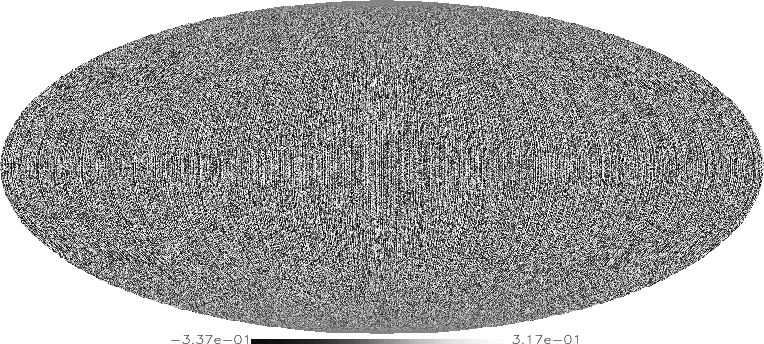 |
Figure 1:
Pure noise (white and 1/f noise together) map before destriping: stripes are
clearly present. The adopted
is 0.05 Hz and units are in mK. See the text for simulation
input parameters |
We developed a simple technique which is able to eliminate gain drifts due to
1/f noise. This is derived from the COBRAS/SAMBA Phase A study proposal
(Bersanelli et al.[1996]) and from a re-analysis of Delabrouille
([1998]). As reported by Janssen et al.([1996]) the
effect of 1/f noise can be seen as one or more additive levels,
different for each scan circle.
We worked with averaged (over 2 hours period) scan circles
and hence we nearly removed drifts within each circle: what is left is related
to the "mean'' 1/f noise level for this observation period.
In fact averaging scan circles into a single ring corresponds to
a low-pass filtering operation. As long as
is not far larger than the
spin frequency, this ensures that only the very lowest frequency
components of the 1/f noise survive. Therefore it is a good approximation
to model the averaged 1/fnoise as a single constant offset Ai for each ring
for the set of parameters we are using.
We want to obtain the baselines for all the circles and re-adjust
the signals correspondingly.
In order to estimate the different Ai we have to find common pixels
observed by different scan circles and the pixel size in the matrix
N is a key parameter. Increasing the resolution used in N
reduces the number of crossings possibly yielding to lower destriping
efficiency,
while adopting resolutions lower than the resolution of the input map
and of the matrix T introduces extra noise,
related to variations of real sky temperature within the scale corresponding
to the lower resolution adopted in N, which
may introduce artifacts in the destriping code.
The adopted pessimistic galactic emission model, which by construction has
gradients larger than those inferred by current data, emphasizes this effect
and our simulations are then conservative in this respect.
In the following Nil, Til and Eil will denote the
pixel number, the temperature and the white noise level
for the pixel in the
 row and
 column.
Let us denote a generic pair of different observations of the
same pixel with an index
column.
Let us denote a generic pair of different observations of the
same pixel with an index  which will range between 1 and
  ,
the
total number of pairs found. In this notation
is
related to two elements of :
,
the
total number of pairs found. In this notation
is
related to two elements of :
 where
i and j identify different scan circles and l and m the
respective position in each of the two circles.
where
i and j identify different scan circles and l and m the
respective position in each of the two circles.
We want to minimize the quantity:
indicates
that each set of (il,jm) is used in that summation. It is clear that S is
quadratic in all the unknown Ai and that only differences between
Ai enter
into Eq. (2). Therefore the solution is determined up to
an arbitrary additive constant (with no physical meaning for anisotropy
measurements). We choose then to remove this indetermination by requiring
that
 .
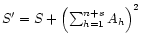
This is equivalent to replace
Eq. (2) with
.
This is equivalent to replace
Eq. (2) with
 .
After some algebra we finally get:
.
After some algebra we finally get:
 (here
(here  is the usual Kronecker symbol).
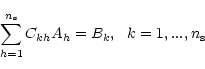
This translates into a set of
linear equation
is the usual Kronecker symbol).
This translates into a set of
linear equation
 of Ckh coefficients is symmetric, positive
defined and non singular. The first property permits to hold in
memory only one half of the matrix
(e.g. the upper-right part),
the second allows us to solve the linear system without having to
exchange rows or columns (Strang [1976]), so preserving the
symmetry.
The non-singularity of
is true provided that there are
enough intersections between different circles and hence is related
to the resolution at which we look for common pixels between different
scan circles, to the scanning strategy and beam location.
A detailed discussion of numerical
algorithm for solving this system with significant saving of
required RAM is presented in Burigana et al.([1997]).
of Ckh coefficients is symmetric, positive
defined and non singular. The first property permits to hold in
memory only one half of the matrix
(e.g. the upper-right part),
the second allows us to solve the linear system without having to
exchange rows or columns (Strang [1976]), so preserving the
symmetry.
The non-singularity of
is true provided that there are
enough intersections between different circles and hence is related
to the resolution at which we look for common pixels between different
scan circles, to the scanning strategy and beam location.
A detailed discussion of numerical
algorithm for solving this system with significant saving of
required RAM is presented in Burigana et al.([1997]).
It is interesting to note that the applicability of
this destriping technique does not depend upon
any a-priori assumption about the real value of
or the
real noise spectral shape since it can work also for different
values of the exponent  in Eq. (1).
Copyright The European Southern Observatory (ESO)
![$\displaystyle \sum_{{\rm all\ pairs}} \left[\frac{[(A_i - A_j) -
(T_{il}-T_{jm})]^2}
{E_{il}^2+E_{jm}^2}\right]$](/articles/aas/full/1999/21/ds8912/img49.gif)
![$\displaystyle \sum_{\pi=1}^{n_{\rm c}} \left[\frac{[(A_i - A_j) - (T_{il}-T_{jm})]^2}
{E_{il}^2+E_{jm}^2}\right]_\pi$](/articles/aas/full/1999/21/ds8912/img50.gif)

![$\displaystyle \sum_{\pi=1}^{n_{\rm c}}
\left[\frac{ [(A_i-A_j)-(T_{il}-T_{jm})]\cdot [\delta_{ik}-\delta_{jk}]}
{E_{il}^2-E_{jm}^2}\right]_\pi$](/articles/aas/full/1999/21/ds8912/img54.gif)