

In this section, we present the expected mismatch errors
 of the individual spectral regions.
We recall that
each is defined as the maximum mismatch shift (in absolute
value) out of the 14 different mismatch cases
(two steps of
of the individual spectral regions.
We recall that
each is defined as the maximum mismatch shift (in absolute
value) out of the 14 different mismatch cases
(two steps of  250 K in
 and one step of
0.2 dex
in logg; see Sect. 3.2). We discuss these results for the 30
main-grid spectra considered,
i.e. for the 5 values of temperature, 1 of surface gravity,
and 6 of rotational velocity, representing the rotating
A-type main-sequence stars (see Sect. 3.3).
First, in Sect. 4.1, we look in more detail at the individual mismatch shifts
arising from the 14 different mismatch cases.
and one step of
0.2 dex
in logg; see Sect. 3.2). We discuss these results for the 30
main-grid spectra considered,
i.e. for the 5 values of temperature, 1 of surface gravity,
and 6 of rotational velocity, representing the rotating
A-type main-sequence stars (see Sect. 3.3).
First, in Sect. 4.1, we look in more detail at the individual mismatch shifts
arising from the 14 different mismatch cases.
The step in (
,
logg) of the mismatch grid
as chosen in Sect. 3.2 needs to be sufficiently small
to sample properly the mismatch error
as a function
of
 and
and
 .
We are satisfied that the latter requirement
has in fact been met because a simple four-parameter model
(
.
We are satisfied that the latter requirement
has in fact been met because a simple four-parameter model
(
 )
fits the 14 mismatch shifts fairly well for most spectral
regions in all main-grid spectra.
We also found that the maximum mismatch shift, i.e. the mismatch error
,
for
)
fits the 14 mismatch shifts fairly well for most spectral
regions in all main-grid spectra.
We also found that the maximum mismatch shift, i.e. the mismatch error
,
for
 K (i.e. for 14 mismatch cases)
is twice that for
K (i.e. for 14 mismatch cases)
is twice that for
 K (i.e. for 8 mismatch cases),
with an rms deviation less than 0.5 for all
30 main-grid spectra and for all spectral regions.
K (i.e. for 8 mismatch cases),
with an rms deviation less than 0.5 for all
30 main-grid spectra and for all spectral regions.
As pointed out in Sect. 1, if spectra have a high line-density one tends to assume that, for a given mismatch case, the mismatch shifts caused by individual blends in a given spectrum are like random numbers distributed symmetrically around zero. Visual inspection of our mismatch shifts (see e.g. Fig. 2) suggests that, on the contrary they have a preferential sign in different spectral regions for many of the spectra and mismatch cases. Although the wavelength regions defined in Sect. 3.4 do not isolate individual blends, those without hydrogen lines are sufficiently narrow and numerous to allow a limited verification of the assumption of randomness of the sign. For each of the 420 samples of mismatch shifts taken from all metal-line regions (for 14 mismatch cases in 30 spectra), we tested the hypothesis that the sign of the shifts in the sample is random. The results can be summarized as follows:
;
 ,
= 0 and
> 7500 K;
the total number of these cases is 110, and in 42
out of them the hypothesis must be rejected even at the 1% level
so it is quite unlikely that they could be ascribed to coincidence.
,
= 0 and
> 7500 K;
the total number of these cases is 110, and in 42
out of them the hypothesis must be rejected even at the 1% level
so it is quite unlikely that they could be ascribed to coincidence.
 50 kms-1.
The correlation exists for all temperatures, although the scatter
increases towards the highest vsini because of the smaller number
of regions defined.
The reason for this common behaviour of most spectral regions has yet to
be investigated by examining the origin of each shift.
Positional relations between the lines of
multiplets contributing to temperature-dependent blends in different regions
presumably play a role.
The important consequence is that, at least for faster rotators,
a majority of the metal-line blends may cause a mismatch shift in the same
sense so that one cannot be certain of reducing systematic errors simply
by including more such blends in a cross-correlation.
This will strongly influence
the extent to which it is useful to combine
individual spectral regions as is discussed in Sect. 5.1.
50 kms-1.
The correlation exists for all temperatures, although the scatter
increases towards the highest vsini because of the smaller number
of regions defined.
The reason for this common behaviour of most spectral regions has yet to
be investigated by examining the origin of each shift.
Positional relations between the lines of
multiplets contributing to temperature-dependent blends in different regions
presumably play a role.
The important consequence is that, at least for faster rotators,
a majority of the metal-line blends may cause a mismatch shift in the same
sense so that one cannot be certain of reducing systematic errors simply
by including more such blends in a cross-correlation.
This will strongly influence
the extent to which it is useful to combine
individual spectral regions as is discussed in Sect. 5.1.
For each of the 30 main-grid spectra we plotted the distribution of mismatch
errors
from the different spectral regions.
A Kolmogorov-Smirnov test shows that, for a given rotational velocity,
the hypothesis that the distributions for the 5 different temperatures
are identical cannot be rejected,
although the relatively small
number of regions must influence that result.
We can therefore combine the results for all
;
Fig. 3 shows the distributions for the 6 values
of vsini. It is immediately apparent that a large range in
exists among the different regions at any given vsini:
the 10% highest errors are on average about a factor 20 larger
than the 10% smallest ones.
![\begin{figure}
\includegraphics[width=20cm]{fig_distr.eps}\end{figure}](/articles/aas/full/1999/19/h1521/img36.gif) |
Figure 3:
Distribution of the mismatch errors
from all spectral
regions.
For each value of vsini, the results from the 5 values of
are combined. Results for H-line regions are shown hashed |
The most important characteristic of these distributions is the
strong and consistent increase in the errors with vsini.
In Sect. 4.3 we will quantify that dependence in more detail.
Although the distributions of all
for different temperatures
are indistinguishable, the mismatch error of each individual
region may vary significantly with
,
as discussed
in Sect. 4.4.
The smallest mismatch errors from the H-line regions are of very much
the same magnitude as the errors of the best metal-line regions,
while at the same time H-line regions are never found among those
regions that give rise to the highest errors. A more detailed discussion
of the H-line regions is given in Sect. 4.5.
As Fig. 3 shows, the global distribution
of mismatch errors scales approximately linearly with vsini.
In order to investigate this dependence more quantitatively for
individual spectral regions, those regions were selected that
contain exactly the same interval in wavelength
for all values of vsini.
This was repeated for the 5 values of
separately in order to
detect a possible further dependence on temperature.
![\begin{figure}
\includegraphics[width=12cm]{fig_vsiniscal.eps}\end{figure}](/articles/aas/full/1999/19/h1521/img37.gif) |
Figure 4:
Normalised mismatch error
as a function of vsini,
plotted on a double logarithmic
scale. Different curves represent all spectral regions that contain
exactly the same interval in wavelength over the full range of vsini
for spectra with
= 8000 K. Dotted lines represent
H-line regions.
The thick line depicts Eq. (1), its slope
representing a linear scaling of the error
between any two values of vsini |
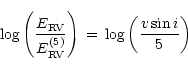
A linear relation between the mismatch error from a given spectral region
and vsini, assuming the error is zero if vsini = 0,
can conveniently be expressed on a logarithmic scale:
 the mismatch error
at vsini = 5 kms-1 to which the errors for other vsiniare normalised.
Figure 4 shows the mismatch error for
= 8000 K
as a function of vsini for all 8 selected regions;
it also depicts Eq. (1). The double logarithmic
scale has the advantage that a linear dependence of the mismatch error on
vsini between any two vsini values is translated into
a connecting line with a gradient of unity, i.e. parallel to
Eq. (1).
the mismatch error
at vsini = 5 kms-1 to which the errors for other vsiniare normalised.
Figure 4 shows the mismatch error for
= 8000 K
as a function of vsini for all 8 selected regions;
it also depicts Eq. (1). The double logarithmic
scale has the advantage that a linear dependence of the mismatch error on
vsini between any two vsini values is translated into
a connecting line with a gradient of unity, i.e. parallel to
Eq. (1).
As the plots in Fig. 4 are not significantly different for different temperatures, we can draw the following conclusions from all of them:
increases monotonically with vsini in almost all
spectral regions,
partly because in a majority of the wavelength regions all individual mismatch
shifts actually increase monotonically, and partly because
,
by its very definition, is likely to keep on growing even if some of
the individual shifts do not.
The behaviour of the individual mismatch shifts themselves (monotonic or not)
can often be explained qualitatively in terms of the results of the
simple two-line study by
Verschueren ([1991]) (see Sect. 2.2), bearing in mind that
the distance between spectral lines in units of their width decreases
as rotational broadening increases.
In particular, in some spectral regions
where the mismatch error exhibits a maximum as a function
of vsini, one finds that the condition for a maximum is
indeed reached and passed at some vsini < 300 kms-1
and that all individual mismatch shifts decrease in absolute magnitude.
on average, the details of the blending
in each individual region determine the final outcome to a large extent.
For a given vsini, the mismatch error
for
any given spectral region may vary considerably with the temperature
parameter
of the spectrum.
This is shown for vsini = 50 kms-1 in Fig. 5.
The following conclusions can be drawn:
.
Average errors for these "best'' regions are
0.04, 0.4, 1, 1.5, 2 and
3 kms-1 for vsini = 5, 50, 100, 150, 200 and 300 kms-1,
respectively. Note that these "best'' regions are largely different ones
for different vsini; this seriously hampers the selection of
regions suitable for all spectra (see Sect. 5);
![\begin{figure}
\includegraphics[width=12cm]{fig_temp.eps}\end{figure}](/articles/aas/full/1999/19/h1521/img40.gif) |
Figure 5:
Mismatch error
as a function of the different spectral regions
for 5 different temperatures: 1 = 7500 K, 2 = 8000 K, 3 = 8500 K,
4 = 9000 K and 5 = 9500 K. The rotational velocity is 50 kms-1in all cases. Spectral regions are indicated by the number of the continuum
window corresponding to their starting wavelength
(see Table 1).
Horizontal full lines indicate the length of a region if it is larger
than the distance between two consecutive continuum windows in
Table 1 |
Figure 5 supports a comparison with the work of Fekel ([1985], [1999]), who has derived accurate RVs for late B- and A-type stars that have vsini < 50 kms-1. Fekel uses the MgII line at 4481 Å (situated in our region No. 14-15) and the 5 FeII and TiII lines between 4500 - 4525 Å (situated at the end of region No. 15-16 and at the beginning of No. 16-17). Our error in region No. 14-15 (MgII) remains small for vsini = 5 kms-1 but it increases drastically with decreasing temperature for vsini = 50 kms-1(see Fig. 5). For that value of the rotation the region is still reliable for early-A spectra, but yields unacceptably high errors for mid- and late-A ones owing to blending by lines which have a strong temperature dependence. Incidentally, the mid and late A-type stars in Fekel's study all have vsini < 15 kms-1 (Fekel 1999, private communication) which helps to explain the relatively small errors he finds for those stars using the MgII line. Also for vsini > 50 kms-1, we find that the MgII line yields relatively small errors for early A-type spectra only.
The other two regions which contain lines used by Fekel are in fact among the very best, producing mismatch errors between 0.02 - 0.04 kms-1 for vsini = 5 kms-1 and between 0.2 - 0.4 kms-1for vsini = 50 kms-1 (depending on temperature). However, since the maximum mismatch in temperature we have considered spans only 2 temperature sub-classes in either direction, our results indicate that allowing a considerably larger mismatch, such as Fekel ([1985], [1999]) employs, is not without risk for vsini approaching 50 kms-1. For vsini > 50 kms-1, our region No. 15-16 remains among the best despite the blending which occurs shortward of Fekel's lines. At that rotational velocity, region No. 16-17 behaves well only in early A-type spectra, and produces relatively high mismatch errors for cooler spectra owing to a complex blend which affects most of Fekel's lines.
Owing to the much larger widths and strengths of the Hydrogen lines compared
to the metal lines in these early-type spectra,
spectral regions that contain H lines
require separate investigation. It is important to realize at the outset
that the mismatch errors of the 4 regions that contain just one H line
differ from zero only because of the
- and
logg-dependent blending with metal lines; the H line itself is
always isolated and symmetric.
On the one hand, mismatch errors arising from those 4 H-line regions
are expected to be smaller on average than those arising from
regions with only metal lines because the strong,
broad H line dampens extraneous contributions while not itself contributing
to the mismatch; smaller errors for H-line regions are
expected also because they have a much larger wavelength span
than metal-line regions and because some degree of cancelling of errors
always occurs (see Sect. 5.1).
On the other hand, some differences in the characteristics of the metal lines
(e.g. a difference in strength of an isolated line)
will yield (larger) mismatch shifts if those lines
occur on the inclined wings of a H-line profile;
in addition, differences in spectrum rectification may be an important
source of mismatch for these regions.
The nett effect cannot easily be predicted, though the distributions
given in Sect. 4.2 already showed that mismatch errors from H-line
regions lie well within the range found for metal-line regions.
Figure 6 shows the mismatch errors
of the
5 H-line regions for the 5 temperatures considered, and for vsini= 150 kms-1. From this and similar plots for different vsiniwe conclude:
 ,
H
,
H and H
and H (labelled 3, 4 and 5) are
relatively small; they show no
common dependence on temperature for any vsini, and in that sense
they behave similarly to the metal-line regions.
Since it is the detailed content of the
metal lines in the H-line regions that determines the mismatch shifts,
the addition of adjacent small wavelength regions to a H-line region
(see the dashed lines) can have a non-negligible effect;
(labelled 3, 4 and 5) are
relatively small; they show no
common dependence on temperature for any vsini, and in that sense
they behave similarly to the metal-line regions.
Since it is the detailed content of the
metal lines in the H-line regions that determines the mismatch shifts,
the addition of adjacent small wavelength regions to a H-line region
(see the dashed lines) can have a non-negligible effect;
 is similar to that of the 3 regions discussed above.
For larger rotational velocities, however, mismatch is dominated by the
blending with the CaII H line, though in
mid- or late-A- spectra the K line also blends with the
far wing of H;
both CaII lines vary markedly with temperature, growing from a very weak
line at late B to strong and broad lines at early F.
The resulting mismatch errors show a very strong temperature
dependence and are relatively high for mid- and late-A spectra.
This particular type of blending occurs only in the Hspectral region;
is similar to that of the 3 regions discussed above.
For larger rotational velocities, however, mismatch is dominated by the
blending with the CaII H line, though in
mid- or late-A- spectra the K line also blends with the
far wing of H;
both CaII lines vary markedly with temperature, growing from a very weak
line at late B to strong and broad lines at early F.
The resulting mismatch errors show a very strong temperature
dependence and are relatively high for mid- and late-A spectra.
This particular type of blending occurs only in the Hspectral region;
Copyright The European Southern Observatory (ESO)
![\begin{figure}
\includegraphics[width=12cm]{fig_split.eps}\end{figure}](/articles/aas/full/1999/19/h1521/img35.gif)
 (dashed line).
All mismatch cases in logg are taken together.
Results are shown for each of the 30 spectra separately with
the numerical labels
referring to their
(dashed line).
All mismatch cases in logg are taken together.
Results are shown for each of the 30 spectra separately with
the numerical labels
referring to their
 ,
the mismatch shift is that of
a hotter (cooler) object with respect to the template whose
,
the mismatch shift is that of
a hotter (cooler) object with respect to the template whose
![\begin{figure}
\includegraphics[width=12cm]{fig_hlines.eps}\end{figure}](/articles/aas/full/1999/19/h1521/img41.gif)