

All indices that are calibrated here are derived from relations between
metallicity parameters and temperature parameters. These relations are
intended to be isoabundance relations. In practice, however, they may not
quite satisfy this condition. One would therefore like to test the
isoabundance relation for (say) index q by using it to calculate
![\begin{displaymath}
{\rm [Fe/H]} = f(q) = Sq+Z\end{displaymath}](/articles/aas/full/1999/16/ds1712/img18.gif) |
(1) |
This test is feasible for  CN and [M/H]. No variation of S and Z
with color can be detected for [M/H], so a single relation that is applicable
for all pertinent colors is obtained for this index. For CN, variation
in both S and Z is detected and allowed for (see Sect. 4).
CN and [M/H]. No variation of S and Z
with color can be detected for [M/H], so a single relation that is applicable
for all pertinent colors is obtained for this index. For CN, variation
in both S and Z is detected and allowed for (see Sect. 4).
For  Fe
Fe , G, and D, there are not enough data to carry out
the test. The formal isoabundance relations for these indices are therefore
assumed to be correct. For Fe and G, the results of the
analyses offer some support to this assumption (again, see Sect. 4).
, G, and D, there are not enough data to carry out
the test. The formal isoabundance relations for these indices are therefore
assumed to be correct. For Fe and G, the results of the
analyses offer some support to this assumption (again, see Sect. 4).
The isoabundance relations given for M1 by Eggen are not adequately
documented![[*]](/icons/foot_motif.gif) . A relation was therefore
derived by assuming that the mean metallicity of stars in a large sample
measured by [9, Eggen (1989a]) is independent of temperature. Eggen did not
base the selection of his sample on a metallicity parameter, so this
assumption is at least plausible.
. A relation was therefore
derived by assuming that the mean metallicity of stars in a large sample
measured by [9, Eggen (1989a]) is independent of temperature. Eggen did not
base the selection of his sample on a metallicity parameter, so this
assumption is at least plausible.
The data used to derive an isoabundance relation should have some
scatter around the relation. The character of the scatter must be understood
if the relation is to be derived correctly. In this case, the scatter turns
out to be quite a bit larger than one would predict from plausible measurement
error. Presumably the "excess'' scatter is caused by star-to-star metallicity
differences. Those differences should have relatively large effects on a
blanketed index like M1, but should have small effects on  (see the entry for the similar index
  in Table III of [44, Taylor
et al. 1987]). was therefore treated as an error-free
parameter, and a one-error least-squares regression of M1 on was
obtained. The result of this calculation will be given below (see Sect. 4,
Table 3, footnote "h'').
in Table III of [44, Taylor
et al. 1987]). was therefore treated as an error-free
parameter, and a one-error least-squares regression of M1 on was
obtained. The result of this calculation will be given below (see Sect. 4,
Table 3, footnote "h'').
|
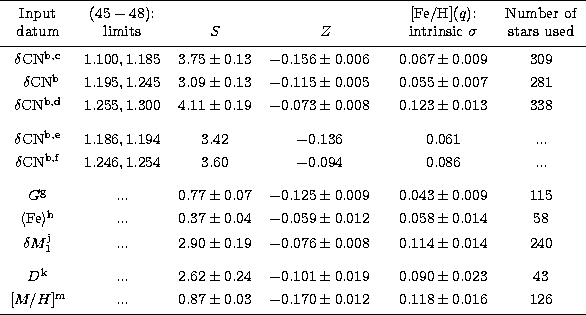
The derivation of Eq. (1) may now be considered. Again one must consider the scatter around a calculated relation. This time, three sources of such scatter may be important:
The nature of the intrinsic scatter is most easily visualized for
CN. Here, one expects CNO/Fe variations to yield a range of values of
CN for any given choice of temperature, surface gravity, and [Fe/H].
In the same way, G should be influenced by Ca/Fe variations and their
counterparts for other metals. Variations in Fe-line strength should be
closely correlated with variations in [Fe/H], but nonetheless there is also
intrinsic scatter in the relation between these two parameters. The same is
true for blanketing and [Fe/H].
It might be argued that a "structural'' least-squares technique is required
here because of the intrinsic scatter. However, since the sources of the
scatter affect only q and not [Fe/H], one can presumably regard the net
scatter from items (2) and (3) as if it were an additional measurement error
in q. This viewpoint permits the use of one of the better-known
"functional'' least-squares techniques. The technique used
here is a linear, two-error algorithm based on the following parameter:
![\begin{displaymath}
\lambda = v({\rm [Fe/H]})/v(q),\end{displaymath}](/articles/aas/full/1999/16/ds1712/img34.gif) |
(2) |
For single determinations of [Fe/H], the rms errors that yield ![$v({\rm
[Fe/H]})$](/articles/aas/full/1999/16/ds1712/img35.gif) are in the range 0.10-0.13 dex (see Table 2 of [41, Taylor
1999b]). The errors are smaller, of course, for stars with multiple
determinations. This range of errors poses a problem, since the adopted algorithm
requires to be the same for all contributing stars. To deal with
this problem, the data are analyzed in groups with similar rms errors. The
values of S from all the groups are then averaged using inverse-variance
weights, with the same procedure being applied to Z.
are in the range 0.10-0.13 dex (see Table 2 of [41, Taylor
1999b]). The errors are smaller, of course, for stars with multiple
determinations. This range of errors poses a problem, since the adopted algorithm
requires to be the same for all contributing stars. To deal with
this problem, the data are analyzed in groups with similar rms errors. The
values of S from all the groups are then averaged using inverse-variance
weights, with the same procedure being applied to Z.
Though v(q) is required by the algorithm described above, its value is not
known in advance. However, one can derive v(q) by assuming that the net
scatter around Eq. (1) is produced by v(q) and a known contribution from
. A "data-comparsion'' algorithm for deriving v(q) in
this way is summarized in Sect. 4 of Appendix B of [34, Taylor (1991]).
In practice, an initial guess for v(q) is made. An initial version of Eq. (1) is then calculated, and the data-comparison algorithm is applied to the scatter around this equation to obtain an improved estimate for v(q). This procedure is iterated to convergence.
Copyright The European Southern Observatory (ESO)

 ]Units are magnitudes for
  .Values of [Fe/H](q) are in dex.
 ]Limits in [Fe/H](q) are -0.8 dex and +0.2 dex.
 ]Data for HD 13530 were not used to derive this equation.
 ]Values of [Fe/H] with
  dex yield a value
of S that is anomalous at better than 99.5% confidence. That value of S
is rejected, but the corresponding value of Z is retained, and the
large-
dex yield a value
of S that is anomalous at better than 99.5% confidence. That value of S
is rejected, but the corresponding value of Z is retained, and the
large- values of [Fe/H] help to determine the error quoted in Col. 5.
Data for HD 116713 and HD 198700 were not used to derive this equation.
values of [Fe/H] help to determine the error quoted in Col. 5.
Data for HD 116713 and HD 198700 were not used to derive this equation.
 ]This relation is an average of the first and second
relations given above, and is intended for the transition region in (45-48)
between the two.
]This relation is an average of the first and second
relations given above, and is intended for the transition region in (45-48)
between the two.
 ]This relation is an average of the second and third
relations given above, and is intended for the transition region in (45-48)
between the two.
]This relation is an average of the second and third
relations given above, and is intended for the transition region in (45-48)
between the two.
 ] Limits in [Fe/H](q) are -0.25 dex and +0.2 dex.
 ] Limits in [Fe/H](q) are -0.35 dex and +0.2 dex.
 ]
] . This calibration was derived only from data in
[
. This calibration was derived only from data in
[ ]Data for HD 41593 were not used. Limits in [Fe/H](q)
are -0.6 dex and +0.45 dex.
]Data for HD 41593 were not used. Limits in [Fe/H](q)
are -0.6 dex and +0.45 dex.
 ]The Buser-Kurucz grid is read within the following
limits:
]The Buser-Kurucz grid is read within the following
limits: ![$-2.0 \leq [M/H] \leq +0.5$](/articles/aas/full/1999/16/ds1712/img29.gif) , 4000 K
, 4000 K  K. At
K. At  K, the grid is read at
  to allow for some evolution in
program stars. Values for
to allow for some evolution in
program stars. Values for  are read at other effective temperatures.
Stellar values of U-B and
are read at other effective temperatures.
Stellar values of U-B and  mag] are compared to the numbers
from the grid (see note "h'' of Table 1).
mag] are compared to the numbers
from the grid (see note "h'' of Table 1).