,
,  ,
,  (linear distances to the lens galaxy,
to the GRB source and between the lens galaxy and the GRB source,
respectively),
(linear distances to the lens galaxy,
to the GRB source and between the lens galaxy and the GRB source,
respectively),
 (velocity dispersion in the lens galaxy),
  ,
,
 (linear and angular radius of
galaxy core),
(linear and angular radius of
galaxy core),  and
and
 (real and visual angular position
of the source from the "observer-lens" axis in units of
(real and visual angular position
of the source from the "observer-lens" axis in units of  ).
).
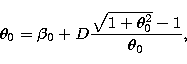
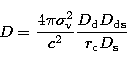
The lens equation is the following
(see e.g.
Wu 1989):
 |
(1) |
 |
(2) |
 is necessary
(Beskin et al. 1998a,b):
is necessary
(Beskin et al. 1998a,b):
 |
(3) | |
 |
is less than  .
.
Let us give quantitative estimates assuming  and H0=
50 km s-1 Mpc-1. For the distances we have
and H0=
50 km s-1 Mpc-1. For the distances we have
![\begin{displaymath}
D_{\rm d,s} = 12 \left [1-(1+z_{\rm d,s})^{-1/2} \right ]
(1+z_{\rm d,s})^{-1}~{\rm Gpc}.\end{displaymath}](/articles/aas/full/1999/15/r8/img18.gif) |
(4) |
![\begin{displaymath}
D_{\rm ds} = 12
\left [
\left(
\frac{1+z_{\rm s}}{1+z_{\rm d}}
\right)^{1/2}
-1
\right] (1+z_{\rm s})^{-3/2}~{\rm Gpc}.\end{displaymath}](/articles/aas/full/1999/15/r8/img19.gif) |
(5) |
 km s-1 and
  kpc for elliptical galaxies,
  km s-1 and
  kpc for spirals (Fukugita & Turner 1991;
Hinshaw & Krauss 1987).
As it is shown in Table 1, elliptical galaxies
can give three images of GRB for any combination of
kpc for spirals (Fukugita & Turner 1991;
Hinshaw & Krauss 1987).
As it is shown in Table 1, elliptical galaxies
can give three images of GRB for any combination of  and
and  .
In the case of a spiral galaxy,
.
In the case of a spiral galaxy,  only for
  and
and  .We estimated the probability P of GRB repetitions for elliptical
galaxies of size
.We estimated the probability P of GRB repetitions for elliptical
galaxies of size  kpc, if the GRB is seen through it (see Table 1).
We used for P the expression
kpc, if the GRB is seen through it (see Table 1).
We used for P the expression 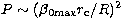 , where R is
the size of the galaxy.
, where R is
the size of the galaxy.
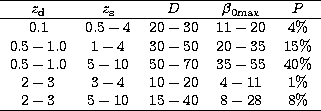 |
From Table 1 we see that about  of the most distant GRBs
will be repeated if their emissions pass close to elliptical galaxies
placed not far from us.
of the most distant GRBs
will be repeated if their emissions pass close to elliptical galaxies
placed not far from us.
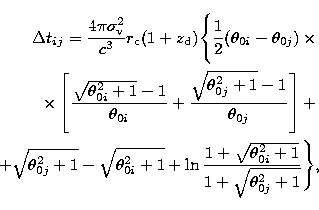
As an example, we now compute the parameters of repeated transients --
intensities and delay times between two subsequent repetitions -- for
 . The estimate of the intensity ratios is obtained according
to the expression of lens magnification
(Wu 1996):
. The estimate of the intensity ratios is obtained according
to the expression of lens magnification
(Wu 1996):
![\begin{displaymath}
\mu = \left \vert\frac {\beta_0} {\theta_0} \left [1+ \left ...
...theta^2_0 \right )^{-\frac{1}{2}}
\right ] \right \vert ^{-1}.\end{displaymath}](/articles/aas/full/1999/15/r8/img34.gif) |
(6) |
 |
||
| (7) |
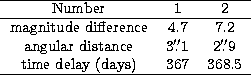
In Table 2 are reported the parameters of the repeated GRBs for  60
(the source
is assumed at
60
(the source
is assumed at  4, while the elliptical galaxy has 0.5).
Thus, repeating transients can be perfectly observed, although they would be
4-7 magnitudes fainter than the first event. Delay times cover the range
from days to years, while characteristic times of physical
intensity variations span from days to months. For this reason,
light curves can have complicated structures.
To distinguish repeating transients we need to analyze all the available data,
such as variations of intensity, astrometry and spectroscopy.
It is necessary to note that observable angular distances between the first GRB
and the repeated transients are
4, while the elliptical galaxy has 0.5).
Thus, repeating transients can be perfectly observed, although they would be
4-7 magnitudes fainter than the first event. Delay times cover the range
from days to years, while characteristic times of physical
intensity variations span from days to months. For this reason,
light curves can have complicated structures.
To distinguish repeating transients we need to analyze all the available data,
such as variations of intensity, astrometry and spectroscopy.
It is necessary to note that observable angular distances between the first GRB
and the repeated transients are  i.e. they can be separated.
Copyright The European Southern Observatory (ESO)