

![\begin{figure}
\includegraphics [width=6.3cm]{r60f1.eps}\end{figure}](/articles/aas/full/1999/15/r60/img1.gif) |
Figure 1: Peak counting rate of 1191 GRBs of the BATSE catalog against hardness-ratio, for the 1024 s temporal bin reported in the catalog. The events signed in grey color are those of the Pendleton et al. class, without photons with energy higher then 300 keV |
 (
( ) by the
peak counting rate of the GRB light curve, evaluated
in the energy range 50-300 keV.
Three values of this last parameter relative to three different
bins of the accumulation time, 64, 256, 1024 ms respectively,
are available in the catalog.
Figure 1
shows the plot for 1024 ms accululation time.
We observe that for each value
of HR there are many possible values of the peak counting rate
. One reason for this is the unknown distance at which the events occur.
Another reason could be the presence of subsets with different luminosity
functions for different light curve shapes and/or different
spectral behaviors. As an example we recall the subset of GRBs
without fluence over 300 keV
(Pendleton et al. 1997), see the grey plot in Fig. 1.
We consider for the analysis only the maximum and minimum value
of the count rate for each HR.
) by the
peak counting rate of the GRB light curve, evaluated
in the energy range 50-300 keV.
Three values of this last parameter relative to three different
bins of the accumulation time, 64, 256, 1024 ms respectively,
are available in the catalog.
Figure 1
shows the plot for 1024 ms accululation time.
We observe that for each value
of HR there are many possible values of the peak counting rate
. One reason for this is the unknown distance at which the events occur.
Another reason could be the presence of subsets with different luminosity
functions for different light curve shapes and/or different
spectral behaviors. As an example we recall the subset of GRBs
without fluence over 300 keV
(Pendleton et al. 1997), see the grey plot in Fig. 1.
We consider for the analysis only the maximum and minimum value
of the count rate for each HR.
![\begin{figure}
\includegraphics [width=6.3cm]{r60f2.eps}\end{figure}](/articles/aas/full/1999/15/r60/img5.gif) |
Figure 2:
Plots of peak photon flux ( ) and hardness-ratio
of the BATSE GRBs, for the 1024 s temporal bins of Class I;
the error bars are reported in the catalog ) and hardness-ratio
of the BATSE GRBs, for the 1024 s temporal bins of Class I;
the error bars are reported in the catalog |
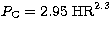 , and of the decreasing part is:
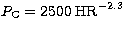 , the best fits resulting the same for the three temporal bins.
In a previous paper we devided GRBs in two Classes I and II
in the plane D-HR, duration hardness-ratio. The two classes are
at the right and at the left of the straight line
, the best fits resulting the same for the three temporal bins.
In a previous paper we devided GRBs in two Classes I and II
in the plane D-HR, duration hardness-ratio. The two classes are
at the right and at the left of the straight line
 respectively. Class I is essentially composed of the longest
events and Class II of the shortest ones but not only.
The two classes are
characterized by two parameters, duration and hardness-ratio
(Belli 1995).
The reported effect is evident in Class II, and not in
Class I (Fig. 2
and Fig. 3).
respectively. Class I is essentially composed of the longest
events and Class II of the shortest ones but not only.
The two classes are
characterized by two parameters, duration and hardness-ratio
(Belli 1995).
The reported effect is evident in Class II, and not in
Class I (Fig. 2
and Fig. 3).
Copyright The European Southern Observatory (ESO)