

 If the high energy spectrum is due to quasi-thermal
Comptonization, it will be sensitive to the amount of seed photons,
which is bound to increase for successive shells. This will in turn
increase the cooling, lower the particle temperature and thus produce
a softer spectrum. This can qualitatively explain the hard-to-soft
behavior of GRB emission and the (weak) correlation duration vs.
hardness.
If the high energy spectrum is due to quasi-thermal
Comptonization, it will be sensitive to the amount of seed photons,
which is bound to increase for successive shells. This will in turn
increase the cooling, lower the particle temperature and thus produce
a softer spectrum. This can qualitatively explain the hard-to-soft
behavior of GRB emission and the (weak) correlation duration vs.
hardness.
If the intrinsic effective temperature is of the order of
50 keV, the observed Comptonized spectrum extends to  MeV at the beginning of the burst. One
would also expect that during the initial phases a Wien peak at the
electron temperature would be formed for (plausibly powerful) bursts
with
MeV at the beginning of the burst. One
would also expect that during the initial phases a Wien peak at the
electron temperature would be formed for (plausibly powerful) bursts
with  3-5.
3-5.
If the progenitors of GRBs are hypernovae, the density in
the vicinity of the central source is dominated by the pre-hypernova
wind. This can lead to optical depths around unity at 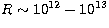 , where shell-shell collisions are assumed to take
place. There is then the possibility that the GRB events are due to
shocks with this material. Therefore: i) in the case of shocks
between shells and the pre-hypernova wind the large densities
involved suggest that inverse Compton emission is favored with respect
to the synchrotron process; ii) if the (still unshocked) interstellar
material has total 1, photons will be down-scattered,
introducing a break in the emergent spectrum at the observed energy
, where shell-shell collisions are assumed to take
place. There is then the possibility that the GRB events are due to
shocks with this material. Therefore: i) in the case of shocks
between shells and the pre-hypernova wind the large densities
involved suggest that inverse Compton emission is favored with respect
to the synchrotron process; ii) if the (still unshocked) interstellar
material has total 1, photons will be down-scattered,
introducing a break in the emergent spectrum at the observed energy
![$511/[\tau_{\rm T}^2\,(1+z)]$](/articles/aas/full/1999/15/r31/img36.gif) keV. Furthermore, the interstellar matter will
act as a "mirror'', sending back the scattered photons, thus increasing
the amount of Compton cooling.
keV. Furthermore, the interstellar matter will
act as a "mirror'', sending back the scattered photons, thus increasing
the amount of Compton cooling.
Copyright The European Southern Observatory (ESO)