

The time dilation of GRBs is essentially a measurement of the redshift vs. brightness relations. To use the 1 + z vs. P relation to constrain the distance scale, the following three effects have to be taken into account: the intrinsic luminosity function of GRBs, correction of the peakflux due to redshift of photons in the detector waveband (similar to the K-correction in the optical measurements of galaxy magnitude), and the uncertainty introduced by the specific cosmological models assumed.
We adopt the standard Friedmann-Lemaître model assuming a power
law luminosity function of GRBs 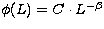 (
(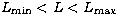 ). If this luminosity function is normalized,
there are two remaining free parameters, the average luminosity <L>
and the width of the luminosity
function
). If this luminosity function is normalized,
there are two remaining free parameters, the average luminosity <L>
and the width of the luminosity
function 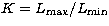 . At
each observed peak flux level P, the GRBs themselves can be located at a
wide range of redshifts because of the above luminosity distribution.
Therefore we calculate the corresponding average redshift <z> of GRBs
as sampled from the above luminosity function. When averaging,
these redshifts have to be appropriately weighted by the density
distribution according to the
. At
each observed peak flux level P, the GRBs themselves can be located at a
wide range of redshifts because of the above luminosity distribution.
Therefore we calculate the corresponding average redshift <z> of GRBs
as sampled from the above luminosity function. When averaging,
these redshifts have to be appropriately weighted by the density
distribution according to the  curve, and possibly some form of
cutoff of the GRB distribution at large redshifts where galaxies are still
not formed.
curve, and possibly some form of
cutoff of the GRB distribution at large redshifts where galaxies are still
not formed.
We fit the time dilation data to the above model. The data utilizes the
peak-to-peak time scales derived from the time intervals between
statistically significant peak structures in the GRB time profiles
(Norris
et al. [1995]; Deng & Schaefer [1998]). It is
found that time data of GRBs can be reasonably fit by models with a
standard candle luminosity or a broad luminosity function. In the case of
models with a luminosity function, the best fit <L> is plotted against
the change of luminosity function width K as shown in Fig. 2 for a
particular model
with  . It is found that the best fit average luminosity
rises as the luminosity function width is increased. The cosmological
parameters are also varied from the values preferred by the inflationary
scenario to the recent values measured by the high redshift supernova
surveys.
. It is found that the best fit average luminosity
rises as the luminosity function width is increased. The cosmological
parameters are also varied from the values preferred by the inflationary
scenario to the recent values measured by the high redshift supernova
surveys.
The combination of the uncertainty in the luminosity function and the
cosmological models translates into large variation of the best average
luminosity <L>. The best fit ranges from  for a cosmological model with
  and a standard candle luminosity L0,
spectral index
and a standard candle luminosity L0,
spectral index  to as high as
  for a cosmological model with
  , and a power law luminosity function ,
  .
.
![\begin{figure}
\includegraphics [width=6.5cm,height=6.5cm]{lkgraph.eps}\end{figure}](/articles/aas/full/1999/15/r21/img27.gif) |
Figure 2:
Best fit average luminosity <L> vs. the width K of
the luminosity function in a particular cosmological model with
and  , luminosity function index , luminosity function index
 , and the spectral index of GRBs . This graph
shows that the best fit of <L> changes by a factor of , and the spectral index of GRBs . This graph
shows that the best fit of <L> changes by a factor of  with a
broad luminosity function width K = 2000 with a
broad luminosity function width K = 2000 |
Copyright The European Southern Observatory (ESO)