

On 12 October 1993, the source exhibited no convincing microvariability
during the observation of one hour and 40 min.
On the next night, 13 October, the source was about 0.1 mag brighter
(see Table 1). On 22 October 1995 BL Lac was stable over the interval of
our observation of about 2.5 hours. Six days
later, 28 October, the source brightened by  mag.
On 29 October 1995, the source was almost
at the same brightness level as on the night before
during our observation (see Table 1). Two month
later, on 22 December 1995, the source became
mag.
On 29 October 1995, the source was almost
at the same brightness level as on the night before
during our observation (see Table 1). Two month
later, on 22 December 1995, the source became
 mag
brighter. On the next night, 23 December
1996, the source was a little fainter than on the night before (see Table 1).
In August 1996, BL Lac undertook a small flare. From 14 to 24
August, the source brightened by
mag
brighter. On the next night, 23 December
1996, the source was a little fainter than on the night before (see Table 1).
In August 1996, BL Lac undertook a small flare. From 14 to 24
August, the source brightened by  mag and on 25 August it faded back
by
mag and on 25 August it faded back
by  mag (see Table 1).
On 14 August we also observed a microvariation in the
source. From JD = 2450310.1979 to 2450310.2153, the source brighten by
mag (see Table 1).
On 14 August we also observed a microvariation in the
source. From JD = 2450310.1979 to 2450310.2153, the source brighten by
 mag in 20 min, then by
  mag
in
mag
in  min (to 2450310.2635). On JD = 2450310.2635 it reached a maximum
and then began to fade. The amplitude of this
microvariability was
min (to 2450310.2635). On JD = 2450310.2635 it reached a maximum
and then began to fade. The amplitude of this
microvariability was  mag (see Fig. 1
and Table 1).
In early September 1996, the
source was at the same brightness level as in August 1996, and the amplitude
of variability was about 0.1 mag. During the observation of one hour and 40 min on 02 September, the source exhibited no evidence of microvariability
(see Table 1).
On 19 October 1996, the
source was as bright as 14 September 1995, and showed no microvariability.
On the next night, 20 October, the source was
slightly fainter than on the night before (see Table 1).
Over the interval of our observation from 7 to 11 November, the source
gradually faded by
mag (see Fig. 1
and Table 1).
In early September 1996, the
source was at the same brightness level as in August 1996, and the amplitude
of variability was about 0.1 mag. During the observation of one hour and 40 min on 02 September, the source exhibited no evidence of microvariability
(see Table 1).
On 19 October 1996, the
source was as bright as 14 September 1995, and showed no microvariability.
On the next night, 20 October, the source was
slightly fainter than on the night before (see Table 1).
Over the interval of our observation from 7 to 11 November, the source
gradually faded by  mag (see Table 1). On 12 December
1996, BL Lac was
mag (see Table 1). On 12 December
1996, BL Lac was  mag brighter than on 11 November
and gradually faded by
mag brighter than on 11 November
and gradually faded by  mag
over the interval of the observation from
12 to 14 December 1996 (see Table 1).
mag
over the interval of the observation from
12 to 14 December 1996 (see Table 1).
![\begin{figure}
\includegraphics [angle=-90,width=8.8cm,clip]{fig1.ps}\end{figure}](/articles/aas/full/1999/09/ds7794/img24.gif) |
Figure 1:
Light curves of BL Lac on 14 August 1996.
The open circles ( ) are
for I band data and filled circles ( ) are
for I band data and filled circles ( ) for R ) for R |
![\begin{figure}
\includegraphics [angle=-90,width=8.8cm,clip]{fig2.ps}\end{figure}](/articles/aas/full/1999/09/ds7794/img26.gif) |
Figure 2:
Light curves of BL Lac on 07 September 1997.
The stars ( ) are for V band data, filled circles () for R ) are for V band data, filled circles () for R |
Combining the historical
light curves constructed by
Shen & Usher (1970) and the long term monitoring
results by Webb et al. (1988), we can see that the range of
variation for BL Lac in the B band was 12.4 to 17.2 mag.
The faintest magnitude ever recorded is 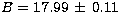 mag,
mag,
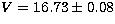 mag
(Carini et al. 1992); nevertheless, during about 17
years (1973 to 1990) BL Lac reached this faintest
state only once (on 1980.367), the usual fainter states for BL Lac
were those states around V=15.7 mag (see Fig. 13 of
Carini et al. 1992).
It is obvious that over the interval of 1995 and 1996 observing runs BL Lac
kept at faint states, and was relatively stable.
The amplitudes of intranight variation recorded in our observation were
less than 0.3 mag (see Table 1). Better sampling observations for this source
in 1995 by Maesano et al. (1997) also recorded no flares or
fluctuation greater than half magnitude from the mean level.
mag
(Carini et al. 1992); nevertheless, during about 17
years (1973 to 1990) BL Lac reached this faintest
state only once (on 1980.367), the usual fainter states for BL Lac
were those states around V=15.7 mag (see Fig. 13 of
Carini et al. 1992).
It is obvious that over the interval of 1995 and 1996 observing runs BL Lac
kept at faint states, and was relatively stable.
The amplitudes of intranight variation recorded in our observation were
less than 0.3 mag (see Table 1). Better sampling observations for this source
in 1995 by Maesano et al. (1997) also recorded no flares or
fluctuation greater than half magnitude from the mean level.
During 1997 observing run, BL Lac became much brighter than it was in 1995
and 1996. On 7 September 1997, it was averagely
12.78 mag in the R band, about 1.9 mag brighter than it was on 14 December
1996 (see Table 1). During the observation on this night the source showed
a steadily brightness increase of  mag (see Fig. 2
and Table 1),
which was probably a part of an intranight variation.
On 3 October 1997, the source became about 1.0 mag fainter in the R band.
No significant variability was observed during the observation of about one
hour on this night (see Table 1).
The observations on 4 December recorded
a microvariation. From the beginning of our observation to
JD = 2450725.0053 the source brightened by
mag (see Fig. 2
and Table 1),
which was probably a part of an intranight variation.
On 3 October 1997, the source became about 1.0 mag fainter in the R band.
No significant variability was observed during the observation of about one
hour on this night (see Table 1).
The observations on 4 December recorded
a microvariation. From the beginning of our observation to
JD = 2450725.0053 the source brightened by  mag, then
by
mag, then
by  mag, and then faded back by about the same amount
till JD = 2450725.0565. The amplitude of this microvariability was
mag, and then faded back by about the same amount
till JD = 2450725.0565. The amplitude of this microvariability was
 mag (see Table 1). From 7 September to 4 December, it decreased
 mag in its brightness.
Nesci et al.
(1998) monitored this source intensively in July 1997 for 9
nights (from 14 to 29 July) and found the source was never stable, but always
showed a variability of at least 0.04 mag/hour, often with superimposed
fast fluctuation on time scales of about an hour and with amplitudes of about
0.1 mag. The largest intraday variation had an amplitude of 0.7 mag.
During their observation the source was at a bright state of about
14.0 mag in the V band. It was obvious that the source was at the stage of a
large outburst during late 1997,
accompanied with much more rapid flares and fluctuations than
in 1995 to 1996 when the source was at faint states.
mag in its brightness.
Nesci et al.
(1998) monitored this source intensively in July 1997 for 9
nights (from 14 to 29 July) and found the source was never stable, but always
showed a variability of at least 0.04 mag/hour, often with superimposed
fast fluctuation on time scales of about an hour and with amplitudes of about
0.1 mag. The largest intraday variation had an amplitude of 0.7 mag.
During their observation the source was at a bright state of about
14.0 mag in the V band. It was obvious that the source was at the stage of a
large outburst during late 1997,
accompanied with much more rapid flares and fluctuations than
in 1995 to 1996 when the source was at faint states.
On 01 March 1994, the source was averagely 0.8 magnitude brighter than
the mean level of B=16.5 mag
(Kidger et al. 1995). From the beginning of our
observation to JD = 2449413.1153 the source brightened by
 mag, then faded back by
 mag and
 mag
(see Fig. 3
and Table 1). On 03 March 1994, the source showed a decline of
mag
(see Fig. 3
and Table 1). On 03 March 1994, the source showed a decline of
 mag
from the beginning of our observation to JD = 2449415.0844, then recovered
about the same amount in the B band to JD = 2449415.1384, and then began
another decline till the end of our observation.
(see Fig. 4
and Table 1).
mag
from the beginning of our observation to JD = 2449415.0844, then recovered
about the same amount in the B band to JD = 2449415.1384, and then began
another decline till the end of our observation.
(see Fig. 4
and Table 1).
![\begin{figure}
\includegraphics [angle=-90,width=8.8cm,clip]{fig3.ps}\end{figure}](/articles/aas/full/1999/09/ds7794/img39.gif) |
Figure 3:
The B and V band light curves of OJ 287 on 01 March 1994.
The stars () are for V band data and triangles
( ) for B ) for B |
mag,
then by  mag, and then by
  mag.
On JD = 2449691.3757 it began to recover
till the end of our observation (see Table 1). On 05 December, the source
was a little brighter than on the night before. On 06 December the
source was stable
during the observation, but
mag.
On JD = 2449691.3757 it began to recover
till the end of our observation (see Table 1). On 05 December, the source
was a little brighter than on the night before. On 06 December the
source was stable
during the observation, but  mag brighter than on the night before.
Forty-eight days later, on 23 January 1995, the source became averagely
0.5 mag fainter in the V band and exhibited a steady decline of
mag brighter than on the night before.
Forty-eight days later, on 23 January 1995, the source became averagely
0.5 mag fainter in the V band and exhibited a steady decline of
 mag. On the next night the
source showed a slow brightness increase of
mag. On the next night the
source showed a slow brightness increase of  mag
which was superimposed by a microvariation of
mag
which was superimposed by a microvariation of
 mag (see Table 1). On 25 January 1995 the source brightened by
 mag from the beginning of our observation to
JD = 2449743.2431, then slowly faded by
mag from the beginning of our observation to
JD = 2449743.2431, then slowly faded by  mag to
the end of our observation. The observation on 26
January 1995 recorded a local brightness minimum of V=15.34 mag which was
brighter than the local maximum of V=15.41 mag on the night before, implying
that the source had undertaken a brightness oscillation over the interval
between 25 and 26 January (see Table 1).
On 27 January 1995 the source was a little fainter than on 26, but showed no
convincing variation during our observation.
On 28 January 1995 the source exhibited a slow darkening of
mag to
the end of our observation. The observation on 26
January 1995 recorded a local brightness minimum of V=15.34 mag which was
brighter than the local maximum of V=15.41 mag on the night before, implying
that the source had undertaken a brightness oscillation over the interval
between 25 and 26 January (see Table 1).
On 27 January 1995 the source was a little fainter than on 26, but showed no
convincing variation during our observation.
On 28 January 1995 the source exhibited a slow darkening of
 mag (see Table 1).
The source was next observed on 22 March 1995 and
mag (see Table 1).
The source was next observed on 22 March 1995 and  mag fainter
than on 28 January 1995. It exhibited a brightness oscillation with an
amplitude of mag (see Fig. 5
and Table 1).
On the next night, 23 March, the source first faded by
mag fainter
than on 28 January 1995. It exhibited a brightness oscillation with an
amplitude of mag (see Fig. 5
and Table 1).
On the next night, 23 March, the source first faded by
 mag and reached a local brightness minimum on
JD = 2449800.125, then recovered 0.06 mag to JD = 2449800.1359, and then kept
stable to the end of our observation (see Table 1).
On 24 March 1995, the source was
averagely 0.25 mag brighter than on the night before. The
light curve on this night seems to show a brightness oscillation, but the
amplitude is less than 3
mag and reached a local brightness minimum on
JD = 2449800.125, then recovered 0.06 mag to JD = 2449800.1359, and then kept
stable to the end of our observation (see Table 1).
On 24 March 1995, the source was
averagely 0.25 mag brighter than on the night before. The
light curve on this night seems to show a brightness oscillation, but the
amplitude is less than 3 (see Table 1).
Over the interval from December 1994 to March 1995 the
source gradually faded by about one magnitude. This was consistent with the
observation by
Sillanp
(see Table 1).
Over the interval from December 1994 to March 1995 the
source gradually faded by about one magnitude. This was consistent with the
observation by
Sillanp et al. (1996a) who recorded an
outburst in this source which peaked around 10 November 1994 and ended in
April 1995.
et al. (1996a) who recorded an
outburst in this source which peaked around 10 November 1994 and ended in
April 1995.
![\begin{figure}
\includegraphics [angle=-90,width=8.8cm,clip]{fig4.ps}\end{figure}](/articles/aas/full/1999/09/ds7794/img51.gif) |
Figure 4:
The B and V band light curves of OJ 287 on 03 March 1994.
The stars () are for V band data and triangles
() for B |
On 24 January 1996 the source was about one magnitude brighter than it
was in March 1995 (see Table 1). On 15
February 1996, the source was stable during our observation and
 mag fainter than on 24 January 1996 (see Table 1).
On 15 April 1996, the source was about 0.27 mag brighter than on 15 February
1996. On the next night, 16 April, the source became a little fainter and
kept stable during our observation (see Table 1).
From 16 to 18 April 1996, the source gradually brightened
by mag, but exhibited no convincing variation on each night.
The source was next observed on 02 January 1997 and became
mag fainter than on 24 January 1996 (see Table 1).
On 15 April 1996, the source was about 0.27 mag brighter than on 15 February
1996. On the next night, 16 April, the source became a little fainter and
kept stable during our observation (see Table 1).
From 16 to 18 April 1996, the source gradually brightened
by mag, but exhibited no convincing variation on each night.
The source was next observed on 02 January 1997 and became
 mag
fainter. Nearly one year later, on 04 December 1997, the source faded by
another 0.2 mag. During the observation on this night it also exhibited a
microvariation of
mag
fainter. Nearly one year later, on 04 December 1997, the source faded by
another 0.2 mag. During the observation on this night it also exhibited a
microvariation of  mag (see Table 1). A month later,
on 01 and 02 January 1998, the source became even fainter.
On 01 January 1998, the source first faded by
mag (see Table 1). A month later,
on 01 and 02 January 1998, the source became even fainter.
On 01 January 1998, the source first faded by  mag,
then brightened back by
mag,
then brightened back by  mag,
mag and
mag,
mag and  mag to a local brightness maximum, and then
began to fade to the end of our observation (see Table 1). The
amplitude of this small flicker was at least 0.16 mag. During the observation
of one hour and 45 min on 02 January 1998, the source showed no
convincing variation (see Table 1). On 28 April
1998, the source was at the same brightness level as in January 1998 and showed
no evidence of microvariability (see Table 1).
Over the interval from January 1996 to April
1998 the source faded gradually by about one magnitude, back to the brightness level
of March 1995. This is consistent with the observation by
Sillanp et al. (1996b) who detected a secondary outburst
in this source which peaked just at Christmas 1995.
mag to a local brightness maximum, and then
began to fade to the end of our observation (see Table 1). The
amplitude of this small flicker was at least 0.16 mag. During the observation
of one hour and 45 min on 02 January 1998, the source showed no
convincing variation (see Table 1). On 28 April
1998, the source was at the same brightness level as in January 1998 and showed
no evidence of microvariability (see Table 1).
Over the interval from January 1996 to April
1998 the source faded gradually by about one magnitude, back to the brightness level
of March 1995. This is consistent with the observation by
Sillanp et al. (1996b) who detected a secondary outburst
in this source which peaked just at Christmas 1995.
The source was rather stable during 04-06 December 1994. Only a slightly
brightness decrease of  mag was observed between
04 and 05 December (see Table 1).
Forty-eight days later, 23 January 1995, the source brightened
by
mag was observed between
04 and 05 December (see Table 1).
Forty-eight days later, 23 January 1995, the source brightened
by  mag, and exhibited a small flicker
of
mag, and exhibited a small flicker
of  mag from JD = 2449741.1222 to 2449741.2115, and
a smaller flicker of 0.06 mag from JD = 2449741.2115 to 2449741.2343
(see Fig. 6
and Table 1).
On the next night the source was
mag from JD = 2449741.1222 to 2449741.2115, and
a smaller flicker of 0.06 mag from JD = 2449741.2115 to 2449741.2343
(see Fig. 6
and Table 1).
On the next night the source was  mag fainter than
the night before, but showed no convincing microvariation.
Then two days later, 26 January, it brightened back by
mag. From 26 to 29 January the source was stable,
no significant intranight variation and
microvariation being detected (see Table 1).
The source was next observed a year later, on 24 January 1996, and was as
bright as on 29 January 1995. No convincing microvariation was detected
on this night (see Table 1). Twenty-two days later, 15 February
1996, the source faded by
mag fainter than
the night before, but showed no convincing microvariation.
Then two days later, 26 January, it brightened back by
mag. From 26 to 29 January the source was stable,
no significant intranight variation and
microvariation being detected (see Table 1).
The source was next observed a year later, on 24 January 1996, and was as
bright as on 29 January 1995. No convincing microvariation was detected
on this night (see Table 1). Twenty-two days later, 15 February
1996, the source faded by  mag. On 13 December 1996,
the source became about one magnitude fainter in the V band.
On 02 and 03 January 1997, it was a little fainter than in December
1996. On 04 December 1997, the source reached the minimum of our
monitoring, with
mag. On 13 December 1996,
the source became about one magnitude fainter in the V band.
On 02 and 03 January 1997, it was a little fainter than in December
1996. On 04 December 1997, the source reached the minimum of our
monitoring, with  mag,
near the faintest magnitude ever recorded of B=17.72 mag.
During the observation of two hours and twenty minutes, the source showed
no evidence of microvariability (see Table 1).
Twenty days later, 24 December, the source brightened back by
mag,
near the faintest magnitude ever recorded of B=17.72 mag.
During the observation of two hours and twenty minutes, the source showed
no evidence of microvariability (see Table 1).
Twenty days later, 24 December, the source brightened back by
 mag. The observation on this night lasted over 4
hours, but detected no convincing microvariations (see Fig. 7
and Table 1).
From 01 January to 24 February 1998 the source slowly faded by
mag. The observation on this night lasted over 4
hours, but detected no convincing microvariations (see Fig. 7
and Table 1).
From 01 January to 24 February 1998 the source slowly faded by
 mag.
On 01 January 1998 the source was mag brighter
than on 24 December 1997 and exhibited a decline of
mag.
On 01 January 1998 the source was mag brighter
than on 24 December 1997 and exhibited a decline of  mag from the
beginning of the observation to JD = 2450815.2295.
On 02 January during the observation of three hours and twenty minutes the
source showed no convincing microvariation.
On 22 February the source exhibited no evidence of microvariation during
the observation of two and half hours.
On 24 February, from the beginning of our observation to JD = 2450869.2220
the source was stable, but during last two hours of our observation the
source showed a microvariation of mag (see Table 1).
mag from the
beginning of the observation to JD = 2450815.2295.
On 02 January during the observation of three hours and twenty minutes the
source showed no convincing microvariation.
On 22 February the source exhibited no evidence of microvariation during
the observation of two and half hours.
On 24 February, from the beginning of our observation to JD = 2450869.2220
the source was stable, but during last two hours of our observation the
source showed a microvariation of mag (see Table 1).
![\begin{figure}
\includegraphics [angle=-90,width=8.8cm,clip]{fig7.ps}\end{figure}](/articles/aas/full/1999/09/ds7794/img69.gif) |
Figure 7:
Light curves of PKS 0735+178 on 24 Dec. 1997.
The open circles () are
for I band data, filled circles () for R,
stars () for V and
triangles () for B |
Copyright The European Southern Observatory (ESO)
![\begin{figure}
\includegraphics [angle=-90,width=8.8cm,clip]{fig5.ps}\end{figure}](/articles/aas/full/1999/09/ds7794/img52.gif)
![\begin{figure}
\includegraphics [angle=-90,width=8.8cm,clip]{fig6.ps}\end{figure}](/articles/aas/full/1999/09/ds7794/img59.gif)