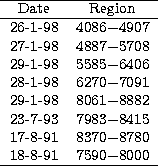
| Dates are given in day-month-(Year-1900). Regions are given in Angström. |
Most of the observations were made with the 152 cm telescope, in
January 1998. The spectrograph used was AURÉLIE (see Gillet et al. 1994)
with a Thomson 7832 double bar detector, with 2048 photodiodes ( ).
The grating used had 300 grooves/mm, blazed at 6000 Å. The original
dispersion is 33 Å/mm, with a resolution of 1.3 Å, equivalent to
65 km
).
The grating used had 300 grooves/mm, blazed at 6000 Å. The original
dispersion is 33 Å/mm, with a resolution of 1.3 Å, equivalent to
65 km s-1 at 6000 Å.
Calibrations were made with a tungsten lamp for flat field and in wavelength by means of a hollow cathod of thorium and argon for the blue and the red and thorium-neon for the near infrared.
The observations from 1990 to 1993 were made with the CARELEC
spectrograph (Lemaitre et al. 1990) mounted on the Coudé focus of the 193
cm telescope. For  Å a grating with 1200 lines/mm,
blazed at 4000 Å was used, which provides a dispersion of
33 Å/mm
in the first order. For
Å a grating with 1200 lines/mm,
blazed at 4000 Å was used, which provides a dispersion of
33 Å/mm
in the first order. For  Å a grating with 1200
lines/mm blazed at 7500 Å was used, which provides a dispersion of
33 Å/mm in the first order. The second order was eliminated with a
filter OG590. The receiver was a Thomson CCD (
Å a grating with 1200
lines/mm blazed at 7500 Å was used, which provides a dispersion of
33 Å/mm in the first order. The second order was eliminated with a
filter OG590. The receiver was a Thomson CCD ( pixels, 23 square
microns), with a resolving power of about one Å. The calibration in
wavelength was made with Ne, Ar and He lamps and the flat field correction
with a tungsten lamp mounted in the spectrograph.
pixels, 23 square
microns), with a resolving power of about one Å. The calibration in
wavelength was made with Ne, Ar and He lamps and the flat field correction
with a tungsten lamp mounted in the spectrograph.
The data were reduced with the software package IHAP developed at ESO and installed at the OHP.
Copyright The European Southern Observatory (ESO)