Due to elevation restrictions of the 100-m telescope, we were
constrained to only include sources with a declination greater than
 . Also, sources with an angular extent greater than the
half-power beam-width of the telescope, which is just under 3 min
of arc, were excluded from the sample for the practical reason that
more time-consuming 2-D raster scans of I, Q, and U around the sources
could be avoided. Within the allotted observing time, we were able
to obtain data for 154 sources, mostly radio galaxies, that were known
to be significantly polarized.
. Also, sources with an angular extent greater than the
half-power beam-width of the telescope, which is just under 3 min
of arc, were excluded from the sample for the practical reason that
more time-consuming 2-D raster scans of I, Q, and U around the sources
could be avoided. Within the allotted observing time, we were able
to obtain data for 154 sources, mostly radio galaxies, that were known
to be significantly polarized.
The receiving system of the 100-m telescope employs a twin-horn system. The left-hand circular signal from the main horn is passed through a series of amplifiers while being mixed down to a frequency of 350 MHz. The right-hand circular signals from the main and reference horns are combined to produce sum and difference signals, which are also amplified and mixed down to a frequency of 350 MHz. The resultant three signals are then fed into a three-channel polarimeter having a 100-600 MHz bandpass, i.e. 500 MHz. The right-handed circular sum signal is then correlated with the left-handed circular signal to obtain the Stokes Q and U components, and the right-handed circular sum and difference signals are correlated to yield Stokes I. For gain stabilization, an intermittent linearly polarized noise calibration signal was introduced into the receiver system. This signal can then be extracted from the output of the polarimeter and used to normalize the Stokes parameters. The result is to further improve the stability of the receiver system already stabilized by the twin-horn method.
Each source was observed in an ON-OFF manner consisting of six "ON"
source and six "OFF" source measurements, each with a duration of just
less than  s. With a
  of 60 K, it was
possible to attain a sensitivity of 5 mJy s-1/2. Each
observation was preceded by a gridded search in the sky to pin-point
the exact location of the source. This was done to ensure that the
sources were directly in the on-axis direction of the telescope. Under
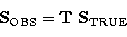
such conditions, we can assume that some linear relationship exists
between the observed and true Stokes parameters. Since for our purposes
circular polarization can be neglected, Stokes I, Q, and U are the
components of the observed and true polarization vectors (i.e.
of 60 K, it was
possible to attain a sensitivity of 5 mJy s-1/2. Each
observation was preceded by a gridded search in the sky to pin-point
the exact location of the source. This was done to ensure that the
sources were directly in the on-axis direction of the telescope. Under
such conditions, we can assume that some linear relationship exists
between the observed and true Stokes parameters. Since for our purposes
circular polarization can be neglected, Stokes I, Q, and U are the
components of the observed and true polarization vectors (i.e.
 ) and one can can
write:
) and one can can
write:
 |
(1) |
 and
and  are
defined in the telescope's aperture plane, and
are
defined in the telescope's aperture plane, and  denotes the
3-by-3 polarization matrix of the whole receiving system, describing
it's imperfections between the source and the polarimeter output. The
first row of determines the overall flux calibration and
includes the cross-talk of polarization into the total power channel.
The final two rows represent the effects of the instrumental polarization
and the polarimeter ellipticity on the true polarization vector.
A complete description of , along with schematics of the
receiving system and polarimeter, can be found in Turlo et al.
(1985).
denotes the
3-by-3 polarization matrix of the whole receiving system, describing
it's imperfections between the source and the polarimeter output. The
first row of determines the overall flux calibration and
includes the cross-talk of polarization into the total power channel.
The final two rows represent the effects of the instrumental polarization
and the polarimeter ellipticity on the true polarization vector.
A complete description of , along with schematics of the
receiving system and polarimeter, can be found in Turlo et al.
(1985).
For an altitude-azimuth mounted telescope, the true Q and U Stokes
parameters in the sky rotate in the aperture plane with the
parallactic angle. Crosstalk from the polarization channels to total
power introduces a sinusoidal variation of Stokes I as a function of
phase angle ( parallactic angle + position angle).
The length
parallactic angle + position angle).
The length 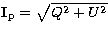 of the observed
polarization vector varies in a more complicated fashion, since it is
given by the distance with respect to the origin of a point moving on
the circumference of an ellipse, being displaced by the instrumental
polarization. These variations can be corrected for by determining the
nine matrix elements of from a set of at least 3 linearly
independent input and output polarization vectors
and . The
collection of polarization vectors of a given source obtained at at
least 3 different parallactic angles constitutes such a set of
independent measurements. Since a set of redundant measurements is
usually preferred, is solved for by the least-squares
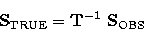
method described by Thiel (1976). Once has
been found, the true polarization vector is given by
of the observed
polarization vector varies in a more complicated fashion, since it is
given by the distance with respect to the origin of a point moving on
the circumference of an ellipse, being displaced by the instrumental
polarization. These variations can be corrected for by determining the
nine matrix elements of from a set of at least 3 linearly
independent input and output polarization vectors
and . The
collection of polarization vectors of a given source obtained at at
least 3 different parallactic angles constitutes such a set of
independent measurements. Since a set of redundant measurements is
usually preferred, is solved for by the least-squares
method described by Thiel (1976). Once has
been found, the true polarization vector is given by
 |
(2) |
is
defined in the aperture plane and must be mapped back into the sky
plane because of the variation of parallactic angle. The position angle
( ) of the linear polarization can then be found in the usual
manner from the second and third components of the polarization vector.
) of the linear polarization can then be found in the usual
manner from the second and third components of the polarization vector.
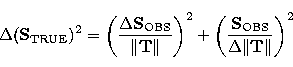
The matrix calibration technique includes an error analysis for
thermal and systematic errors. The propagation of noise with respect to
the Stokes parameters is described by Thiel (1976)
 |
(3) |
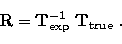
 and
and  denote the
true and experimentally determined transformation matrices,
respectively. An imperfect correction of the polarimetric effects is
then described by a residual transformation matrix
denote the
true and experimentally determined transformation matrices,
respectively. An imperfect correction of the polarimetric effects is
then described by a residual transformation matrix
 |
(4) |
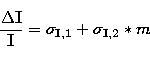
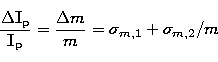
 should be very close to unity, but nevertheless, just like
, gives rise to phase angle dependent variations in total
power, polarized power
should be very close to unity, but nevertheless, just like
, gives rise to phase angle dependent variations in total
power, polarized power  and position angle
. The amplitudes of these residual variations are given by
and position angle
. The amplitudes of these residual variations are given by
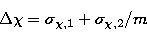
 |
(5) |
 |
(6) |
 |
(7) |
. Since, for a given
source, the actual size and sign of the residual errors are dependent
on phase angle and thus on the particular time of observation,
they almost behave like an additional noise error, the standard
deviation of which can conservatively be approximated by the above
amplitudes. Thus, the overall error in Stokes I,
and will be given by the squared sum of
both noise and residual systematic contributions.
It is important to emphasise that the absolute errors in position angle
will still be somewhat larger than those obtained from our error
analysis, since they are subject to the accuracy of the adopted
position angles of the calibrators, and to some low-level systematic
contribution due to Faraday rotation of the polarization position angles.
We estimate the latter to be at most  .
.
We also note that our implicit assumption of the applicability of
Gaussian statistics for the calculation of the errors of the degree of
polarization m and is valid only as a first-order
approximation since a) the matrix elements may not be statistically
independent under certain conditions and, b) the polarized flux is
subject to Ricean statistics. The latter problem is important for
sources with low signal-to-noise (i.e.  ) in their polarized
flux (cf. Wardle & Kronberg 1974, and references
therein).
) in their polarized
flux (cf. Wardle & Kronberg 1974, and references
therein).
The reliability and repeatability of the above calibration scheme with
the 100-m telescope has been tested by Turlo et al.
(1985) and Forkert (1984). We applied the
same calibration procedure as they did. Each observing session is divided
into several sections corresponding to the availability of individual
calibrators that had known and consistent parameters, and complete overlap
in hour angle. In each section the elements of are
redetermined using the particular visible calibrator over the maximum
possible range of parallactic angles. This approach is chosen, since
aside from possible inconsistencies between calibrator parameters,
there are variations in the matrix properties derived from different
calibrators, which cannot be ascribed to thermal noise alone. Forkert
(1984) demonstrated the presence of additional az-el
dependent polarized components, these being most prominent at low
elevations. Experience showed that the mixing of calibrators in order
to determine was inferior to the approach chosen. Another
essential ingredient of the procedure is an elevation-dependent gain
correction (peak-to-peak 3%).
Using 3C 286 as their primary calibrator, Turlo et al. find that the
matrix elements of within certain limits remain stable
over periods of greater than four months at  6 cm. Their
estimates of the noise dependent scatter over a day for 3C 286 was
12.8 mJy, or 0.17% for and 0.09 degrees for
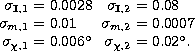
. For the same set of calibrators we used (see below), Forkert
(1984) determined typical values for the constants
describing the residual variations in amplitude (assuming 0 < m < 1):
6 cm. Their
estimates of the noise dependent scatter over a day for 3C 286 was
12.8 mJy, or 0.17% for and 0.09 degrees for
. For the same set of calibrators we used (see below), Forkert
(1984) determined typical values for the constants
describing the residual variations in amplitude (assuming 0 < m < 1):
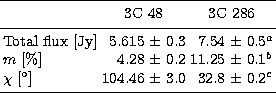
For the data presented here, 3C 48 and 3C 286 were chosen as the
calibrator sources; their total flux, m, and are listed in
Table 1 where the parameters of 3C 48 were adjusted
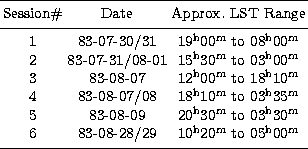
slightly to be consistent with 3C 286. A different matrix was computed for each observing session and used to reduce the data
for that session. A log of the observing sessions is recorded in
Table 2. We obtain a similar level of repeatability for the
calibrators as Turlo et al. (1985) - see above, but we
also noticed slight variations in the matrix elements amongst the set of
matrices. We interpret these variations to be related to the extent of
the parallactic angle coverage, since each observing session
sampled different parallactic angle ranges and overlap in some cases
is minimal. In some cases, a particular source was observed in more
than one session. An example, 0010+04, observed in four different
sessions, each reduced with a different matrix , is shown
in Table 3. Since we found no reason to question the
validity of any particular matrix, a straightforward unweighted average
of the Stokes I, Q, and U values was used to produce the final results
(Table 4).
 a Baars et al. (1977). |
Copyright The European Southern Observatory (ESO)