Koski (1978)
and Kay (1994) found that all Seyfert 2 galaxies show
an ultraviolet excess and
weak absorption lines when compared with galaxies with no emission lines,
indicating the presence of a blue featureless continuum.
Boisson & Durret (1986)
and
Vaceli et al. (1997) suggested that this continuum is
a non-thermal power-law continuum.
Kinney et al. (1991) argued that most of the Seyfert 2s in which a blue continuum has
been observed are of type Sb or earlier, suggesting that it is truly
associated with the Seyfert nucleus.
Shuder (1981)
showed that its strength and the  luminosity are
strongly correlated suggesting that a direct physical connection exists between
the two; studying a sample of 28 Seyfert 2s,
Yee (1980) found that the
luminosity are
strongly correlated suggesting that a direct physical connection exists between
the two; studying a sample of 28 Seyfert 2s,
Yee (1980) found that the
 and continuum fluxes (rather than luminosities) are proportional over
two orders of magnitude, with, however, a relatively large dispersion; but
a number of those objects are now known to be Seyfert 1 galaxies.
and continuum fluxes (rather than luminosities) are proportional over
two orders of magnitude, with, however, a relatively large dispersion; but
a number of those objects are now known to be Seyfert 1 galaxies.
Martin et al. (1983) discovered that a small fraction of all Seyfert 2 galaxies have a highly polarized continuum. Subsequently, Antonucci & Miller (1985); Miller & Goodrich (1990) and Tran et al. (1992) showed that these objects harbour a hidden Seyfert 1 nucleus, the observed polarized continuum arising from scattering of the nuclear continuum by dust or warm electrons. But most Seyfert 2s have very little polarization (Martin et al. 1983), much less than expected in the reflection model (Miller & Goodrich 1990).
On the other hand, Terlevich et al. (1990) showed that in Seyfert 2 galaxies, the IR Ca II triplet is equal or, in some cases, higher than in normal elliptical galaxies, which is most naturally explained by the presence of young stars contributing heavily to the nuclear light at near-IR wavelengths.
Heckman et al. (1995) used International Ultraviolet Explorer (IUE) spectra of 20 of the brightest type 2 Seyfert nuclei to build an ultraviolet template for this class; while the continuum was well detected in the template, there was no detectable broad line region (BLR), implying that no more than 20% of the template continuum could be light from a hidden Seyfert 1 nucleus scattered by dust; they suggested that either most of the nuclei in their sample were "pure'' type 2 Seyfert galaxies for which we have a direct view of the central engine and which simply lack of BLR, or that most of the observed ultraviolet continuum is produced by starbursts. From the absence of polarization of the continuum of most Seyfert 2 galaxies and of broad Balmer lines, Cid Fernandez & Terlevich (1995) concluded that, most probably, this continuum was due to a population of young stars in the vicinity of the nucleus. Colina et al. (1997) obtained ultraviolet HST images of four nearby Seyfert 2 galaxies known to have circumstellar star-forming rings, providing direct empirical evidence that the UV flux emitted by these galaxies is dominated by radiation coming from clusters of young hot stars distributed along the star-forming ring. If similar rings are a common characteristic of Seyfert 2 galaxies, the large IUE aperture would include both the Seyfert 2 nucleus and the rings for distances larger than 25 Mpc. Gonzalez Delgado et al. (1998) presented HST images and ultraviolet spectra of three Seyfert 2 nuclei (IC 3639, NGC 5135 and IC 5135); the data show the existence of nuclear starbursts (with absorption features formed in the photosphere of late O and early B stars) dominating the ultraviolet light. It is remarkable that, of the three observed galaxies, two (NGC 5135 and IC 5135) have a "composite'' nuclear emission spectrum, while the third (IC 3639), which has the largest UV nuclear flux (associated with the Seyfert nucleus) relative to the total UV flux, has a pure Seyfert 2 spectrum due to the relative weakness of the starburst emission component.
We conclude that there is ample evidence for the presence of young, hot stars in the nuclear region of many Seyfert 2 galaxies. When the continuum is relatively bright, the associated H II region could be strong enough to displace the object into the "transition'' zone in the diagnostic diagrams.
AGNs are more frequent in early type galaxies while starbursts are more often found in late-type galaxies (Véron & Véron-Cetty 1986; Ho et al. 1997b; Vaceli et al. 1997). It is therefore rather surprising to find almost systematically a population of young stars in Seyfert 2 galaxies; perhaps the nuclear activity triggers the star formation?
The  and
and  ratios are strongly correlated in H II regions.
Theoretical studies show that the heavy-metal abundances
change continuously along this
sequence, a low ratio indicating a high metal abundance and a high
ratio, a low metal abundance, with the heavy metal abundances changing
from
ratios are strongly correlated in H II regions.
Theoretical studies show that the heavy-metal abundances
change continuously along this
sequence, a low ratio indicating a high metal abundance and a high
ratio, a low metal abundance, with the heavy metal abundances changing
from  at the lower right of Fig. 4a to
 at the
upper left (see for instance
Dopita & Evans 1986;
Ho et al. 1997b).
However, Stasinska & Leitherer (1996) have shown that most startbusts
and H II galaxies can be described as being produced by an evolving
starburst with an universal initial mass function embedded in a gas cloud
of the same metallicity. The emission line ratios depend mainly on two
independent parameters: the age of the starburst and the metallicity. In
this scenario, the ratio effectively changes with these two parameters
and therefore is not a direct measurement of metallicity.
The metallicity is strongly correlated with luminosity, luminous
galaxies having higher metallicities; this correlation is also valid for
elliptical galaxies, for which the metallicity is determined from absorption
lines with [O/H]
at the
upper left (see for instance
Dopita & Evans 1986;
Ho et al. 1997b).
However, Stasinska & Leitherer (1996) have shown that most startbusts
and H II galaxies can be described as being produced by an evolving
starburst with an universal initial mass function embedded in a gas cloud
of the same metallicity. The emission line ratios depend mainly on two
independent parameters: the age of the starburst and the metallicity. In
this scenario, the ratio effectively changes with these two parameters
and therefore is not a direct measurement of metallicity.
The metallicity is strongly correlated with luminosity, luminous
galaxies having higher metallicities; this correlation is also valid for
elliptical galaxies, for which the metallicity is determined from absorption
lines with [O/H]  1 at MB = -21
(Salzer et al. 1989;
Zaritsky et al. 1994).
1 at MB = -21
(Salzer et al. 1989;
Zaritsky et al. 1994).
AGNs are known to occur preferentially in high luminosity
(Ho et al. 1997b),
early-type
(Véron & Véron-Cetty 1986;
Vacali et al. 1997) galaxies;
they are therefore expected to have high metallicities.
Indeed, the NLRs of active galactic nuclei have enhanced nitrogen abundances
(Storchi-Bergmann & Pastoriza 1989, 1990;
Storchi-Bergmann et al. 1992;
Schmitt et al. 1994).
In these NLRs, [N/O] correlates with [O/H] in a
manner identical to H II regions in normal galaxies, with nuclear [O/H]
and [N/O] values ranging from  to
to  (Storchi-Bergmann et al. 1996b).
Storchi-Bergmann et al. (1996b,c) have determined the chemical
composition of the H II regions in the ring surrounding the nucleus of several
AGNs, as well as in the nuclei; high metallicities were found ([O/H]
(Storchi-Bergmann et al. 1996b).
Storchi-Bergmann et al. (1996b,c) have determined the chemical
composition of the H II regions in the ring surrounding the nucleus of several
AGNs, as well as in the nuclei; high metallicities were found ([O/H]
 and
[N/O]
and
[N/O]  )
both in the H II regions and in the AGNs,
these abundances being
similar to those found in the nuclei of non-active galaxies with the same
morphological type and absolute magnitude. Further work by
Storchi-Bergmann et al. (1998) has shown that, in fact, oxygen abundances
derived for Seyfert 2 nebulosities and neighbouring H II regions (assuming
that the emission lines in the active nucleus are due to photoionization
by a typical active galactic nucleus continuum) are well correlated, while
this is not the case for Liners. This suggests that the gas in AGNs
and in the neighbouring H II regions has the same origin and that the
scatter observed in the Seyfert 2 region in the
diagnostic diagrams, involving the ratio, is due to variations in the
nitrogen abundance. In NGC 6300, in which = 3.4, the
nitrogen abundance is estimated to be
)
both in the H II regions and in the AGNs,
these abundances being
similar to those found in the nuclei of non-active galaxies with the same
morphological type and absolute magnitude. Further work by
Storchi-Bergmann et al. (1998) has shown that, in fact, oxygen abundances
derived for Seyfert 2 nebulosities and neighbouring H II regions (assuming
that the emission lines in the active nucleus are due to photoionization
by a typical active galactic nucleus continuum) are well correlated, while
this is not the case for Liners. This suggests that the gas in AGNs
and in the neighbouring H II regions has the same origin and that the
scatter observed in the Seyfert 2 region in the
diagnostic diagrams, involving the ratio, is due to variations in the
nitrogen abundance. In NGC 6300, in which = 3.4, the
nitrogen abundance is estimated to be  .
.
We have seen that nuclear H II regions and Seyfert 2 nebulosities, when appearing in the same galaxy, have the same high metallicity; as a result of their metallicity, the H II regions have a low excitation, while the Seyfert 2 nebulosities have a high excitation. This explains why it is relatively easy to separate the two components in "transition'' spectra.
The first photoionization models invoked to explain the narrow emission lines
in AGNs assumed a single density cloud. However, new observations quickly
suggested the presence of several emitting clouds, ruling out single
component models. Most of the multicloud models first studied
were such that the emitting
gas, as a whole, was ionization-bounded and thus the He II 4686
line intensity relative to was
determined by the hardness of the ionizing spectrum. In these models, the
extreme values reached by the
4686
line intensity relative to was
determined by the hardness of the ionizing spectrum. In these models, the
extreme values reached by the  ratio are not
well reproduced. A number of
objects have of the order of 0.2 or more; such high values cannot be
accounted for unless the line emitting clouds are matter-bounded
(Stasinska 1984). On the
basis of a weak trend for the low excitation lines to become weaker as
gets larger,
Viegas-Aldrovandi (1988)
and
Viegas & Prieto (1992) argued
in favor of a model in which matter-bounded clouds are present; indeed, if the
gas is not optically thick to all the ionizing continuum (i.e., is matter
bounded), the H+ emitting volume is smaller, but the He++ volume
is not, leading to a higher line ratio. Moreover,
Viegas-Aldrovandi & Gruenwald (1988)
and
Rodriguez-Ardila et al. (1998) showed that, for most
AGNs, the observed low-excitation lines are better explained by matter-bounded
models with about 50% of the luminosity produced in
ionization-bounded clouds.
ratio are not
well reproduced. A number of
objects have of the order of 0.2 or more; such high values cannot be
accounted for unless the line emitting clouds are matter-bounded
(Stasinska 1984). On the
basis of a weak trend for the low excitation lines to become weaker as
gets larger,
Viegas-Aldrovandi (1988)
and
Viegas & Prieto (1992) argued
in favor of a model in which matter-bounded clouds are present; indeed, if the
gas is not optically thick to all the ionizing continuum (i.e., is matter
bounded), the H+ emitting volume is smaller, but the He++ volume
is not, leading to a higher line ratio. Moreover,
Viegas-Aldrovandi & Gruenwald (1988)
and
Rodriguez-Ardila et al. (1998) showed that, for most
AGNs, the observed low-excitation lines are better explained by matter-bounded
models with about 50% of the luminosity produced in
ionization-bounded clouds.
Storchi-Bergmann et al. (1996a) have obtained long-slit spectra of five
active galaxies showing extended high excitation lines. At some positions,
two of the objects (PKS 0349-27 and PKS 0634-20) show quite peculiar
line ratios, with a strong He II4686 line ( /
/
 ) and
weak [N II] lines (that is, < 0.3). In fact, there seems to be
a correlation between and , weak [N II] lines being associated
with strong He II emission, suggesting that very small ratios
(as observed in the two above mentioned radiogalaxies) are not necessarily
a signature of star-formation, but a natural consequence of having a
region dominated by matter-bounded clouds
(Binette et al. 1996, 1997).
However, in the extranuclear regions of PKS 0349-278 in which strong
He II4686 and weak [N II]6583 lines are observed, the
[O I] 6300 line is also reduced (
) and
weak [N II] lines (that is, < 0.3). In fact, there seems to be
a correlation between and , weak [N II] lines being associated
with strong He II emission, suggesting that very small ratios
(as observed in the two above mentioned radiogalaxies) are not necessarily
a signature of star-formation, but a natural consequence of having a
region dominated by matter-bounded clouds
(Binette et al. 1996, 1997).
However, in the extranuclear regions of PKS 0349-278 in which strong
He II4686 and weak [N II]6583 lines are observed, the
[O I] 6300 line is also reduced ( 0.05), which is
a natural consequence of the model
(Viegas-Aldrovandi 1988), while in
our sample of weak [N II]6583 galaxies, we verify that the
[O I]6300 line is not weakened in most of the objects.
0.05), which is
a natural consequence of the model
(Viegas-Aldrovandi 1988), while in
our sample of weak [N II]6583 galaxies, we verify that the
[O I]6300 line is not weakened in most of the objects.
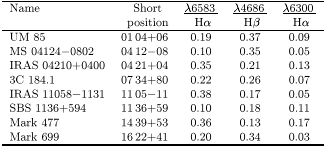
In Table 8 we give the list of known AGNs with relatively
weak [N II] lines ( < 0.45) with published values of the and
ratios. Three objects in this table (UM 85, MS 04124-0802 and Mark
699) have both weak [N II] lines ( < 0.20) and a strong He II line
(4686/ > 0.30).
In the last two, the [O I] lines are also relatively weak (  0.05);
these two objects could be dominated by matter-bounded clouds. Alternatively,
in the other objects, the weakness of the [N II] lines could be due to a
selective under-abundance of nitrogen. For a photoionized single cloud model
with
0.05);
these two objects could be dominated by matter-bounded clouds. Alternatively,
in the other objects, the weakness of the [N II] lines could be due to a
selective under-abundance of nitrogen. For a photoionized single cloud model
with  10-2.5,
Ferland & Netzer (1983) predicted
1.0 for solar nitrogen abundances and 0.3 for nitrogen
abundances 0.3 solar.
10-2.5,
Ferland & Netzer (1983) predicted
1.0 for solar nitrogen abundances and 0.3 for nitrogen
abundances 0.3 solar.
It has been suggested by several authors (see for instance
Ferland & Netzer 1983;
Shields 1992;
Ho et al. 1993a) that in Seyfert 2s, as well as in Liners, the ionized gas is
excited by a non-thermal continuum, the only differences being the value of
the ionizing parameter which would be  for Liners, and
 for Seyfert 2s. If this is the case, the discontinuity
between Seyfert 2s and Liners is not easily understood. No reliable detection
of the He II line in bona fide Liners has been reported suggesting
that there could be a serious problem with the picture of simply reducing
U in a standard power-law photoionization model predicting
> 0.15
(Viegas-Aldrovandi & Gruenwald 1990), as the weakness of
He II indicates that the continuum illuminating the NLR clouds must contain
few photons more energetic than
54.4 eV, the ionization potential of He+
(Péquignot 1984).
Binette
et al. (1996) proposed that the emission spectrum
of Liners is due to ionization-bounded clouds illuminated by a ionization
spectrum filtered by matter-bounded clouds hidden from view by obscuring
material. In this case, the He II emission is reduced
( < 0.01).
However, a nearly total obscuration of the matter-bounded component must then
be invoked in order to keep the emission from He II at an acceptable low
level, a scenario which seems to be rather unlikely to
Barth et al. (1996).
for Seyfert 2s. If this is the case, the discontinuity
between Seyfert 2s and Liners is not easily understood. No reliable detection
of the He II line in bona fide Liners has been reported suggesting
that there could be a serious problem with the picture of simply reducing
U in a standard power-law photoionization model predicting
> 0.15
(Viegas-Aldrovandi & Gruenwald 1990), as the weakness of
He II indicates that the continuum illuminating the NLR clouds must contain
few photons more energetic than
54.4 eV, the ionization potential of He+
(Péquignot 1984).
Binette
et al. (1996) proposed that the emission spectrum
of Liners is due to ionization-bounded clouds illuminated by a ionization
spectrum filtered by matter-bounded clouds hidden from view by obscuring
material. In this case, the He II emission is reduced
( < 0.01).
However, a nearly total obscuration of the matter-bounded component must then
be invoked in order to keep the emission from He II at an acceptable low
level, a scenario which seems to be rather unlikely to
Barth et al. (1996).
Copyright The European Southern Observatory (ESO)