

 63 for the East and 064 for West
observations. In the second part the errors became smaller, and are
057 and 061, for
the East and West observations correspondingly.
With the new filter the width of the measured borders of
the Sun became narrower and, as such, the definition of the limb of the Sun
became more precise
and the error of the diameter measurement decreased a little.
Figure 1 brings the histograms of the observed semi-diameter
values distribution in these two half-periods.
63 for the East and 064 for West
observations. In the second part the errors became smaller, and are
057 and 061, for
the East and West observations correspondingly.
With the new filter the width of the measured borders of
the Sun became narrower and, as such, the definition of the limb of the Sun
became more precise
and the error of the diameter measurement decreased a little.
Figure 1 brings the histograms of the observed semi-diameter
values distribution in these two half-periods.
![\begin{figure}
\includegraphics [width=8.8cm]{ds1614f1.ps}\end{figure}](/articles/aas/full/1999/05/ds1614/img5.gif) |
Figure 1: Histogram of the observed semi-diameter distribution. Solid line refers to the observations made before January 1st, 1998 while the dashed line refers to those made later. The plot demonstrates clearly that the errors of observations became smaller after the narrower bandpass filter was installed |
There is a difference between the observations quality
from East and West transits. The average temperatures for East and West
observations depend on the season and vary from +25 C
in winter to +45C, and sometimes even higher, in summertime.
However, the air temperature in the morning is some 6 to 8C
lower than after midday, while the variation of the temperature in
the morning (during East observations) is typically 4C higher than
after midday
(West observations). The agitation of the images
is much smaller in the afternoons than in the mornings. Even the
visual inspection of the images on the monitor during the observations
reveals the effect.
C
in winter to +45C, and sometimes even higher, in summertime.
However, the air temperature in the morning is some 6 to 8C
lower than after midday, while the variation of the temperature in
the morning (during East observations) is typically 4C higher than
after midday
(West observations). The agitation of the images
is much smaller in the afternoons than in the mornings. Even the
visual inspection of the images on the monitor during the observations
reveals the effect.
Fried's parameter r0 (Irbah et al. 1994) is, thus, larger for West observations (4.2 cm), than for the East ones (3.8 cm). That is, the seeing conditions are better after midday, the atmosphere being more stable at that time. The understanding of the process delayed the start of West observations till April 1997.
Normally, about 20 or more, up to 30, observations, on each side of the Sun's meridian cross, are made in summer months. These figures fall to about 10 or less observations, on each side, in June when the Sun is comparatively low above the horizon. The summer months, December to February, are mostly rainy at Rio de Janeiro, so during these months we have usually less observational days than in winter (June to August) but much more diameter measurements. In total there were 246 days of observation till June 30th, 1998.
The error for a single observation is slightly larger than the one
obtained at the Calern Observatory (03) owing to the environmental
conditions of the ON site. The average daily error of the mean
observed value of the solar semi-diameter for the first half-period
is 021, both for the eastern and western observations.
In the second half-period the daily error became smaller and is
018 for the East and 019 for the West observations.
![\begin{figure}
\includegraphics [width=11cm]{ds1614f2.ps}\end{figure}](/articles/aas/full/1999/05/ds1614/img7.gif) |
Figure 2:
Values of the Sun semi-diameter vs. Modified Julian Day observed
at the ON. East observation - open circles and West ones are black circles.
Each point represents a mean daily value of the Sun semi-diameter with its
average error i.e. average error bar of  020 020 |
Figure 2 gives the values of the solar semi-diameter reduced to the one astronomical unit plotted against the Modified Julian Day. Each point represents the value of the mean daily semi-diameter. East and West series are differently represented. The larger scatter of the initial observations is evident, although no systematic offset is apparent. On the contrary, the average values for the 1997 and 1998 summer observations agree well.
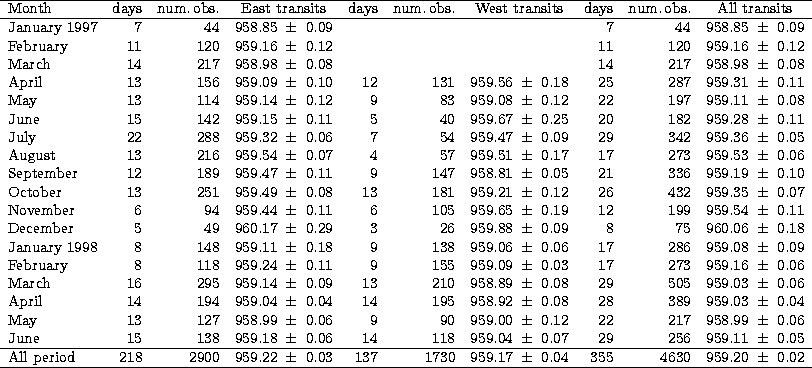 |
In the Table 1, number of the days of observation, total number of observations during a month and monthly averages are presented, both splitting East and West observations and combining them together. An analysis on the average values was already presented (Jilinski et al. 1998) and a forthcoming paper discussing the jointly results obtained in Calern and at ON is in preparation.
The complete results of the daily series can be retrieved in electronic form from the SIMBAD database and from the homepage of the Observatório Nacional (http://obsn.on.br/radius/). For the electronic form, the complete daily series are given: the number of observations, the semi-diameter mean value, its rms error, the date, the Modified Julian Date and the error for a single observation. The data are given for eastern and western observations separately.
In spite of the hard weather conditions of the observations, the instrument performed rather stably. No dependence was found for the observed semi-diameter on zenith distance, time length of observations (that vary from 2 to 7 min), azimuth or heliographic latitude of CCD scan across the Sun disc.
Copyright The European Southern Observatory (ESO)