

 . Using a geometric series top-up in this
L
range would certainly lead to a significant overestimate of the total collision
strength at the high energies. At 100 Ryd, say,
it is only for L>30 that the top-up procedure can be safely
implemented, and the latter amounts to a barely acceptable 20%
of the total collision strength.
In Fig. 2 the total collision strength for this transition is plotted using the
reduced energy method of BT. A further difficulty with this transition
becomes apparent: for the non-resonant region the collision strength,
rather than flattening out as in most quadrupole transitions, displays a slow
increase. As discussed before, this effect makes the management of the
convergence of the partial wave expansion
particularly difficult at the high
energies.
It also causes difficulties in determining the high-temperature trend of the
effective collision strength as will be shown below. The present reduced
collision strength seems to converge
to the point
. Using a geometric series top-up in this
L
range would certainly lead to a significant overestimate of the total collision
strength at the high energies. At 100 Ryd, say,
it is only for L>30 that the top-up procedure can be safely
implemented, and the latter amounts to a barely acceptable 20%
of the total collision strength.
In Fig. 2 the total collision strength for this transition is plotted using the
reduced energy method of BT. A further difficulty with this transition
becomes apparent: for the non-resonant region the collision strength,
rather than flattening out as in most quadrupole transitions, displays a slow
increase. As discussed before, this effect makes the management of the
convergence of the partial wave expansion
particularly difficult at the high
energies.
It also causes difficulties in determining the high-temperature trend of the
effective collision strength as will be shown below. The present reduced
collision strength seems to converge
to the point  which is in reasonable
agreement (
which is in reasonable
agreement ( %) with the high-energy Coulomb-Born limit of 1.64
estimated by BCT.
%) with the high-energy Coulomb-Born limit of 1.64
estimated by BCT.
![\begin{figure}
\begin{center}
\includegraphics [width=8.5cm]{1564f1.eps}
\end{center}\end{figure}](/articles/aas/full/1998/20/ds1564/img31.gif) |
Figure 1:
Partial collision strength for the  D D  S transition in Ar III
as a function of the total orbital angular momentum L. Squares: 10 Ryd.
Circles: 100 Ryd S transition in Ar III
as a function of the total orbital angular momentum L. Squares: 10 Ryd.
Circles: 100 Ryd |
![\begin{figure}
\begin{center}
\includegraphics [width=8.5cm]{1564f2.eps}
\end{center}\end{figure}](/articles/aas/full/1998/20/ds1564/img32.gif) |
Figure 2:
Total collision strength for the D S transition in Ar III plotted as a function
of the reduced energy with C=9.0. It is seen that the non-resonant
region increases slowly and approaches the point |
![\begin{figure}
\begin{center}
\includegraphics [width=8.5cm]{1564f3.eps}
\end{center}\end{figure}](/articles/aas/full/1998/20/ds1564/img33.gif) |
Figure:
Effective collision strength for the D S transition in Ar III as a function of the
reduced
temperature with a) C=0.2 and b) C=5.0.
Circles: present calculation.
Squares: IP-X. Crosses:
Johnson & Kingston (1990). Filled square: High-energy
Coulomb-Born limit by BCT |
In Fig. 3 the present reduced effective collision strength is compared
with earlier work, and in Table 1 we list the present effective collision
strength in the extended range of 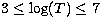 and compare them with
the data by IP-X. It may be seen that
the low-temperature regime is dominated by the
contribution from resonances (see Fig. 2), particularly a resonance sitting
at threshold that is responsible for the high value of
and compare them with
the data by IP-X. It may be seen that
the low-temperature regime is dominated by the
contribution from resonances (see Fig. 2), particularly a resonance sitting
at threshold that is responsible for the high value of  .
.
 |
 , they are well below 20% up to
  and they
reach
and they
reach
 % only towards the upper limit of the temperature range considered in
IP-X. In our opinion, such differences are consistent with the level of
accuracy (
% only towards the upper limit of the temperature range considered in
IP-X. In our opinion, such differences are consistent with the level of
accuracy ( %) claimed in IP-X for the lower members of the
Si and S isoelectronic sequences. Furthermore, it is found that
the fairly steep climb of the reduced effective collision strength to its
high-temperature limiting value of
%) claimed in IP-X for the lower members of the
Si and S isoelectronic sequences. Furthermore, it is found that
the fairly steep climb of the reduced effective collision strength to its
high-temperature limiting value of
 only starts at relatively high temperatures,
and
certainly stands out from the gently oscillating patterns at intermediate
temperatures. As shown in Fig. 3, the characteristic features in each
temperature regime can be enhanced by a suitable choice of the scaling
parameter C. For instance, in Fig. 3b we have used a C parameter
similar to that used by BCT which stretches the low-temperature
regime suggesting a value of
only starts at relatively high temperatures,
and
certainly stands out from the gently oscillating patterns at intermediate
temperatures. As shown in Fig. 3, the characteristic features in each
temperature regime can be enhanced by a suitable choice of the scaling
parameter C. For instance, in Fig. 3b we have used a C parameter
similar to that used by BCT which stretches the low-temperature
regime suggesting a value of  for IP-X; with this
choice
of scaling parameter the high-temperature behaviour of the present data
appears almost as a vertical climb. It is worth mentioning that an estimate
of the effective collision strengths for
T>106.5 K requires an energy range greater than 100 Ryd.
Therefore a top-up procedure was introduced where the collision strength for
E>100 Ryd was assumed constant at
for IP-X; with this
choice
of scaling parameter the high-temperature behaviour of the present data
appears almost as a vertical climb. It is worth mentioning that an estimate
of the effective collision strengths for
T>106.5 K requires an energy range greater than 100 Ryd.
Therefore a top-up procedure was introduced where the collision strength for
E>100 Ryd was assumed constant at  .
.
Copyright The European Southern Observatory (ESO)