

An internal instrumental magnitude was computed from the measured density of each exposure. For this purpose, the volume under each Gaussian was considered and an internal instrumental magnitude was defined as

where 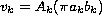 , Ak being the peak density of
the k-th exposure in the triple image, and ak,bk the semiaxes of
the elliptical contour. But this is true only in the case of non-saturated
images for which a Gaussian model is correct.
, Ak being the peak density of
the k-th exposure in the triple image, and ak,bk the semiaxes of
the elliptical contour. But this is true only in the case of non-saturated
images for which a Gaussian model is correct.
For saturated images it happens that the volume of the fitted Gaussian is smaller than the one which would correspond to a linear detector without saturation because the image is, in some way, cut by the saturation limit of the plate.
Let us suppose that we have a Gaussian
and that we cut it in two parts at a certain height h. The ratio between the
volume of the "lower'' part, V, and the total one,  , is
found to be:
, is
found to be:

where h is the truncation height and the total height is assumed to be 1.
This allows to obtain the "true'' Gaussian volume in the
case of saturated (truncated) images as a function of the plate saturation
peak (truncation)  , the image area a, and the measured
volume V:
, the image area a, and the measured
volume V:

This is an estimation of the volume which can be
used in the evaluation of the
internal magnitude when dealing with saturated images. The measured
volume V is a Gaussian one, corresponding to the volume under a bivariate
Gaussian: It is the semimajor times the semiminor image axis times maximum
amplitude of image peak density. We are interested also in comparing the
magnitudes estimated from V (uncorrected) and the ones from
(corrected).
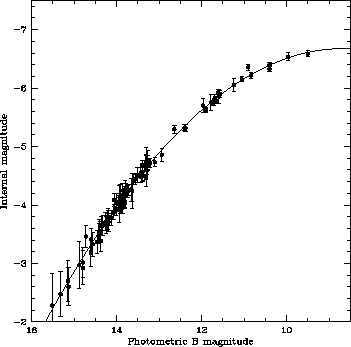
Figure 11: Magnitude calibration using the measured internal magnitudes
and a photometric sequence
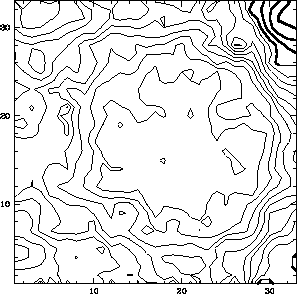
Figure 12: Contour plot of different background levels. Thicker lines
correspond to larger values. The non-uniformity of the background across the
plate is obvious, as well as the large inhomogeneity toward the plate edges
The photometric reduction was performed with 102 stars from the SIMBAD
data base which have been identified in the plate. More than  of these
data comes from a work by Eggen & Sandage (1964), which
ensures that we are dealing with a mostly homogeneous sample.
of these
data comes from a work by Eggen & Sandage (1964), which
ensures that we are dealing with a mostly homogeneous sample.
A second order polynomial was used to fit the data and
accuracies of  (case of
uncorrected magnitudes) and
(case of
uncorrected magnitudes) and
 (when
corrected magnitudes are introduced) were
obtained. A total of two outliers and seven poor quality stars were removed
from the sample prior to the fitting. An analysis of these poor quality stars
revealed that six of them are the brightest stars in the sample located at a
distance from the plate center larger than 4.7 cm, where optical aberrations
produce important distortions on the images. The seventh one removed is the
brightest star in the whole sample. As the method of corrected volumes relies
on the proper estimation of the image area, it is very sensitive to distorted
cases such as the ones just described. Thus, a wrong estimation of the image
area produces a wrong estimation of the correction to the image volume and this
method cannot deal with these pathological cases.
The method of corrected magnitudes constitutes an experimental model
which forces the calibration curve to be closer to linear at the bright end
and may be used if such a property were essential. In
Fig. 11 (click here) we show how the fitting looks like when using uncorrected
magnitudes, after dropping off the seven problematic cases. The error bars in
this figure are the propagated errors of the profile parameter errors.
(when
corrected magnitudes are introduced) were
obtained. A total of two outliers and seven poor quality stars were removed
from the sample prior to the fitting. An analysis of these poor quality stars
revealed that six of them are the brightest stars in the sample located at a
distance from the plate center larger than 4.7 cm, where optical aberrations
produce important distortions on the images. The seventh one removed is the
brightest star in the whole sample. As the method of corrected volumes relies
on the proper estimation of the image area, it is very sensitive to distorted
cases such as the ones just described. Thus, a wrong estimation of the image
area produces a wrong estimation of the correction to the image volume and this
method cannot deal with these pathological cases.
The method of corrected magnitudes constitutes an experimental model
which forces the calibration curve to be closer to linear at the bright end
and may be used if such a property were essential. In
Fig. 11 (click here) we show how the fitting looks like when using uncorrected
magnitudes, after dropping off the seven problematic cases. The error bars in
this figure are the propagated errors of the profile parameter errors.
One can compare the accuracy obtained here,
with the accuracy in
Eggen & Sandage paper, which is
 . It is
clear that
. It is
clear that  is negligible in comparison
with
is negligible in comparison
with  , therefore one can state that the main sources of the found
rms error
, therefore one can state that the main sources of the found
rms error  must be related to the quality of our CdC plate and to the
specific reduction method described here.
must be related to the quality of our CdC plate and to the
specific reduction method described here.