

This is Nova Cru 1935. It is a poorly known object discovered as a variable
in 1935 and later reclassified as a nova, but without a spectroscopic
confirmation (D87). The H in moderate emission in our spectrum is
very sharp, its width not exceeding the instrumental PSF and very unlike
those of the validated CVs (cf. Fig. 3).
in moderate emission in our spectrum is
very sharp, its width not exceeding the instrumental PSF and very unlike
those of the validated CVs (cf. Fig. 3).
| Name | Continuum Fluxes | ||||||||||
| 3450 | 3750 | 4000 | 4400 | 4800 | 5200 | 5600 | 6000 | 7050 | 8000 | 8800 | |
| V650 Ori | 1.22 | 1.22 | 1.12 | 1.00 | 0.47 | 0.95 | 0.48 | ||||
| DE Cnc | 0.69 | 0.78 | 1.02 | 1.20 | 1.00 | 1.24 | 1.28 | 1.21 | 1.08 | 0.93 | |
| 1H 1025+220 | 2.53 | 1.92 | 1.75 | 1.38 | 1.14 | 1.00 | 0.85 | 0.74 | 0.53 | 0.40 | 0.32 |
| V442 Cen | 0.77 | 1.15 | 1.17 | 1.09 | 1.00 | 0.88 | 0.74 | 0.51 | |||
| PG 1157+004 | 1.90 | 1.76 | 1.57 | 1.30 | 1.05 | 1.00 | 0.86 | 0.72 | 0.51 | 0.38 | 0.28 |
| IM Com | 0.43 | 0.89 | 0.99 | 0.94 | 1.18 | 1.00 | 0.93 | 0.92 | 0.74 | 0.58 | 0.45 |
| AP Cru | 0.05 | 0.11 | 0.18 | 0.58 | 0.76 | 1.00 | 1.32 | 1.44 | 1.72 | 2.02 | 1.98 |
| V485 Cen | 1.86 | 1.67 | 1.39 | 1.00 | 0.83 | 1.00 | 0.79 | 0.71 | 0.69 | 0.57 | 0.43 |
| PG 1510+234 | 2.27 | 1.96 | 1.81 | 1.46 | 1.17 | 1.00 | 0.85 | 0.73 | 0.51 | 0.39 | 0.30 |
| EK TrA | 2.86 | 2.64 | 1.64 | 1.16 | 0.92 | 1.00 | 0.80 | 0.72 | 0.79 | 0.55 | 0.43 |
| PG 1522+122 | 2.97 | 2.54 | 2.34 | 1.69 | 1.27 | 1.00 | 0.78 | 0.63 | 0.36 | 0.25 | 0.18 |
| BR Lup | 3.29 | 2.55 | 1.61 | 1.19 | 0.99 | 1.00 | 0.89 | 0.79 | 0.82 | 0.70 | 0.40 |
| IM Nor | 1.03 | 1.16 | 0.43 | 0.93 | 1.00 | 1.18 | 1.99 | 3.93 | |||
| HP Nor | 2.03 | 1.72 | 1.61 | 1.37 | 1.14 | 1.00 | 0.87 | 0.76 | 0.60 | 0.48 | 0.37 |
| IK Nor | 1.88 | 1.69 | 0.96 | 0.81 | 0.84 | 1.00 | 1.05 | 1.13 | 1.44 | 1.55 | 1.39 |
| KQ Nor | 0.17 | 0.24 | 0.49 | 0.67 | 0.99 | 1.00 | 1.17 | 1.23 | 1.23 | 1.15 | 0.99 |
| LR Nor | 0.27 | 0.45 | 0.67 | 0.81 | 0.96 | 1.00 | 1.11 | 1.18 | 1.13 | 1.10 | 0.84 |
| PG 1633+115 | 1.72 | 1.50 | 1.65 | 1.41 | 1.17 | 1.00 | 0.86 | 0.73 | 0.53 | 0.41 | 0.32 |
| AC Sco 1 | 0.14 | 0.25 | 0.48 | 0.72 | 0.95 | 1.00 | 1.09 | 1.12 | 1.03 | 0.92 | 0.76 |
| AC Sco 2 | 0.15 | 0.28 | 0.45 | 0.61 | 0.87 | 1.00 | 1.19 | 1.32 | 1.48 | 1.56 | 1.49 |
| HO Del | 1.95 | 1.95 | 1.33 | 1.11 | 1.02 | 1.00 | 0.89 | 0.86 | 0.81 | 0.64 | 0.49 |
The object has been observed close to an outburst maximum, with the only
emission being a faint core in the H profile.
This object too has been observed during an outburst phase, half-way between maximum and quiescence as suggested by the spectral appearance and the V magnitude in Table 6 (click here). The classification among the Z Cam sub-class in DS93 could indicate that we have observed HP Nor during a stand-still phase.
The spectrum is classified as a white dwarf of the DA type. A negative
detection at  (
( mag) was reported in Paper I. Photometry
in Table 6 (click here) fits well the entries in the PG catalogue
(Green et al. 1986),
arguing against photometric variability.
mag) was reported in Paper I. Photometry
in Table 6 (click here) fits well the entries in the PG catalogue
(Green et al. 1986),
arguing against photometric variability.
Remarkable spectrum with He I lines rivaling in intensity with hydrogen, a
chemical abundance effect. Augusteijn et al. (1996) argued
for a 59 orbital period, thus our 60 exposure
spectrum looks as a perfect average over the orbital period. The suggestion
by Augusteijn et al. about contribution to the system emission by the
secondary star in the red part of the spectrum is confirmed by the color
progression in our Table 6 (click here). Tutukov & Yungelson
(1996) has modeled the ultra-short orbital period binaries like V485
Cen as helium white dwarf donors and carbon-oxygen WD accretors, with
important implications for supernovae and accretion induced collapses.
orbital period, thus our 60 exposure
spectrum looks as a perfect average over the orbital period. The suggestion
by Augusteijn et al. about contribution to the system emission by the
secondary star in the red part of the spectrum is confirmed by the color
progression in our Table 6 (click here). Tutukov & Yungelson
(1996) has modeled the ultra-short orbital period binaries like V485
Cen as helium white dwarf donors and carbon-oxygen WD accretors, with
important implications for supernovae and accretion induced collapses.
The object has been photometrically confirmed as a dwarf nova with a short
outburst cycle length by Iida et al. (1995), with a range in
V between 14.8 and 17.9 mag. Our spectrum shows an H in moderate
emission and an emission core inside a broad absorption for higher Balmer
lines which is appropriate for a CV halfway between outburst maximum and
quiescence, as supported by the V=16.3 mag we measured on our spectrum.
Haefner (1995) reported the object does not show flickering activity. Our photometry in Table 6 (click here) is quite close to that reported in the PG catalogue (Green et al. 1986), suggesting limited or no variability. Our spectrum resembles that of a late sdB (HeI 4471 Å weakly present).
| Name | Classification |
| V650 Ori | cool cont. |
| DE Cnc | cool cont. |
| 1H 1025+220 | CV |
| V442 Cen | CV |
| PG 1157+004 | WD (DA) |
| IM Com | cool cont. |
| AP Cru | K7 + H em. |
| V485 Cen | CV |
| PG 1510+234 | CV |
| EK TrA | CV |
| PG 1522+122 | sdB |
| BR Lup | CV |
| IM Nor | K: |
| HP Nor | CV |
| IK Nor | CV |
| KQ Nor | K3 III |
| LR Nor | G2 II : |
| PG 1633+115 | CV |
| AC Sco 1 | F8 V |
| AC Sco 2 | G5 V |
| HO Del | CV |
| Name | V | U-B | B-V |  |  |
| V650 Ori | 20.25 | 0.40 | 0.42 | ||
| DE Cnc | 18.16 | 0.47 | 0.76 | 0.51 | 0.58 |
| 1H 1025+220 | 16.44 | -0.81 | 0.09 | 0.20 | 0.17 |
| V442 Cen | 12.25 | 0.19 | 0.37 | 0.11 | |
| PG 1157+004 | 15.81 | -0.70 | 0.17 | 0.16 | 0.15 |
| IM Com | 18.07 | 0.06 | 0.56 | 0.34 | 0.37 |
| AP Cru | 18.68 | 0.60 | 1.37 | 0.79 | 0.98 |
| V485 Cen | 18.06 | -0.81 | 0.29 | 0.29 | 0.46 |
| PG 1510+234 | 16.27 | -0.72 | 0.06 | 0.17 | 0.13 |
| EK TrA | 16.50 | -1.09 | 0.05 | 0.39 | 0.41 |
| PG 1522+122 | 16.44 | -0.84 | -0.15 | 0.02 | -0.13 |
| BR Lup | 18.42 | -1.18 | 0.15 | 0.41 | 0.49 |
| IM Nor | 20.03 | 1.47 | 1.22 | 1.48 | |
| HP Nor | 14.18 | -0.75 | 0.15 | 0.24 | 0.30 |
| IK Nor | 17.58 | -1.03 | 0.69 | 0.69 | 0.89 |
| KQ Nor | 13.71 | 0.83 | 1.08 | 0.58 | 0.64 |
| LR Nor | 18.28 | 0.29 | 0.92 | 0.55 | 0.62 |
| PG 1633+115 | 15.95 | -0.58 | 0.13 | 0.19 | 0.19 |
| AC Sco 1 | 13.95 | 0.86 | 1.02 | 0.51 | 0.53 |
| AC Sco 2 | 17.18 | 0.66 | 1.19 | 0.70 | 0.82 |
| HO Del | 17.82 | -0.86 | 0.26 | 0.41 | 0.45 |
Elliot & Liller (1972) reviewed the available very scanty photometric
data on IM Nor  Nova Nor 1920, which rose to mag 9 and
lingered there for at least a couple of months. No spectroscopic information
collected during the eruption is available. Our spectrum refers to the star
marked in the finding chart by D87 and is quite featureless, possibly a K
star. We measure B=21.5 on our spectrum, which is quite close to the
eye-estimated mag = 22j by D87 on the SRC plates. The faintness (and
therefore distance), very red colors and low galactic latitude (
Nova Nor 1920, which rose to mag 9 and
lingered there for at least a couple of months. No spectroscopic information
collected during the eruption is available. Our spectrum refers to the star
marked in the finding chart by D87 and is quite featureless, possibly a K
star. We measure B=21.5 on our spectrum, which is quite close to the
eye-estimated mag = 22j by D87 on the SRC plates. The faintness (and
therefore distance), very red colors and low galactic latitude ( ) all suggest significant reddening. The strongest absorption line
in the spectrum is in fact the (interstellar) NaI D at
) all suggest significant reddening. The strongest absorption line
in the spectrum is in fact the (interstellar) NaI D at  Å.
Å.
A CV-like emission line spectrum with the TiO bands of the secondary star
well visible in the red. The red-peaked energy distribution of the secondary and
a low relative brightness of the disk may explain the slope of the continuum
and the red colors in Table 6 (click here). Interstellar reddening does not seem to play
an appreciable role due to the absence of NaI D absorption at  Å.
Å.
The spectra of Ringwald (1993) show weak H emission and even weaker
H absorption. Our spectrum presents emission cores in broad H,
H
absorption. Our spectrum presents emission cores in broad H,
H and H
and H absorptions and a full emission H of
moderate intensity. Misselt & Shafter (1995) reported short term
absorptions and a full emission H of
moderate intensity. Misselt & Shafter (1995) reported short term
 mag variability of PG 1633+115 with periods
 and wider
  variability over weeks.
The object looks as a genuine CV observed possibly far from flat quiescence
conditions.
variability over weeks.
The object looks as a genuine CV observed possibly far from flat quiescence
conditions.
The star marked in DS93 is an optical double. We observed both objects.
The brighter star is classified as F8 V. The fainter one  arcsec
to the south of the bright one is a G5 V.
arcsec
to the south of the bright one is a G5 V.
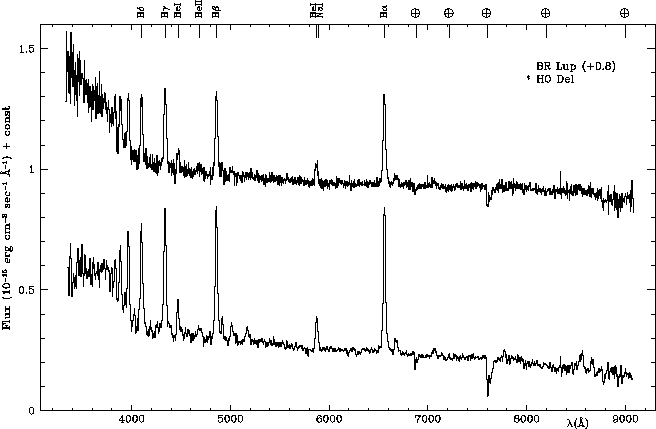
Figure 4: Spectra of BR Lup and HO Del. The offset applied for plot clarity
is given in brackets next to the star name. The spectra are not corrected for
reddening. The asterisk means that a boxcar smoothing (3 pixels window) has
been applied. Fluxes in units of 10-15 erg cm-2 s-1 Å-1
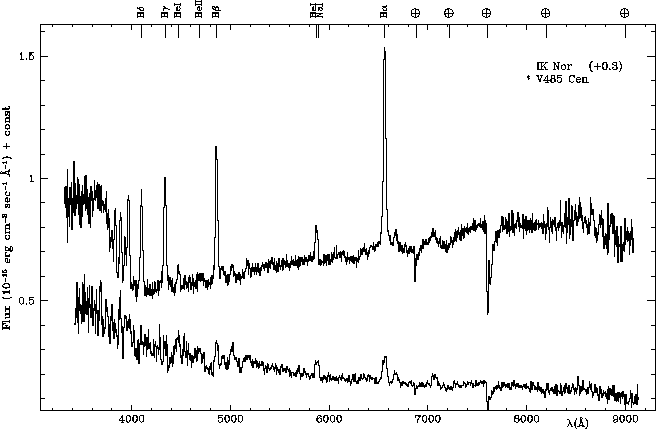
Figure 5: Spectra of IK Nor and V485 Cen. The offset applied for plot clarity
is given in brackets next to the star name. The spectra are not corrected for
reddening. The asterisk means that a boxcar smoothing (3 pixels window) has
been applied. Fluxes in units of 10-15 erg cm-2 s-1 Å-1
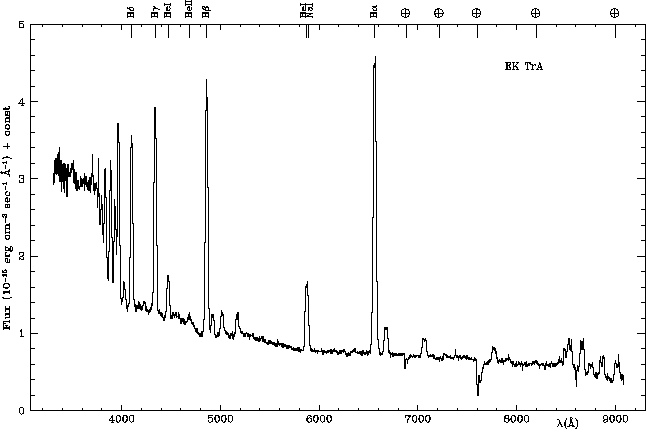
Figure 6: Spectrum of EK TrA (not corrected for reddening).
Fluxes in units of 10-15 erg cm-2 s-1 Å-1
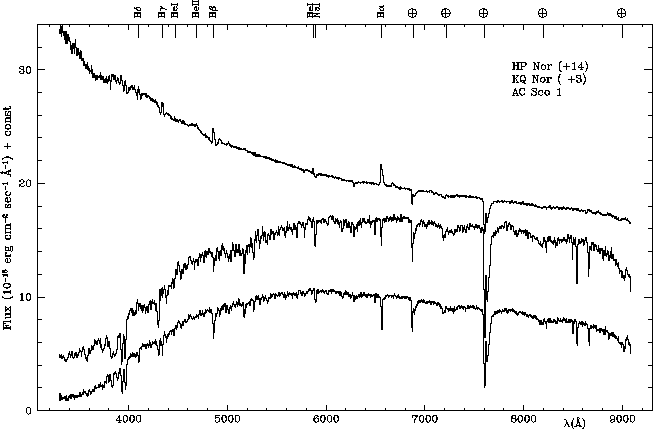
Figure 7: Spectra of HP Nor, KQ Nor and AC Sco #1. The offset applied
for plot clarity is given in brackets next to the star name. The spectra
are not corrected for reddening. Fluxes in units
of 10-15 erg cm-2 s-1 Å-1
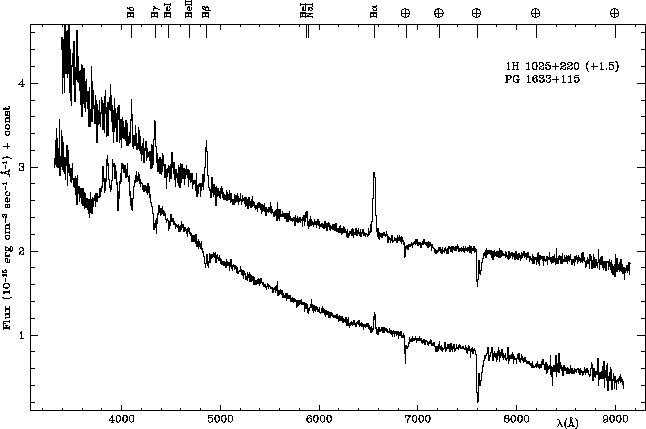
Figure 8: Spectra of 1H 1025+220 and PG 1633+115.
The offset applied for plot clarity
is given in brackets next to the star name. The spectra are not corrected for
reddening. Fluxes in units of 10-15 erg cm-2 s-1 Å-1
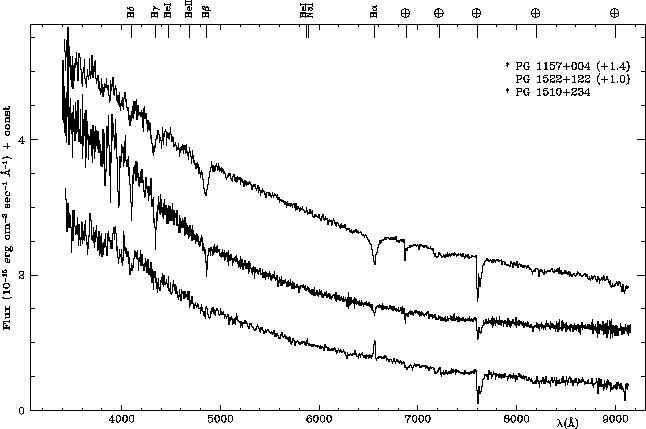
Figure 9: Spectra of PG 1157+004, PG 1522+122 and PG 1510+234.
The offset applied for plot clarity
is given in brackets next to the star name. The spectra are not corrected for
reddening. The asterisk means that a boxcar smoothing (3 pixels window) has
been applied. Fluxes in units of 10-15 erg cm-2 s-1 Å-1
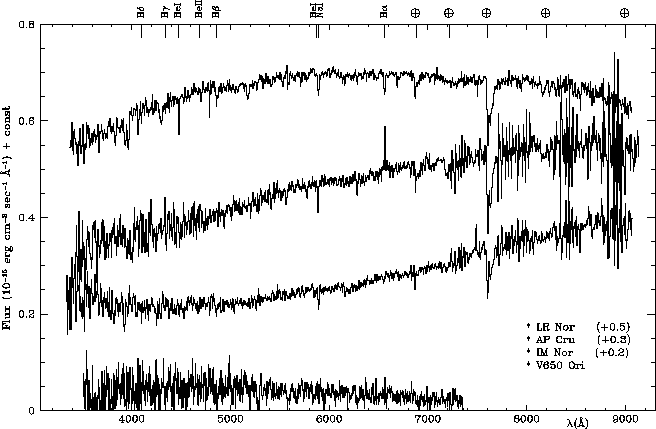
Figure 10: Spectra of LR Nor, AP Cru, IM Nor and V650 Ori.
The offset applied for plot clarity
is given in brackets next to the star name. The spectra are not corrected for
reddening. The asterisk means that a boxcar smoothing (3 pixels window) has
been applied. Fluxes in units of 10-15 erg cm-2 s-1 Å-1
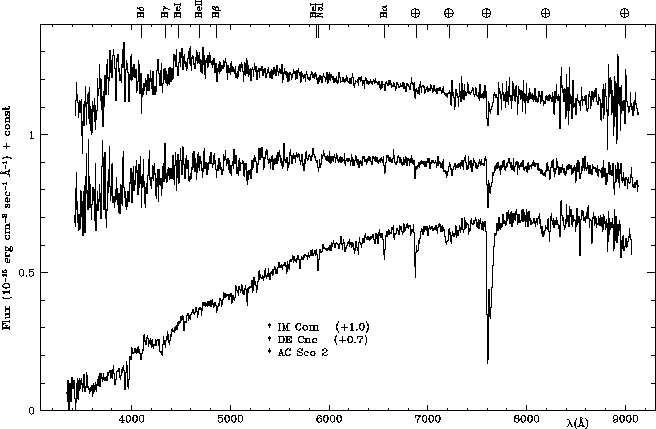
Figure 11: Spectra of IM Com, DE Cnc and AC Sco #2.
The offset applied for plot clarity
is given in brackets next to the star name. The spectra are not corrected for
reddening. The asterisk means that a boxcar smoothing (3 pixels window) has
been applied. Fluxes in units of 10-15 erg cm-2 s-1 Å-1
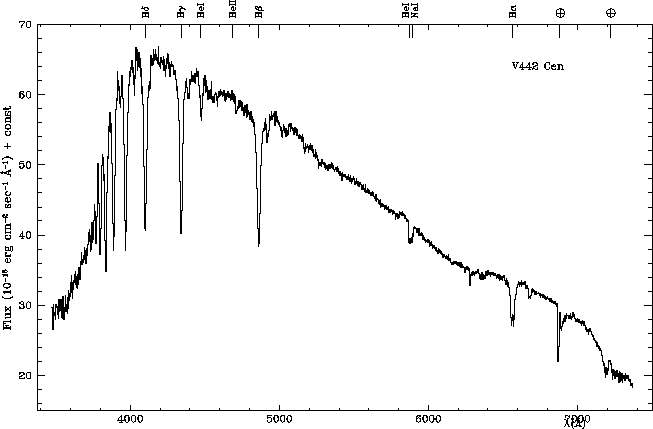
Figure 12: Spectrum of V442 Cen.
Fluxes in units of 10-15 erg cm-2 s-1 Å-1