

Differential data were calculated only when the time interval between the measurements between the comparison(s) and the programme star was short enough, usually well under 15 minutes. It was found that the differential data consistently provided slightly cleaner light curves than the absolute data.
Ap stars are normally characterized by very regular periodic
variations which can be
fitted by simple Fourier series (see Manfroid & Renson 1994)

where m is the magnitude, P the fundamental period, I the total number of harmonics, t the time and t0 the origin of time.
A nice fit is generally obtained with two components, though
a few stars are known to need 3 components -- e.g.,
52 Oph, 27G. Car, 25 Sex,  Scl (Manfroid & Renson 1994)
and TW Col (Renson & Manfroid 1992a) - or even 4 components
as 46 Eri (Manfroid & Renson 1989) and VV Scl (Renson & Manfroid 1992b).
Scl (Manfroid & Renson 1994)
and TW Col (Renson & Manfroid 1992a) - or even 4 components
as 46 Eri (Manfroid & Renson 1989) and VV Scl (Renson & Manfroid 1992b).
In all cases where high-order series have been derived, the third- or fourth-order components are small and a large number of accurate measurements were necessary to bring them out. On the other hand, the fundamental and the first overtone are larger and often of comparable amplitudes. In those rare instances where variations can be adequately described with a single cosine, it is often the first overtone which dominates the fundamental, yielding a symmetrical double wave (see, e.g., HD 83366, Mathys et al. 1985). These considerations show that a two-component series is well suited to analyze our data sets. The number of observations per free parameter in Eq. (1) is between 3 and 5, which is adequate.
The parameters of the light curve were obtained by a least-squares method. The value of the period itself was estimated through two usual methods: (1) by looking for the minimum of the chi-square merit function over a set of trial periods (see, e.g., Manfroid & Renson 1996; Manfroid & Mathys 1997), and (2) by using the period-searching algorithm proposed by Renson (1978, 1980). The final values were checked by visual inspection of the phase diagrams.
As expected from measurements taken every night at about the same hour the periodograms are strongly affected by aliasing phenomena. We found convenient to compare those periodograms with those of simulated data including a single periodic signal. Simulations were built for each of the suspected periods, and they were sampled exactly as the actual data. This provided a help for discarding spurious periods. There are nevertheless several stars for which we could not make unambiguous choice.
More than half the stars have shown clear variations within the time span of the observations. For nine stars, periodicities could be derived. The remaining stars have either too low an amplitude, or too long a period.
Table 2 (click here) lists the periods obtained (with plausible aliases for some stars) as well as some major characteristics of the variations: (1) the total amplitude in the most variable of the 17 lightcurves, as derived from the analytical model, and (2) the ratio of the total amplitude divided by the standard deviation of the residuals in the magnitude or color index where this ratio is the largest. The latter quantity shows which of the 17 lightcurves is the cleanest. (Our coding of the Geneva magnitudes or indices is given in Table 3 (click here)).
Beside these 9 stars, HD 9529, 187039, 187752, 191857 and 222561, showed signs of variability, but no definite period could be found.
The detailed tables containing all the parameters of the lightcurves are stored in digital form at the CDS. HD 8717 is presented in Table 4 (click here) as an example.
A few selected lightcurves are
presented in Fig. 1 (click here). All curves ( ) are also to be found
at the CDS.
) are also to be found
at the CDS.
| HD | Period (error) | aliases | range | i | S/N | j | |
| 8717 | 2.15 (0.01) | 0.685 | 0.0427 | 13 | 8.07 | 1 | |
| 188309 | 0.905 (0.01) | 10.0/1.115 | 0.0714 | 8 | 8.08 | 8 | |
| 191439 | 3.24 (0.03) | 0.0480 | 11 | 8.38 | 9 | ||
| 192674 | 4.45 (0.05) | 0.82/1.28/8.9 | 0.0258 | 8 | 4.45 | 10 | |
| 192687 | 1.19 (0.01) | 6.25 | 0.0921 | 8 | 10.21 | 8 | |
| 194750 | 2.26 (0.01) | 0.688/4.48 | 0.0433 | 8 | 5.63 | 10 | |
| 195112 | 1.82 (0.01) | 0.0561 | 8 | 8.25 | 8 | ||
| 200623 | 2.18 (0.01) | 0.684/1.85 | 0.0526 | 17 | 11.68 | 17 | |
| 207259 | 2.16 (0.01) | 0.681/4.31 | 0.0527 | 17 | 13.77 | 17 | |
|
|
| 1 | V | ||||||
| 2 | U-B | ||||||
| 3 | V-B | ||||||
| 4 | B1-B | ||||||
| 5 | B2-B | ||||||
| 6 | V1-B | ||||||
| 7 | G-B | ||||||
| 8 | U | ||||||
| 9 | B | ||||||
| 10 | B1 | ||||||
| 11 | B2 | ||||||
| 12 | V1 | ||||||
| 13 | G | ||||||
| 14 | B1-B2 | ||||||
| 15 | B2-V1 | ||||||
| 16 | V1-G | ||||||
| 17 | B1-V1 | ||||||
|
|
| HD 8717 |  |  | |||||
| B1 | B2 |  |  |  | r | S/N | |
| 1 | 0.0130 (0.0017) | 0.0051 (0.0018) | 4.00 (0.13) | 5.92 (0.32) | 0.0038 | 0.0309 | 8.07 |
| 2 | 0.0049 (0.0013) | 0.0051 (0.0014) | 2.67 (0.25) | 0.40 (0.25) | 0.0058 | 0.0175 | 3.03 |
| 3 | 0.0078 (0.0013) | 0.0036 (0.0014) | 4.02 (0.16) | 5.87 (0.35) | 0.0040 | 0.0193 | 4.84 |
| 4 | 0.0027 (0.0013) | 0.0008 (0.0014) | 1.44 (0.37) | 0.45 (1.52) | 0.0040 | 0.0059 | 1.50 |
| 5 | 0.0028 (0.0017) | 0.0028 (0.0018) | 3.52 (0.57) | 0.02 (0.46) | 0.0044 | 0.0094 | 2.14 |
| 6 | 0.0077 (0.0013) | 0.0047 (0.0014) | 3.83 (0.17) | 5.11 (0.27) | 0.0041 | 0.0205 | 5.01 |
| 7 | 0.0102 (0.0017) | 0.0080 (0.0018) | 4.12 (0.16) | 0.05 (0.16) | 0.0056 | 0.0314 | 5.66 |
| 8 | 0.0080 (0.0026) | 0.0063 (0.0027) | 3.34 (0.27) | 0.26 (0.36) | 0.0067 | 0.0225 | 3.34 |
| 9 | 0.0052 (0.0021) | 0.0015 (0.0023) | 3.97 (0.41) | 6.04 (1.25) | 0.0031 | 0.0117 | 3.76 |
| 10 | 0.0033 (0.0017) | 0.0022 (0.0018) | 3.49 (0.47) | 0.00 (0.56) | 0.0041 | 0.0093 | 2.29 |
| 11 | 0.0078 (0.0021) | 0.0042 (0.0023) | 3.81 (0.27) | 6.21 (0.39) | 0.0054 | 0.0208 | 3.81 |
| 12 | 0.0129 (0.0013) | 0.0057 (0.0014) | 3.89 (0.10) | 5.32 (0.23) | 0.0048 | 0.0309 | 6.47 |
| 13 | 0.0153 (0.0013) | 0.0094 (0.0014) | 4.07 (0.08) | 0.00 (0.10) | 0.0053 | 0.0427 | 8.05 |
| 14 | 0.0047 (0.0017) | 0.0020 (0.0018) | 0.90 (0.36) | 2.99 (0.70) | 0.0053 | 0.0116 | 2.20 |
| 15 | 0.0052 (0.0013) | 0.0045 (0.0014) | 0.85 (0.25) | 1.36 (0.26) | 0.0054 | 0.0157 | 2.91 |
| 16 | 0.0035 (0.0013) | 0.0077 (0.0014) | 1.65 (0.27) | 3.80 (0.17) | 0.0061 | 0.0199 | 3.28 |
| 17 | 0.0099 (0.0017) | 0.0048 (0.0018) | 0.88 (0.17) | 1.79 (0.32) | 0.0061 | 0.0223 | 3.67 |
is
the scatter around the least-squares fit. r is the total
range of the analytical light curve. S/N is the signal-to-noise ratio
defined as the total range divided into the
scatter. Similar tables for the other stars are available from
the CDS archive
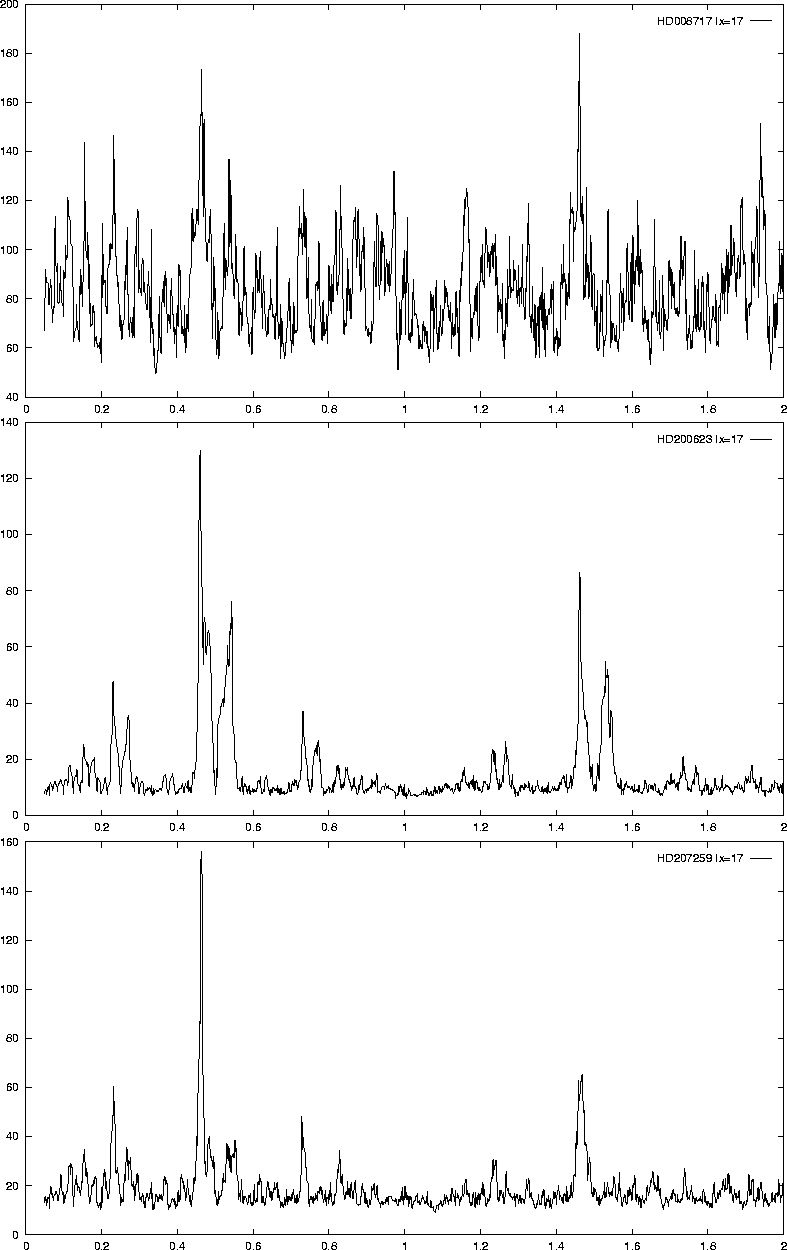
Figure 1: Periodogrammes for the differential data
of HD 8717, 200623 and 207259 in B1-V1.
The parameter plotted is Renson's  . The horizontal
axis is the frequency in d-1. These stars
have the peculiarity of showing almost exactly
the same period
. The horizontal
axis is the frequency in d-1. These stars
have the peculiarity of showing almost exactly
the same period  . The noise level and the relative
importance of the various aliases differ from star to star.
The complete set of periodogrammes is available at the CDS
. The noise level and the relative
importance of the various aliases differ from star to star.
The complete set of periodogrammes is available at the CDS