

A. Description of observed stars
In recent work it has been shown that the mass loss rate in the red giant branch appears to be higher than previously thought (Zuckerman et al. 1995). Most of the objects observed in our survey are normal giants showing a far-infrared emission typical of circumstellar dust. In Table 2 (click here) we list the 20 normal giants showing a faint Li line. The 57 normal stars, with no Li line, are listed in Table 3 (click here).
| IRAS name | identification | S.T. | mV | W(Li) | W(Li)/W(Ca) |
| 01504+5953 | DO24938 | M3 | 0.05 | 0.32 | |
| 02401+8139 | SAO432 | K2 | 8.5 | 0.10 | 0.43 |
| 03396+5111 | SAO24181 | K7 | 8.5 | 0.08 | 0.36 |
| 05505+0932 | SAO113234 | K2 | 8.1 | 0.03 | 0.13 |
| 07365-1923 | 0.10 | 0.20 | |||
| 12100-6952 | S Mus | 0.01 | 0.05 | ||
| 13027-6024A | 0.09 | 0.08 | |||
| 14262-5805 | CGCS2163 | 0.04 | 0.33 | ||
| 16583-0408 | BSC6318 | K4I | 4.8 | 0.06 | 0.28 |
| 17464+6739 | 0.01 | 0.25 | |||
| 18232+0800 | BSC6902 | G8I | 5.6 | 0.01 | 0.05 |
| 18416+0232 | 0.03 | 0.30 | |||
| 18453+1949 | SAO104107 | K3 | 8.0 | 0.06 | 0.23 |
| 19019-1039A | 0.01 | 0.06 | |||
| 19246+2826 | DY Cyg | 0.01 | 0.48 | ||
| 19425+4939 | SAO48778 | K0 | 7.6 | 0.06 | 0.32 |
| 19575+7618 | SAO9582 | MA | 0.03 | 0.18 | |
| 20550+6418 | 0.06 | 0.29 | |||
| 21121+4920 | DO39334 | 0.03 | 0.25 | ||
| 21196+4648 | SAO50754 | K3I | 7.8 | 0.01 | 0.35 |
| IRAS name | identification | S.T. | mV |
| 01068+5428 | SAO 2204 | K0 | 7.0 |
| 03421+0146 | SAO 111338 | K2 | 8.0 |
| 03557+0118 | SAO 111532 | K5 | 7.2 |
| 05074-0037 | SAO 131834 | K0 | 6.3 |
| 05461-0148 | SAO 132556 | K2 | 7.7 |
| 07150-4034 | SAO 218604 | G0 | 7.3 |
| 07310-1918 | SAO 153062 | K0 | 5.0 |
| 08158-3554 | SAO 199051 | K5 | 6.5 |
| 08175-4602 | SAO 219783 | K0 | 7.0 |
| 08389-4145 | |||
| 09184-4457 | SAO 221077 | K0I | 6.5 |
| 09270-5855 | SAO 237018 | 8.8 | |
| 09337-5301 | |||
| 11418-5809 | SAO 239336 | K2 | 7.5 |
| 12392-5429 | SAO 240165 | K5I | 6.5 |
| 12401-6224 | |||
| 13027-6024B | |||
| 13086-5643 | CV Cen | ||
| 13301-5516B | ER Cen | ||
| 13301-5516C | ER Cen | ||
| 13399-5605 | |||
| 13432-1210 | SAO 158152 | K0 | 5.7 |
| 14121-5155 | CGCS2151 | ||
| 14130-5305 | SAO 241582 | K5 | 7.7 |
| 14244-5448 | SAO 241733 | MA | 8.5 |
| 14311-5311 | |||
| 14359-5855 | |||
| 16094-4600 | GCSS502 | A | |
| 16103-5321 | |||
| 16111-3253 | SAO 207480 | K0I | 6.0 |
| 16255-5738 | SAO 243874 | K0 | 6.0 |
| 16553-1417 | SAO 160195 | K2 | 7.2 |
| 17158+1323 | |||
| 17388-4333 | SAO 228311 | K2 | 7.3 |
| 17402+5150 | SAO 30522 | K0 | 6.0 |
| 17477-2146 | SAO 185836 | K5 | |
| 17499-1352 | GCVS9795 | ||
| 17547+0012 | SAO 122953 | K5 | 8.9 |
| 18048-0636 | |||
| 18073+0032 | |||
| 18120-0237 | SAO 142176 | K5 | 7.8 |
| 18383+0708 | DO5000 | K5 | 9.0 |
| 18405-1732 | |||
| 18420-1834 | |||
| 18500+1428 | SAO 104203 | K0 | 6.5 |
| 19049+1702 | |||
| 20001+4358 | SAO 49105 | M0 | 7.2 |
| 20027+2534 | |||
| 20035-0413 | SAO 144062 | K0 | 6.5 |
| 20052+3551 | |||
| 20227+5605 | |||
| 20375+2925 | DO19235 | ||
| 21181+5406 | CCS3011 | ||
| 21217-8501 | SAO 258899 | K2 | 6.4 |
| 22209-0726 | SAO 146062 | G6I | 6.0 |
| 23579+5916 | BSC9079 | G9I | 6.1 |
de la Reza et al. (1997) argue that the presence of dust around normal-Li giants is connected to a Li depletion occurring faster than the shell dissipation. The normal giants are located apart from the LRG, the latter being redder. We note that in the IRAS diagram "box" surveyed in the present work this effect is not observed.
A large group of stars with strong molecular bands is listed in Table 4 (click here). The bandheads are mainly at 665.1, 668.0, and 671.7 nm, corresponding to TiO bands.
| IRAS name | identification | S.T. | mV | note |
| 00135+4736 | DO23016 | ab | ||
| 06262+0727 | ab | |||
| 06319+0500 | SAO 114079 | MB | 7,1 | c |
| 07081-2248 | SAO 173118 | M | ab | |
| 07417-3343 | SSSC0741-337 | ab | ||
| 08194-4509 | a | |||
| 08234-3536 | GCSS 311 | b | ||
| 08249-4425A | ab | |||
| 08346-5626 | b | |||
| 08577-4003 | b | |||
| 10109-5357 | a | |||
| 10551-5250 | GCSS 418 | a | ||
| 11252-5510 | ab | |||
| 11396-5547 | UMSA | A3III | a | |
| 11516-3935 | UMSA | M3III | a | |
| 12200-5620 | a | |||
| 12454-7411 | a | |||
| 13057-7115 | a | |||
| 13301-5516A | ER Cen | c | ||
| 13552-5529 | a | |||
| 13575-5529 | c | |||
| 14066-5657 | a | |||
| 14244-5448 | SAO 241733 | MA | 8.5 | ab |
| 14528-5134 | ab | |||
| 15353-6325 | c | |||
| 15363-4918 | c | |||
| 15591+8313 | SAO 2638 | 9.0 | a | |
| 16166-5426 | c | |||
| 16237-5627 | b | |||
| 16345+0728 | a | |||
| 17050+1449 | DO15795 | ab | ||
| 17167+1517 | SAO 102733 | M | 9.1 | b |
| 17283-4240 | c | |||
| 17462-0907 | 2 I10380 I10380 | c | ||
| 18060-0740 | a | |||
| 18160-2636 | a | |||
| 18338+0911 | DO4926 | a | ||
| 18405-1732 | c | |||
| 19043+2021 | abc | |||
| 19066-0624 | ab | |||
| 19136+0423 | b | |||
| 19316+1636 | a | |||
| 19468+4019 | c | |||
| 19490+3706 | V1294 Cyg | c | ||
| 19579+2518 | ab | |||
| 20061+4131 | V426 Cyg | a | ||
| 20062+0451 | SAO 125493 | M0 | 9.0 | a |
| 20283+7414 | DO19235 | ab | ||
| 20333+3127 | b | |||
| 20447+3808 | ab | |||
| 21440+5113 | ab | |||
| 22131+5557 | c | |||
| 23115+5651 | ab | |||
| 23591+6154 | DO 43982 | ab |
I": Two Micron Sky Survey Improved. , b) Ca I, c) Li I.
A few stars, listed in Table 5 (click here), show features not typical of the
groups above discussed and we classified them as spurious objects. Most of
them show a large absorption line, that could represent
early-type stars. We have detected 4 stars with
faint emission line, which we tentatively classify as possible
weak T Tauri stars. We also detected 2 Carbon stars.
| IRAS name | identification | S.T. | mV | note |
| 05142+7910 | SAO 5496 | F8 | 5.1 | a |
| 06444+0038 | CGCS 580 | c | ||
| 06489-0511 | CGCS 597 | c | ||
| 08197-3447 | CGCS 1143 | b | ||
| 08217-4518 | CGCS 1158 | d | ||
| 08249-4425B | a | |||
| 13301-5516D | ER Cen | a | ||
| 15053-5322 | CGCS 2214 | d | ||
| 17275-1016 | a | |||
| 18339-1323A | b | |||
| 18339-1323B | a | |||
| 18587+0947 | a | |||
| 19019-1039B | a | |||
| 19136+2127 | d | |||
| 19160+4641 | d | |||
| 19235+1054 | d | |||
| 19263+1214 | a | |||
| 19337+1620 | a | |||
| 19431+3014 | a | |||
| 19572+5157A | CM Cyg | b | ||
| 19572+5157B | CM Cyg N | d | ||
| 21270+4100 | b | |||
| 23481+6154 | a | |||
absorption,
b) emission, c) Carbon star,
d) other.
IRAS 16161-1445 (HD 146850) - In Castilho et al. (1995) we
carried out a detailed analysis of this star and found  ,
,  and solar ratios of
  elements O,Mg, Ca,
Ti relative to Fe. This star is a typical disk star.
elements O,Mg, Ca,
Ti relative to Fe. This star is a typical disk star.
IRAS 07559-5859 (HD 65750) - This  (Pesce et al.
1989) oxygen-rich star is very interesting because of its large
(3-4 arcmin) dust and gas envelope. Reimers (1977) estimated
a
(Pesce et al.
1989) oxygen-rich star is very interesting because of its large
(3-4 arcmin) dust and gas envelope. Reimers (1977) estimated
a  /year mass loss rate, and an envelope mass
of
/year mass loss rate, and an envelope mass
of  .
Witt & Rogers (1991) estimated that this mass loss rate is not
enough to form the observed
envelope and they proposed that a past and more efficient mass loss event
occurred about 32000 years ago.
Its evolutionary status is not well defined due to the
large uncertainties in the mass
and luminosity determinations. Probably HD 65750 is at the base of the AGB.
.
Witt & Rogers (1991) estimated that this mass loss rate is not
enough to form the observed
envelope and they proposed that a past and more efficient mass loss event
occurred about 32000 years ago.
Its evolutionary status is not well defined due to the
large uncertainties in the mass
and luminosity determinations. Probably HD 65750 is at the base of the AGB.
The presence of this large envelope confirms our previous suggestion (Gregorio-Hetem et al. 1993) that the Li-rich giants are associated with circumstellar dust and gas envelopes emitting mostly in the infrared, and that this characteristic could be related with the high Li abundances (Castilho 1995; de la Reza et al. 1996).
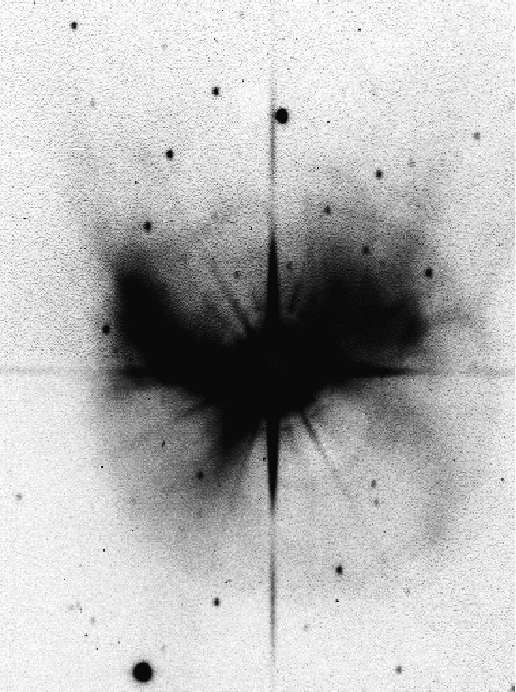
Figure 3: I band image of HD 65750, showing the large envelope
 . North is up and West is to right
In Fig. 3 (click here) we present an I band CCD image of HD 65750, showing its large envelope (IC 2220). The image was obtained with a 60 s. exposure at the 60 cm B&C telescope at LNA (Brazil).
IRAS 10204-6135 (HD 90082) - Although the Li line doublet in this star is
comparable to the Ca I line
( ), the molecular lines in this region do not permit
a good estimation of the
), the molecular lines in this region do not permit
a good estimation of the  .
.
IRAS 19012-0747 and IRAS 19038-0026 - We found no identification
for the optical counterparts
of these two IRAS sources and no previous work on then. Both
seem to be K stars.
The  ratio for IRAS 19012-0747 is the largest of
our sample.
ratio for IRAS 19012-0747 is the largest of
our sample.
IRAS 18241-1443 (GCSS 577) - Chen & Kwok (1993) used this star
in their circumstellar material study.
It was identified as a S star by Kershbaum & Hron (1992). Its
low resolution IRAS
spectrum shows no peculiar features in the range  (Olnon
& Raimond 1986).
(Olnon
& Raimond 1986).