

We present a small sample of the collision strengths and compare the maxwellian-averaged collision strengths from the present 49-term calculation with those from the 16-level BP calculation and those by Berrington & Pelan (Paper XII); all non-vanishing maxwellian-averaged collision strengths are given in Table 3, located in a computer file available on request.
Figure 1 (click here) shows a comparison of the collision strengths
for the transitions from the ground level
 to
to  ,
,
 and
and  from the 49CC NR calculations (left) and from the 16-level BP calculation
(right). The panels on the right are on smaller energy scales
to reveal the detailed resonance structures obtained with a finer
energy mesh in the BP calculation.
It should be mentioned that similar detailed resonance structures would also
be obtained for the 49CC case as for the BP case if a finer energy
mesh had been used for the energy range 0 to 0.5 Ryd.
However, this does not significantly affect the rate coefficients,
except for a slight loss of accuracy at very low temperatures.
It is seen from Fig. 1 (click here) that owing to the larger target expansion
the resonance structures in the 49CC NR case
are more extensive than in the 16-level BP case.
Consequently, as seen below, the 49CC rate coefficients show a much larger
resonance enhancement.
from the 49CC NR calculations (left) and from the 16-level BP calculation
(right). The panels on the right are on smaller energy scales
to reveal the detailed resonance structures obtained with a finer
energy mesh in the BP calculation.
It should be mentioned that similar detailed resonance structures would also
be obtained for the 49CC case as for the BP case if a finer energy
mesh had been used for the energy range 0 to 0.5 Ryd.
However, this does not significantly affect the rate coefficients,
except for a slight loss of accuracy at very low temperatures.
It is seen from Fig. 1 (click here) that owing to the larger target expansion
the resonance structures in the 49CC NR case
are more extensive than in the 16-level BP case.
Consequently, as seen below, the 49CC rate coefficients show a much larger
resonance enhancement.
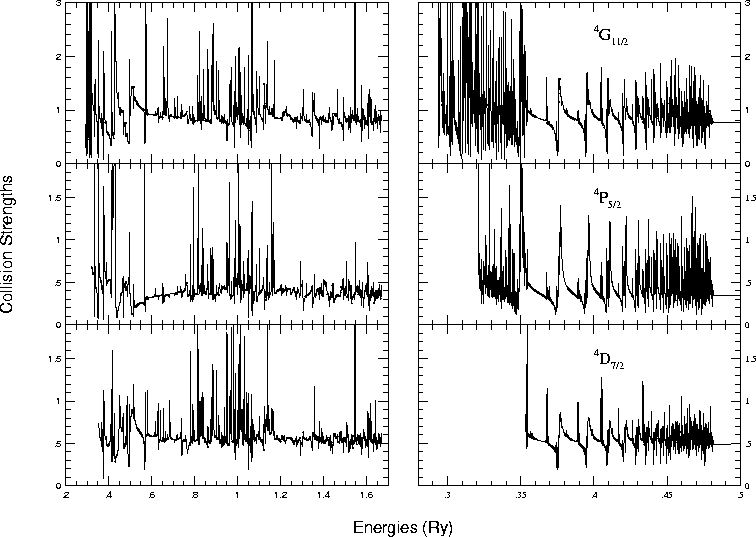
Figure 1: The collision strengths for the forbidden transitions
from the ground level
to ,
and
from the 49CC NR calculations (left panels)
and from the 16-level BP calculation (right panels).
Note the different energy scales in the right and the left panels
Figure 2 (click here) shows the collision strengths for the optically allowed
transitions  ,
,
 and
and
 .
As mentioned earlier, the Coulomb-Bethe approximation was employed
to estimate the contributions by higher partial waves.
It is clear from
this figure that relative resonance contributions are not
as strong as in the forbidden transitions and that the rate coefficients
are dominated by the high energy region where the collision strength
has the Bethe asymptotic behavior,
.
As mentioned earlier, the Coulomb-Bethe approximation was employed
to estimate the contributions by higher partial waves.
It is clear from
this figure that relative resonance contributions are not
as strong as in the forbidden transitions and that the rate coefficients
are dominated by the high energy region where the collision strength
has the Bethe asymptotic behavior,  .
.
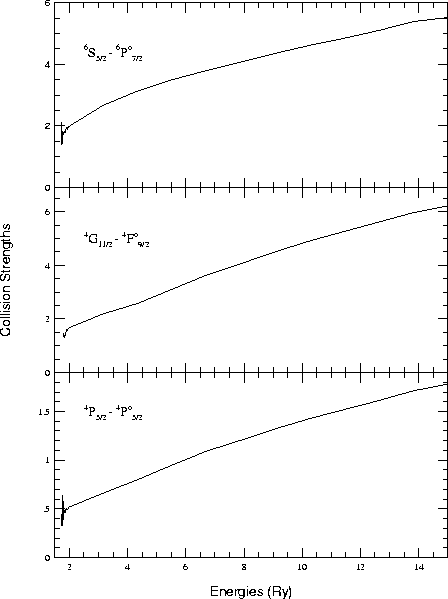
Figure 2: The collision strengths for the
optically allowed transitions
a) ,
b) and
c)
from the 49CC calculation
The procedure for obtaining maxwellian-averaged collision strengths or effective collision strengths can be found in earlier publications in this series (e.g. see Papers I, VI or XVIII). In Table 2 (click here) we compare the present results (49CC) for some transitions at two temperatures, 3981 K and 39811 K, with those from our 16-level BP calculation (BP) and from Berrington & Pelan (1995, Paper XII). In this table, the BP results are quite close to those in Paper XII, indicating that the relativistic effects are not important for these transitions, while the 49CC results are generally larger than the above two entries, indicating large enhancements due to resonance and coupling effects.
 |
 | |||||||
| i | j | 49CC | BP | Paper XII | 49CC | BP | Paper XII | |
| 1 | 2 | 1.38e+00 | 1.15e+00 | 1.07e+00 | 1.00e+00 | 8.82e-01 | 8.27e-01 | |
| 1 | 3 | 1.15e+00 | 9.98e-01 | 8.94e-01 | 8.37e-01 | 7.44e-01 | 6.89e-01 | |
| 1 | 4 | 9.21e-01 | 7.99e-01 | 7.16e-01 | 6.70e-01 | 6.00e-01 | 5.51e-01 | |
| 1 | 5 | 6.91e-01 | 5.98e-01 | 5.37e-01 | 5.02e-01 | 4.55e-01 | 4.13e-01 | |
| 1 | 6 | 5.91e-01 | 4.91e-01 | 4.55e-01 | 4.83e-01 | 4.06e-01 | 3.85e-01 | |
| 1 | 7 | 3.94e-01 | 3.36e-01 | 3.03e-01 | 3.22e-01 | 2.73e-01 | 2.57e-01 | |
| 1 | 8 | 1.97e-01 | 1.60e-01 | 1.52e-01 | 1.61e-01 | 1.34e-01 | 1.28e-01 | |
| 1 | 9 | 5.47e-01 | 5.56e-01 | 5.20e-01 | 5.88e-01 | 5.24e-01 | 5.00e-01 | |
| 1 | 10 | 4.10e-01 | 4.15e-01 | 3.90e-01 | 4.41e-01 | 3.99e-01 | 3.75e-01 | |
| 1 | 11 | 2.74e-01 | 2.85e-01 | 2.60e-01 | 2.94e-01 | 2.70e-01 | 2.50e-01 | |
| 1 | 12 | 1.37e-01 | 1.39e-01 | 1.30e-01 | 1.47e-01 | 1.33e-01 | 1.25e-01 | |
| 2 | 3 | 3.45e+00 | 2.67e+00 | 3.89e+00 | 2.26e+00 | 1.89e+00 | 2.68e+00 | |
| 2 | 4 | 7.76e-01 | 6.01e-01 | 5.08e-01 | 4.56e-01 | 2.99e-01 | 3.20e-01 | |
| 2 | 5 | 1.63e-01 | 1.50e-01 | 5.36e-02 | 9.30e-02 | 5.81e-02 | 3.18e-02 | |
| 2 | 6 | 7.27e-01 | 6.32e-01 | 8.10e-01 | 6.16e-01 | 4.78e-01 | 4.74e-01 | |
| 2 | 7 | 3.64e-01 | 3.15e-01 | 4.81e-01 | 3.00e-01 | 2.40e-01 | 2.58e-01 | |
| 2 | 8 | 4.00e-02 | 2.29e-02 | 2.75e-02 | 3.32e-02 | 1.10e-02 | 9.92e-03 | |
| 2 | 9 | 1.88e+00 | 1.46e+00 | 1.28e+00 | 1.48e+00 | 1.25e+00 | 1.10e+00 | |
| 2 | 10 | 7.64e-01 | 6.29e-01 | 6.00e-01 | 6.67e-01 | 5.53e-01 | 5.05e-01 | |
| 2 | 11 | 2.61e-01 | 2.62e-01 | 2.38e-01 | 2.44e-01 | 2.33e-01 | 2.12e-01 | |
| 2 | 12 | 6.38e-02 | 6.28e-02 | 5.88e-02 | 5.86e-02 | 5.77e-02 | 5.34e-02 | |
| 6 | 7 | 8.70e-01 | 6.36e-01 | 6.50e-01 | 7.06e-01 | 5.27e-01 | 4.96e-01 | |
| 6 | 8 | 3.06e-01 | 1.91e-01 | 2.20e-01 | 2.44e-01 | 1.41e-01 | 1.40e-01 | |
| 6 | 9 | 8.85e-01 | 6.82e-01 | 6.56e-01 | 8.06e-01 | 6.15e-01 | 6.00e-01 | |
| 6 | 10 | 5.57e-01 | 3.92e-01 | 4.33e-01 | 5.11e-01 | 3.41e-01 | 3.47e-01 | |
| 6 | 11 | 2.99e-01 | 2.16e-01 | 2.34e-01 | 2.68e-01 | 1.87e-01 | 1.76e-01 | |
| 6 | 12 | 1.24e-01 | 8.52e-02 | 9.58e-02 | 1.07e-01 | 7.37e-02 | 6.69e-02 | |
| 9 | 10 | 1.25e+00 | 8.16e-01 | 8.62e-01 | 9.74e-01 | 7.24e-01 | 6.93e-01 | |
| 9 | 11 | 4.47e-01 | 2.10e-01 | 2.14e-01 | 3.34e-01 | 1.65e-01 | 1.52e-01 | |
| 9 | 12 | 1.88e-01 | 8.47e-02 | 8.67e-02 | 1.42e-01 | 6.72e-02 | 6.19e-02 | |
 from the 49-term non-relativistic calculation (49CC),
from 16-level relativistic Breit Pauli (BP) calculation,
and from Berrington & Pelan (1995, Paper XII). i and
j, referred to Table 1 (click here), are the initial level and the
final levels
from the 49-term non-relativistic calculation (49CC),
from 16-level relativistic Breit Pauli (BP) calculation,
and from Berrington & Pelan (1995, Paper XII). i and
j, referred to Table 1 (click here), are the initial level and the
final levels
The maxwellian-averaged collision strengths were calculated for all 8771 non-vanishing transitions between the 140 energy levels shown in Table 1 (click here), for 20 temperatures ranging from 2000 to 500000 K. The entire dataset of effective collision strengths in the above temperature range is tabulated in Table 3. It is noted that collision strengths for some of the transitions vanish due to a restriction on the quantum numbers of the initial and final levels, such as, for example, the large spin-change transitions between sextets and doublets. These are not included in Table 3. Table 3 is available only in electronic form from the CDS or via ftp from the authors at: This email address is being protected from spambots. You need JavaScript enabled to view it. .