

Our model calculations are based on the following picture. The central AGB star
has a given mass ( ), luminosity (
 ), and effective temperature
(
), and effective temperature
( ) and loses mass with a prescribed constant mass loss rate (
 ). At
some distance from the star the outflowing gas has cooled to the dust
condensation temperature (
). At
some distance from the star the outflowing gas has cooled to the dust
condensation temperature ( ) and dust is assumed to form instantly at this
radius (r1), which lies very close to the sonic point (critical point). The
dust grains of single size are accelerated away from the central star by
radiation pressure, drifting through the gas and dragging along the gas
component due to the frictional coupling provided by dust-gas collisions.
) and dust is assumed to form instantly at this
radius (r1), which lies very close to the sonic point (critical point). The
dust grains of single size are accelerated away from the central star by
radiation pressure, drifting through the gas and dragging along the gas
component due to the frictional coupling provided by dust-gas collisions.
A 1D radiation hydrodynamics code, originally developed to investigate the dynamical evolution of protostellar clouds, is employed to solve the time-dependent equations of hydrodynamics and frequency-dependent radiative transfer for a two component ``fluid'' consisting of gas and dust under the assumption of spherical symmetry. Details about the numerical methods used are described by Yorke & Krügel (1977), and by Yorke (1980a,b). The code has been modified extensively to adapt it for the modeling of dusty stellar outflows. The basic equations to be solved in this context are given below.
The structure of the stellar outflow is governed by the following basic
equations of hydrodynamics.
1) Equation of motion for the gas component:

where u is the gas velocity, w the dust velocity,  is the gas
density, p is the gas pressure,
is the gas
density, p is the gas pressure,  is the total mass inside radial
coordinate r, and
is the total mass inside radial
coordinate r, and

measures the thermal velocity dispersion of the gas molecules at gas temperature
T (for the molecular weight we assumed  , corresponding to gas
of solar composition with hydrogen in atomic form). All other symbols have
their usual meaning. The first term on the right hand side of Eq. (1 (click here))
describes the
acceleration due to the gas pressure gradient (gas pressure term), the second
term corresponds to the gravitational force and the third term accounts for the
dynamical coupling between gas and dust (friction term).
, corresponding to gas
of solar composition with hydrogen in atomic form). All other symbols have
their usual meaning. The first term on the right hand side of Eq. (1 (click here))
describes the
acceleration due to the gas pressure gradient (gas pressure term), the second
term corresponds to the gravitational force and the third term accounts for the
dynamical coupling between gas and dust (friction term).
2) Equation of continuity for the gas component:

3) Equation of motion for the dust component (single grain):

where  and a are the
mass and radius of a dust grain, respectively, c is the speed of light, and
and a are the
mass and radius of a dust grain, respectively, c is the speed of light, and

is the flux-weighted extinction cross section (including absorption and
isotropic scattering:  ).
The first term on the right hand side of Eq. (4 (click here))
describes the acceleration of a dust grain by radiation
pressure, the second term corresponds to the gravitational deceleration by the
central mass (usually much smaller than the radiative acceleration), and the
third term again accounts for the dynamical coupling between gas and dust.
Interaction between dust particles (``dust pressure'') is neglected.
).
The first term on the right hand side of Eq. (4 (click here))
describes the acceleration of a dust grain by radiation
pressure, the second term corresponds to the gravitational deceleration by the
central mass (usually much smaller than the radiative acceleration), and the
third term again accounts for the dynamical coupling between gas and dust.
Interaction between dust particles (``dust pressure'') is neglected.
4) Equation of continuity for the dust component:

where  is the number density of dust grains. Hence, the total amount
of dust in the computational domain changes only due to the fluxes through
the model boundaries. Condensation or evaporation of dust is not considered.
is the number density of dust grains. Hence, the total amount
of dust in the computational domain changes only due to the fluxes through
the model boundaries. Condensation or evaporation of dust is not considered.
The thermal structure of the dust shell is determined by the radiation
field of the central star, which is assumed to radiate as a blackbody with
 in this work. The energy equation stipulates the condition of
radiative equilibrium at any time.
in this work. The energy equation stipulates the condition of
radiative equilibrium at any time.
5) Energy equation:

where  is the frequency-integrated radiative energy flux.
The temperature of the dust component is related to the equilibrium
radiation field by
is the frequency-integrated radiative energy flux.
The temperature of the dust component is related to the equilibrium
radiation field by

where  is the angle-averaged specific intensity and
  is the
Planck function at the local dust temperature
is the
Planck function at the local dust temperature  .
We presently do not solve the energy equation for the gas
component. Instead, we simply take
.
We presently do not solve the energy equation for the gas
component. Instead, we simply take

an assumption which needs to be modified for applications where the gas
temperature is a critical quantity, like for the calculation of molecular
emission line profiles (see also discussion in Sect. 5).
For the computation of the radiative transfer
(including synthetic spectra) we account only for the absorption, scattering,
and thermal emission of the dust grains, whereas the gas component is presently
ignored since it is practically transparent in the continuum.
The method used for solving the equation of radiative transfer in
spherical geometry is described in detail by Yorke (1980b). Briefly, a ray
tracing algorithm is used to obtain the frequency-dependent equilibrium
radiation field which is usually found after a few iterations. This routine is
basically used to find the variable Eddington factors, f, which are further
used to solve the frequency-independent moment equation for the
frequency-integrated mean intensity J, taking into account the constraint
given by Eq. (7 (click here)). Solving the moment equation (with given Eddington
factors) is much faster than solving the detailed radiative transfer using the
ray system. Since the Eddington factors are changing rather slowly with time,
ray tracing needs to be repeated only after several hydrodynamical time steps
(typically 10) to recompute them.
The treatment of radiative transfer has been modified according to our needs. In particular, the central star and the dust free region between the stellar surface and the inner boundary of the dust shell is now covered with a better spatial resolution by increasing the number of rays in the central region. We emphasize that this method does not involve any approximations but rather allows a rigorous solution of the radiative transfer problem.
For the present study we employ time-dependent hydrodynamics to find steady state solutions, starting from a given initial configuration subject to appropriate (time-independent) boundary conditions. The time needed to achieve steady state is given by the thickness of the shell divided by the mean outflow velocity. Though time consuming, this approach has the advantage of yielding only those solutions which are dynamically stable, at least in 1D.
To pose the problem, we first have to specify the basic properties of the
central star which is assumed to radiate as a black body. These are its mass,
, its luminosity, , its effective temperature,
(which together with defines the stellar radius), and the mass loss
rate, . These quantities are assumed to be constant with time
(i.e. we tacitly assume a mass source inside the star to keep from
changing in accordance with ).
Second, we have to define the properties of the dust grains and their
abundances. In this study we use astronomical silicates, graphite
or amorphous carbon, with properties as specified in Table 1 (click here).
The corresponding opacity data for astronomical silicates and graphite were
kindly provided by B. Draine (for details see Laor & Draine 1993), and
were taken from Rouleau & Martin (1991) for amorphous carbon. The wavelength
dependence of the absorption and scattering efficiencies,

are displayed in Fig. 1 (click here) for the three types of dust, assuming
spherical grains with a radius of  m. In the hydrodynamical
calculations we use a grid of 169 wavelength points distributed between
0.01 and 3100
m. In the hydrodynamical
calculations we use a grid of 169 wavelength points distributed between
0.01 and 3100  m.
m.
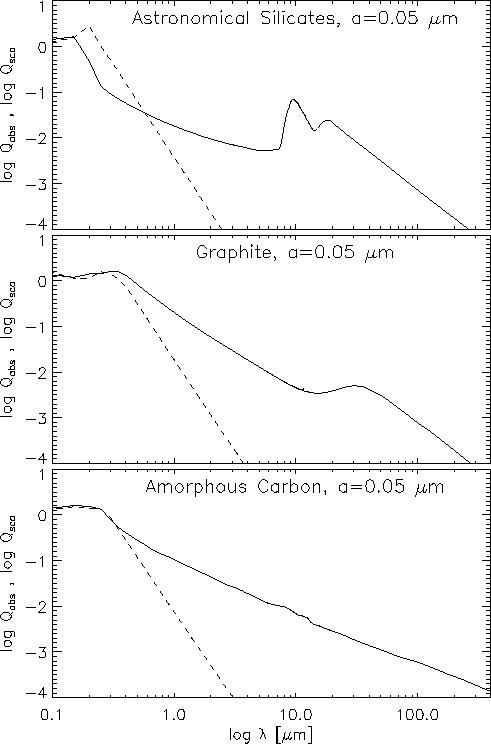
Figure 1:
Wavelength dependence of absorption efficiency  (solid) and
scattering efficiency
(solid) and
scattering efficiency  (dashed) for grains of astronomical
silicates (top), of graphite (middle) and of amorphous carbon (bottom) adopted
in the present work. Note that for the assumed grain size of m,
scattering opacity becomes negligible at far infrared wavelengths. For
astronomical silicates and for graphite,
(dashed) for grains of astronomical
silicates (top), of graphite (middle) and of amorphous carbon (bottom) adopted
in the present work. Note that for the assumed grain size of m,
scattering opacity becomes negligible at far infrared wavelengths. For
astronomical silicates and for graphite,  beyond
  m. In contrast, the absorption efficiency of
amorphous carbon may be roughly approximated by
m. In contrast, the absorption efficiency of
amorphous carbon may be roughly approximated by  over the whole range of infrared wavelengths
The distance of the inner edge of the dust shell from the central star, r1,
is determined during the model calculations by an iterative procedure such that
the resulting dust temperature at the inner boundary (according to
Eq. (8 (click here))) corresponds to to the dust condensation temperature,
. The computational radial grid starts at r1, the inner edge
of the dust shell, and ends at an outer radius  cm.
cm.
The boundary conditions at r1 determine the nature of the
solution. At the inner boundary we adopt a constant initial velocity
which is identical for the gas and the dust component and is taken to be
2 to 4 km/s, close to (but not smaller than) the local isothermal sound speed:

The gas density at the inner boundary is then given by

the dust density is related to the gas density via the dust-to gas ratio
 as
as

At the outer boundary, u, w, and  can be computed consistently
from the hydrodynamical equations in the case of a supersonic outflow
considered here. Since no information can travel into the computational domain
from outside, there is no necessity (and no possibility) to pose boundary
conditions for the hydrodynamics at the outermost grid point. But we need to
specify a boundary condition for the solution of the radiative transfer. We
assume that the ``interstellar'' radiation field incident on the outer boundary
from outside is that of a blackbody at
can be computed consistently
from the hydrodynamical equations in the case of a supersonic outflow
considered here. Since no information can travel into the computational domain
from outside, there is no necessity (and no possibility) to pose boundary
conditions for the hydrodynamics at the outermost grid point. But we need to
specify a boundary condition for the solution of the radiative transfer. We
assume that the ``interstellar'' radiation field incident on the outer boundary
from outside is that of a blackbody at  K.
K.
In the case of gray opacity,  becomes independent of the radiation
field and hence is no longer a function of of r. Assuming, in addition,
a very strong coupling between gas and dust such that the drift velocity
w-u becomes negligible, and further ignoring gas pressure,
the equation of motion can be solved analytically.
It is worth noting that the well known solution for
becomes independent of the radiation
field and hence is no longer a function of of r. Assuming, in addition,
a very strong coupling between gas and dust such that the drift velocity
w-u becomes negligible, and further ignoring gas pressure,
the equation of motion can be solved analytically.
It is worth noting that the well known solution for  ,
,

is independent of the mass loss rate. The flux-averaged opacity per unit mass,
 , is related to via

Introducing the ratio between radiative to gravitational acceleration,

(which is a constant in the gray case), Eq. (14 (click here)) may be rewritten as

where

is the escape velocity at the dust formation radius r1. We have checked that
our numerical code finds the correct solution for this test case of gray dust
opacity and vanishing drift velocity. As expected, numerical errors of the
order  (where
  is the numerical resolution of the radial
grid) are found for the resulting velocity relative to the analytical solution,
the numerical velocities being systematically smaller. A proper choice of the
radial grid ensures that these kinds of errors are kept below
is the numerical resolution of the radial
grid) are found for the resulting velocity relative to the analytical solution,
the numerical velocities being systematically smaller. A proper choice of the
radial grid ensures that these kinds of errors are kept below  .
.
All models used for this investigation have N=240 radial grid point spaced
according to

By choosing an appropriate value q>1 we have concentrated the grid points
in the inner part of the model such that the spatial resolution in the
acceleration region is four times better than for an equidistant logarithmic
grid covering the same radius range with the same number of points. The
resulting lower resolution in the outer parts is not critical since here all
quantities approach their asymptotic limits and are almost constant with r.
| Astronomical | Graphite | Amorphous | |
| Silicates | Carbon | ||
| Grain size [m] | 0.05 | 0.05 | 0.05 |
| Specific mass density | |||
 [g cm-3] [g cm-3] | 3.30 | 2.26 | 1.85 |
| Condensation | |||
| temperature [K] | 800 | 850 | 850 |
| Dust-to-gas ratio | |||
 | 0.0050 | 0.0015 | 0.0015 |