


Figure 11: The schematic photometric history of R71, 1955-1994. The
insert shows the detailed descending branch of maximum 1 with the
long-time scale micro-variations
R71 = HDE 269006 had a spectral type B2.5Iep (Feast et al.
1960) at minimum brightness. It was already noted by Thackeray
(1974) and Feast et al. (1960) that R71 was variable.
The HDE magnitude at the end of the 19th century was 92 and the  of the Cape Phot. Durchm. at roughly the same time was 95.
Additionally, according to Herschel's observations, mv = 9.5 in 1847
(Thackeray 1974). Thus in the middle of the last century, and
also 50y later, R71 was brighter than the top of the 1975 maximum shown
in Fig. 11 (click here) (99). According to Thackeray (1974) the
Harvard photographic magnitude indicated that R71 was again bright in
1925, viz. 92. Thus, the total range in the last 150y is
at least 18. Table 2 (click here) lists the global characteristics of the
light and colour variations during the last 40y.
Van Genderen (1979) discussed the photometric history of
R71 from
of the Cape Phot. Durchm. at roughly the same time was 95.
Additionally, according to Herschel's observations, mv = 9.5 in 1847
(Thackeray 1974). Thus in the middle of the last century, and
also 50y later, R71 was brighter than the top of the 1975 maximum shown
in Fig. 11 (click here) (99). According to Thackeray (1974) the
Harvard photographic magnitude indicated that R71 was again bright in
1925, viz. 92. Thus, the total range in the last 150y is
at least 18. Table 2 (click here) lists the global characteristics of the
light and colour variations during the last 40y.
Van Genderen (1979) discussed the photometric history of
R71 from  to 1978 including the monitoring
of an SD maximum and a subsequent descending branch.
to 1978 including the monitoring
of an SD maximum and a subsequent descending branch.
Figure 11 (click here) shows at least two SD
phases (numbered 1-2) that are red in the maxima and blue in the
minima. For maximum 3 no colour variations are known yet. The two
straight line pieces in the very beginning represent two
individual observations of which the precise dates are unknown.
Scattered individual observations are indicated by dots.
Monitored parts are indicated by continuous curves.
Numerous fluctuations in the descending branch are shown in the insert.
According to their time scale ( ) and colour behaviour
these should be classified as long-time scale micro-variations.
After the fading of S Dor phase No. 1
short-time scale micro-variations with quasi-periods of 24d and
14d were recorded (van Genderen et al.
1985, 1988). New unpublished VBLUW observations made in 1988 and
1989 (Sect. 2) show a quasi-period of 20d. All these short-time
scale variations are generally blue in the maxima and red in the
minima.
) and colour behaviour
these should be classified as long-time scale micro-variations.
After the fading of S Dor phase No. 1
short-time scale micro-variations with quasi-periods of 24d and
14d were recorded (van Genderen et al.
1985, 1988). New unpublished VBLUW observations made in 1988 and
1989 (Sect. 2) show a quasi-period of 20d. All these short-time
scale variations are generally blue in the maxima and red in the
minima.
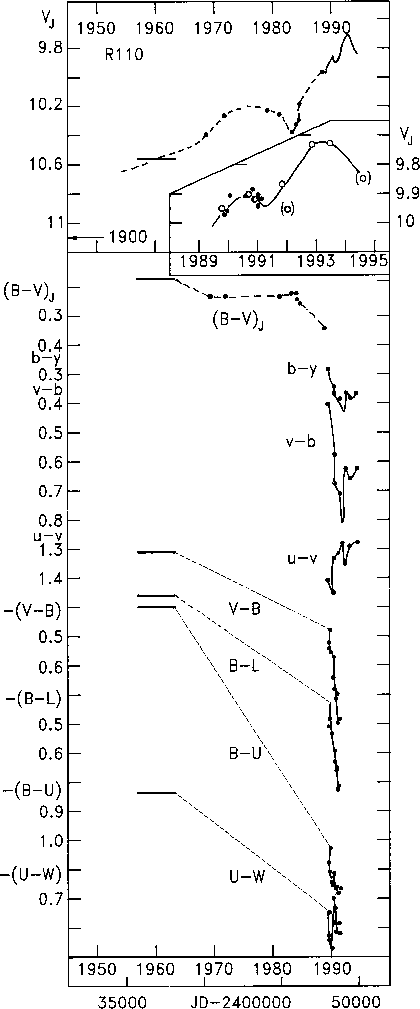
Figure 12: The schematic light and colour curves of R110, 1950-1995,
all in magnitude scale. The insert shows the light curve
1989-1995 in more detail
The  curve in Fig. 11 (click here) is based on observations made
in the Johnson UBV system and on transformed V-B values of the
Walraven system.
Spectroscopic monitoring done between 1955 and 1981 offers a
check on whether R71 was active or not in this time interval: in
the light maxima the emission lines of [Fe II] are absent and in
the light minima they are present (Thackeray 1974; Wolf et al.
1981; see the corresponding dates in the light curve of van
Genderen et al. 1985). According to spectra taken between 1955 and
1965, there was no SD type activity whatsoever. Consequently, we are
pretty sure that R71 was in a minimum state all that time (see
the broken curve 1960-1970 in Fig. 11 (click here)).
curve in Fig. 11 (click here) is based on observations made
in the Johnson UBV system and on transformed V-B values of the
Walraven system.
Spectroscopic monitoring done between 1955 and 1981 offers a
check on whether R71 was active or not in this time interval: in
the light maxima the emission lines of [Fe II] are absent and in
the light minima they are present (Thackeray 1974; Wolf et al.
1981; see the corresponding dates in the light curve of van
Genderen et al. 1985). According to spectra taken between 1955 and
1965, there was no SD type activity whatsoever. Consequently, we are
pretty sure that R71 was in a minimum state all that time (see
the broken curve 1960-1970 in Fig. 11 (click here)).