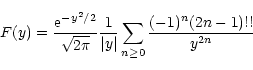
Here we collect some mathematical results concerning the logarithmic potential
and mainly related to the limit case
 for a fixed value of h or,
equivalently,
for a fixed value of h or,
equivalently,
 for a fixed value of
  .
.
First we consider the collinear problem
 .
For other similar
problems but with different exponent, for instance,
.
For other similar
problems but with different exponent, for instance,
 ,
,
 ,
and with Hamiltonian
,
and with Hamiltonian
 ,
the scalings
,
the scalings
 ,
,
 lead to (
 )
)
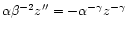 ,
which has the same form as before if
,
which has the same form as before if
 Let w=z'
and
Let w=z'
and
 .
Then the level of energy, H=hand
.
Then the level of energy, H=hand
 are related by
 .
Hence,
.
Hence,
 can be scaled to the values
  or -1. Furthermore, a collision
solution (i.e. of unbounded acceleration) leaving from (or ending at) x=0 for
t=0 is of the form
or -1. Furthermore, a collision
solution (i.e. of unbounded acceleration) leaving from (or ending at) x=0 for
t=0 is of the form
 with
with
 ,
,
 ,
if
,
if  .
For
.
For  and
and
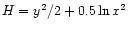 ,
the scalings defined above lead to
,
the scalings defined above lead to
 and
and
 .
So we can always reduce to the
level
.
So we can always reduce to the
level  setting
 and then
  .
.
To solve the equations of motion  ,
,
 with
with
 ,
it is convenient to use y as independent variable.
Then, for x>0, and assuming that at t=0,
,
it is convenient to use y as independent variable.
Then, for x>0, and assuming that at t=0,  ,
,
 ,
where N, F (
,
where N, F (
 denote, respectively,
the density and distribution function of the standard normal law (0 average and
standard deviation 1). In particular, a solution leaving from collision ends
again at it (
denote, respectively,
the density and distribution function of the standard normal law (0 average and
standard deviation 1). In particular, a solution leaving from collision ends
again at it ( )
after
)
after
 .
Furthermore, as
.
Furthermore, as
 (with error less, in absolute value,
than the first neglected term), the relation
(with error less, in absolute value,
than the first neglected term), the relation
 for
for  follows immediately. Due to the symmetry, the same relation applies
when
but
follows immediately. Due to the symmetry, the same relation applies
when
but
 .
Note that y decreases if x>0
and it increases if x<0. Hence two solutions
appear for the limit problem. These solutions are the natural continuation
one from the other. This is the suitable "regularization'' to be used for the
"collision'' in that problems, as a blow up shows in a simple way. The
natural continuation of an orbit (i.e., the one allowing to recover continuity
with respect to initial conditions) is just to "cross'' the origin in the same
direction that the orbit has. This is in contrast with the classical two-body
problem, where the regularization looks like an elastic bounce.
.
Note that y decreases if x>0
and it increases if x<0. Hence two solutions
appear for the limit problem. These solutions are the natural continuation
one from the other. This is the suitable "regularization'' to be used for the
"collision'' in that problems, as a blow up shows in a simple way. The
natural continuation of an orbit (i.e., the one allowing to recover continuity
with respect to initial conditions) is just to "cross'' the origin in the same
direction that the orbit has. This is in contrast with the classical two-body
problem, where the regularization looks like an elastic bounce.
When we consider the problem ,
 on the level
h=0 of
on the level
h=0 of
 with
small,
no relevant differences with the previous problem appear unless |x| is small
(of the order
with
small,
no relevant differences with the previous problem appear unless |x| is small
(of the order
 ,
K finite). The effect of
is to bound y(now
,
K finite). The effect of
is to bound y(now
 at x=0 instead of
  )
and "to match'' the
two previous solutions in the regions x>0 and x<0. As the time interval to
go from x=0 to
)
and "to match'' the
two previous solutions in the regions x>0 and x<0. As the time interval to
go from x=0 to
 for any finite K goes to zero with
in both
problems, the limit period is
for any finite K goes to zero with
in both
problems, the limit period is
 (always on the level h=0; the
scaling
(always on the level h=0; the
scaling  is required for other energies, see Sect. 5).
Now we are interested in the normal variational equations (as presented
in (31)) in the limit case
.
In an equivalent way we can
reformulate the second of (31), rewritten as
 with
and x being a solution of the
first in (31), rewritten as
with
and x being a solution of the
first in (31), rewritten as
 on h=0. As
we are interested in values of
on h=0. As
we are interested in values of  for which the trace of the monodromy
matrix is 2 (see Sect. 5.1, Fig. 14 and related discussion),
we should have a periodic solution of the normal variational equations. The
n-th value of ,
for which the trace of the monodromy
matrix is 2 (see Sect. 5.1, Fig. 14 and related discussion),
we should have a periodic solution of the normal variational equations. The
n-th value of ,
 ,
should correspond to a periodic solution
having n full oscillations in one period, i.e.,
2n zeros exactly. Due to symmetry properties we can select one of the zeros
at x=0,
,
should correspond to a periodic solution
having n full oscillations in one period, i.e.,
2n zeros exactly. Due to symmetry properties we can select one of the zeros
at x=0,
 (and, by symmetry, another at
x=0,
(and, by symmetry, another at
x=0,
 ). Hence, we are looking for a solution that vanishes
at the extreme values of y and having exactly n-1 zeros between them when
x>0. The remaining n-1 zeros occur for x<0.
). Hence, we are looking for a solution that vanishes
at the extreme values of y and having exactly n-1 zeros between them when
x>0. The remaining n-1 zeros occur for x<0.
In the limit, when
,
we have the linear equation
 where t, x can be expressed as a function
of
where t, x can be expressed as a function
of  as above. Thus, using y as independent variable, we
have (
as above. Thus, using y as independent variable, we
have (
 )
)
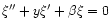 .
Let
.
Let
 .
Then the equation for g reads
.
Then the equation for g reads
 .
The solutions of this equation grow slower
than
.
The solutions of this equation grow slower
than
 for
for
 only if
  is an integer. Then we obtain
g(y)=Hem(y), the Hermite
polynomials (see Abramowitz & Stegun 1972). They can be computed
from He0(y)=0, He1(y)=y,
Hem+1(y)=yHem(y)-m Hem-1(y)for
is an integer. Then we obtain
g(y)=Hem(y), the Hermite
polynomials (see Abramowitz & Stegun 1972). They can be computed
from He0(y)=0, He1(y)=y,
Hem+1(y)=yHem(y)-m Hem-1(y)for  .
As we want n-1 real zeros of
.
As we want n-1 real zeros of  ,
one finally has
,
one finally has  .
.
Copyright The European Southern Observatory (ESO)