

In this work we have shown that detailed information about global and local
dynamics can be obtained by means of simple tools. In the first part we take
advantage of the pendulum model and its corresponding Hamiltonian
(the pseudo-invariant  )
to derive the basic dynamics of a general
bar-like system. The numerical evidence shows that even if the potential
is comparatively far from the central symmetry, the tangential motion (at
moderate-large radii) is well represented by a pendulum. Therefore we can use
all the theory behind this universal system to explain loop and box orbits, the
stochastic layer and how this picture changes as the perturbation increases.
However to get more insight about the structure of the
phase space we need the help of another technique.
)
to derive the basic dynamics of a general
bar-like system. The numerical evidence shows that even if the potential
is comparatively far from the central symmetry, the tangential motion (at
moderate-large radii) is well represented by a pendulum. Therefore we can use
all the theory behind this universal system to explain loop and box orbits, the
stochastic layer and how this picture changes as the perturbation increases.
However to get more insight about the structure of the
phase space we need the help of another technique.
In Sect. 1 we said that alternative tools were proposed to explore the phase space. Let us summarise then the most often used in Galactic Dynamics by means of a comparative discussion with the MEGNO;
a) The computation of the Poincaré surface of section is the most popular
technique to sketch the basic dynamics. However it works in a simple way in 2D
systems and, to obtain details about the fine structure of the phase space, one
needs very long integrations. This is evident from Fig. 11a where we
needed a comparatively large computational effort to obtain the first details
of the resonance structure close to the stochastic layer. In fact, many small
resonances marked in the corresponding figure for
 (Fig. 10) are not visible
in this high resolution surface of section.
(Fig. 10) are not visible
in this high resolution surface of section.
Besides a 2D plane is not, in general, the natural space to display the motion. Figure 6 shows that, at least for the potential considered here, the 2D sphere is the natural manifold to represent the dynamics.
For higher dimensional problems one can use a combination of Poincaré maps with a slicing technique (see, for instance, Simó et al. 1995 for some examples). But a systematic use of this approach requires more computational and graphic effort;
b) As we have already said, the computation of the LCN is widely used to separate
regular and different chaotic components of the phase space (each of them, in
general, with different Lyapunov times). The works of Udry &
Pfenniger (1988), Merritt & Friedman (1996) and Wozniak &
Pfenniger (1999) are a few examples of applications to models of triaxial
elliptical and barred disc galaxies. However, as we showed above, the classical
LCN technique is not useful to investigate the fine structure of the regular
component. Moreover, to separate regular and irregular regions with
 periods, the motion time should be very large,
 periods
at least;
periods
at least;
c) The spectral analysis introduced by Binney & Spergel (1982, 1984), is basically a Fourier analysis of the orbit. Recently, Carpintero & Aguilar (1998) developed an efficient algorithm, following the approach of Binney & Spergel, that provides information about the frequencies associated to the invariant torus where the motion proceeds (see however item d). The latter algorithm is able to classify orbits in different families and to distinguish the presence of irregular, stochastic motion in relatively short motion times, less than 103 periods;
d) The most powerful tool at hand is, perhaps, the FMA due to Laskar (1990,
1993, 1999) and applied to Galactic Dynamics by, for instance, PL96,
Wachlin & Ferraz-Mello (1998), Papaphilippou & Laskar (1998),
Valluri & Merritt (1998). This technique, specifically proposed to the
study of dynamics in the Solar System is, in fact, similar to the spectral
analysis but developed in a much more sophisticated way. In general, the FMA
provides, for short-to-moderate motion times (
 periods, depending
on the needed accuracy), very precise estimates of the frequencies (if they
exist, that is if the motion takes place on a torus) and hence information
about the global dynamics, details concerning the fine structure of the phase
space (high-order resonances) and a relatively clear identification of the
chaotic regions (where the precise determination fails). See also Gómez
et al. (1987) for an alternative approach with applications to Space
Science.
periods, depending
on the needed accuracy), very precise estimates of the frequencies (if they
exist, that is if the motion takes place on a torus) and hence information
about the global dynamics, details concerning the fine structure of the phase
space (high-order resonances) and a relatively clear identification of the
chaotic regions (where the precise determination fails). See also Gómez
et al. (1987) for an alternative approach with applications to Space
Science.
Even though with this tool it is possible
to derive a diffusion-like coefficient in frequency
space, its connection with the LCN has not been established yet.
In fact it is unclear that the mean-rate of variation
of frequencies over a given time
interval, that is the lack of precise estimates of the frequencies,
provides direct quantitative information about the "amount of hyperbolicity'',
being the latter measured by the LCN. Papaphilippou & Laskar (1998),
Valluri & Merritt (1998) associate the diffusion rate of a given orbit
in a 3D Hamiltonian with the maximum mean-rate between both rotation numbers,
 ,
,
 .
But from standard theory of diffusion, it seems that the diffusion coefficient
should be related with the mean square value
instead with the mean value. This is the way in which, for instance,
Chirikov defines the diffusion rate to investigate diffusion in phase space
(including Arnold diffusion, see Chirikov 1979 Sects. 5.4, 7.2 and 7.3).
A different approach (but with the same result) is given by
Saslaw (1985)-Ch. 4, where he illustrates the diffusion process in
phase space by means of the one dimensional Fokker-Planck equation.
.
But from standard theory of diffusion, it seems that the diffusion coefficient
should be related with the mean square value
instead with the mean value. This is the way in which, for instance,
Chirikov defines the diffusion rate to investigate diffusion in phase space
(including Arnold diffusion, see Chirikov 1979 Sects. 5.4, 7.2 and 7.3).
A different approach (but with the same result) is given by
Saslaw (1985)-Ch. 4, where he illustrates the diffusion process in
phase space by means of the one dimensional Fokker-Planck equation.
The FMA is developed in the framework of near-integrable Hamiltonian systems.
For these systems, with the phase space almost entirely foliated by invariant
tori, this technique proves to be very useful.
As shown in Figs. 10 and 12,
as well as
 (Fig. 11b) reveal much more details about the resonance
structure than the FMA. Only a few of the resonances marked in those figures
are present in Figs. 8 and 9 of PL96 (at least for the graphical resolution of
their figures). In that figures PL96 plot the rotation number, r,
defined as
(Fig. 11b) reveal much more details about the resonance
structure than the FMA. Only a few of the resonances marked in those figures
are present in Figs. 8 and 9 of PL96 (at least for the graphical resolution of
their figures). In that figures PL96 plot the rotation number, r,
defined as
 for boxes and
 for loops, against the parameter that label each family, px0 and x0
respectively, for q=0.9, 0.8 and 0.7. In all cases we observe a regular,
monotonous dependence of r on px0 and x0 except in some regions
where the curve is not regular. Scattered points mean irregular orbits, an
horizontal plateau a stability island and a small gap an unstable periodic
orbit. The value of r in those zones where it is constant or undefined
provides the order of the resonance and the width of the plateau or the gap, a
measure of the resonance size.
for loops, against the parameter that label each family, px0 and x0
respectively, for q=0.9, 0.8 and 0.7. In all cases we observe a regular,
monotonous dependence of r on px0 and x0 except in some regions
where the curve is not regular. Scattered points mean irregular orbits, an
horizontal plateau a stability island and a small gap an unstable periodic
orbit. The value of r in those zones where it is constant or undefined
provides the order of the resonance and the width of the plateau or the gap, a
measure of the resonance size.
In this direction, the MEGNO is able to give the
actual size of a resonance as well as to put in evidence its internal structure.
Besides we get simultaneously a good estimate of the LCN with a comparatively
small computational effort. Both
and
reveal the
hyperbolic structure of the phase space. This tells us where irregular motion
would appear when the perturbation is enlarged or when additional degrees of
freedom are added. This last point will be investigated by means of the MEGNO
in a separate paper.
The FMA gives an accurate value of the rotation number, a label for each resonance. So, it is possible to follow the evolution of a given resonance as the perturbation changes while, for instance, from Fig. 12 it is not evident how to do that when we change the value of q, unless a systematic continuation of periodic orbits vs. q is done. Hence the combination of the MEGNO with a precise spectral analysis would lead to a complete description of the dynamics;
e) The spectra of stretching numbers, helicity and twist angles proposed
by Contopoulos & Voglis (1996, 1997). An application to a 2D
model of barred galaxy is given by Patsis et al. (1997). The main
advantage of this tool is its efficiency to separate regular and stochastic
domains in rather short motion times,
 periods;
f) In two recent papers, Cincotta & Simó (1999, 2000) proposed
the conditional entropy of nearby orbits, I, defined through the arc length
parameter along the orbit instead of the time as a random variable, as an
efficient tool to investigate the phase space as well as to derive the LCN in
realistic physical times ( periods). In fact, the indicator
  was defined here in such a way that it behaves in a similar manner than the
logarithmic time-derivative of I,
was defined here in such a way that it behaves in a similar manner than the
logarithmic time-derivative of I,
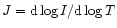 .
The
main difference between J and
is that the former is a second order
magnitude in
.
The
main difference between J and
is that the former is a second order
magnitude in  (at first order
  )
while, by definition,
is linear in .
Hence, J appears to be rather sensitive to
the presence of periodic orbits and, when the region of the phase space under
study includes several high order resonances, J looks noisy and depends more
strongly on the time step. For instance, in Cincotta & Simó (2000) we
study several orbits in the window shown in Fig. 11a by means of the
conditional entropy and even though the resonance structure is visualized, the
picture is not as clear as that provided by .
This can be understood
recalling that in this small interval 43 periodic orbits with period
)
while, by definition,
is linear in .
Hence, J appears to be rather sensitive to
the presence of periodic orbits and, when the region of the phase space under
study includes several high order resonances, J looks noisy and depends more
strongly on the time step. For instance, in Cincotta & Simó (2000) we
study several orbits in the window shown in Fig. 11a by means of the
conditional entropy and even though the resonance structure is visualized, the
picture is not as clear as that provided by .
This can be understood
recalling that in this small interval 43 periodic orbits with period  exist. However the first applications of the conditional entropy to
simple potentials (Hénon & Heiles 1964, for instance) show that it is
also a powerful tool. Some analytical arguments behind this method are given in
the mentioned papers but a rigorous theory is still lacking.
exist. However the first applications of the conditional entropy to
simple potentials (Hénon & Heiles 1964, for instance) show that it is
also a powerful tool. Some analytical arguments behind this method are given in
the mentioned papers but a rigorous theory is still lacking.
In conclusion we can say that the MEGNO resumes almost
all the nice features of the methods mentioned above. In fact, it is effective
to obtain relevant information about global dynamics and the fine structure of
the phase space with a relatively small computational effort. The indicator
allows to identify clearly regular and irregular motion as well as
stable and unstable periodic orbits.
A linear least squares fit of
 is enough to get a good estimate of the Lyapunov time in regular and
irregular components of the phase space.
Indeed, the MEGNO is the simplest
way to obtain such information on the phase space, since it has been tailored
taking advantage of our
knowledge on the basic dynamics in this kind of systems.
The derivation of the LCN from the MEGNO
rests on the idea that much information about the dynamics is contained in the
time evolution of an single orbit
is enough to get a good estimate of the Lyapunov time in regular and
irregular components of the phase space.
Indeed, the MEGNO is the simplest
way to obtain such information on the phase space, since it has been tailored
taking advantage of our
knowledge on the basic dynamics in this kind of systems.
The derivation of the LCN from the MEGNO
rests on the idea that much information about the dynamics is contained in the
time evolution of an single orbit  and in the tangent vector
 and the least squares fit is a first attempt to
extract this information. These questions, as well as the use of a single orbit
(instead of an ensemble) to investigate the structure of one component or the
irregular part of the phase space will be the subject of a future paper.
and the least squares fit is a first attempt to
extract this information. These questions, as well as the use of a single orbit
(instead of an ensemble) to investigate the structure of one component or the
irregular part of the phase space will be the subject of a future paper.
Finally, in what respects to the 2D logarithmic potential, we can say that the results given in this work together with the studies performed, for instance, by MS89 and PL96 resume almost all the dynamics of the model.
Acknowledgements
The first author would like to acknowledge the hospitality of the Departament de Matemàtica Aplicada i Anàlisi, Universitat de Barcelona where this work was done and the Consejo Nacional de Investigaciones Científicas y Técnicas de la República Argentina who supported his visit to the University of Barcelona. The second author has been supported by DGICYT grant PB 94-0215 (Spain). Partial support from the catalan grant CIRIT 1998S0GR-00042 is also acknowledged. Both authors are grateful to an anonymous referee for a careful reading of the manuscript and helpful recommendations.
Copyright The European Southern Observatory (ESO)