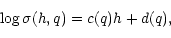
Let us now investigate the global dynamical properties of the logarithmic
potential in the parameter space (h,q). In what follows we use
the formulation given in Sect. 3, denoting the dimensionless energy
and time again by h and t, and the variables as lowercase. To get the "true''
energy (i.e., in the old variables) just compute
 with
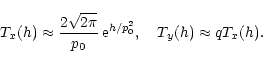
p02=2 and
with
p02=2 and
 (see Eq. (17) and discussion around).
First we consider the parameter space. In Sect. 2.2 we show that q
should be restricted to some domain,
 ,
to have the
logarithmic model physical sense;
,
to have the
logarithmic model physical sense;
 .
This subspace
defines in the hq-plane the "physical region'' where the density is positive
everywhere. This is sketched in Fig. 13 where we see that for
.
This subspace
defines in the hq-plane the "physical region'' where the density is positive
everywhere. This is sketched in Fig. 13 where we see that for
 ,
the physical region is restricted to
,
the physical region is restricted to
 .
For
.
For
 no bounds for q exist. Therefore to explore the dynamics for generic values
of the energy (
),
q0*=0.71 is a good lower bound for q.
no bounds for q exist. Therefore to explore the dynamics for generic values
of the energy (
),
q0*=0.71 is a good lower bound for q.
![\begin{figure}
\par\includegraphics[height=8.4cm,angle=-90]{H1686f32.ps}\end{figure}](/articles/aas/full/2000/20/h1686/img385.gif) |
Figure 13:
Parameter space (h,q) of the logarithmic Hamiltonian (17).
The physical region is determined by
where
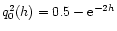 (see Sect. 2.2 and text)
 |
Next we discuss the stability of the long-axis and short-axis periodic orbits. The stability analysis is done by means of a standard Floquet technique and using the fact that both orbits are periodic orbits of 1D Hamiltonians with period Tx and Ty, respectively. Let us summarise the procedure.
From (17) and denoting, as before, by  the potential, for
the long-axis periodic orbit, we have
the potential, for
the long-axis periodic orbit, we have
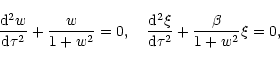
 be a Tx-periodic solution for x(t). Consider now
the normal variational equations to the latter vector field for
,
that is,
be a Tx-periodic solution for x(t). Consider now
the normal variational equations to the latter vector field for
,
that is,
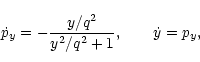
 a
Sy-periodic solution for z(s)
(Sy=Ty/q). The normal variational
equations are then
a
Sy-periodic solution for z(s)
(Sy=Ty/q). The normal variational
equations are then
 and
and
 while, for the
y-axis orbit,
while, for the
y-axis orbit,
 and
and
 Therefore, the stability of both
orbits can be studied in the
Therefore, the stability of both
orbits can be studied in the  -plane. The region defined by
 corresponds to the y-axis orbit while that where
 to the x-axis orbit.
The first in (31) leads to

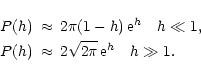
 for the x- and y-axis orbit,
respectively. So, in terms of the original variables like in (16),
for the x- and y-axis orbit,
respectively. So, in terms of the original variables like in (16),
 and for
 we get
The stability index is defined, as usual, by the trace of the monodromy matrix
associated to (31). That is, defining
 and
and
 ,
the second in (31) can be written
as
,
the second in (31) can be written
as
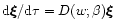 where D is the
 differential matrix
 .
Thus if we write
.
Thus if we write
 ,
being
,
being
 any initial condition and
 ,
then
,
then  satisfies the equation,
 is a P(h)-periodic solution of the first
in (31) or of (32). The monodromy matrix is, by definition,
M=A(P(h)). To compute M we have to solve (34). However, as the flow
is invariant by the change
is a P(h)-periodic solution of the first
in (31) or of (32). The monodromy matrix is, by definition,
M=A(P(h)). To compute M we have to solve (34). However, as the flow
is invariant by the change
 ,
then one
has
A11=A22, using the symplectic character of .
So to get
Tr(M) it is enough to solve for the first column of A. A periodic
orbit is linearly stable (unstable) if
,
then one
has
A11=A22, using the symplectic character of .
So to get
Tr(M) it is enough to solve for the first column of A. A periodic
orbit is linearly stable (unstable) if
 (>2). In case
 ,
the orbit is said to be marginal stable. For these
particular periodic orbits of the logarithmic potential, one has immediately
that
,
the orbit is said to be marginal stable. For these
particular periodic orbits of the logarithmic potential, one has immediately
that
 .
So, instability comes only from
.
So, instability comes only from
 .
This is due to the fact that
.
This is due to the fact that
 is
P/2-periodic, so
M=A(P/2)2 and as A(P/2) is real symplectic, M
cannot have negative eigenvalues.
is
P/2-periodic, so
M=A(P/2)2 and as A(P/2) is real symplectic, M
cannot have negative eigenvalues.
In Fig. 14a we present the stability diagram of both periodic orbits
for
 (i.e., a true energy interval about
[-4.6,25.4])
and
(i.e., a true energy interval about
[-4.6,25.4])
and
 .
The region defined by
.
The region defined by
 corresponds to the
stability diagram of the y-axis orbit while that for
corresponds to the
stability diagram of the y-axis orbit while that for
 to the x-axis orbit. We plot in grey those zones where
,
in white those where
to the x-axis orbit. We plot in grey those zones where
,
in white those where
 and the lines are level curves of
.
From
and the lines are level curves of
.
From
 (
( integer) emanate the
so-called instability tongues. This behaviour is due to the parametric
resonance. Indeed, the second in (31) for small h can be written as
integer) emanate the
so-called instability tongues. This behaviour is due to the parametric
resonance. Indeed, the second in (31) for small h can be written as
![$\ddot{\xi}+[\beta+\mu(h)c(t)]\xi=0$](/articles/aas/full/2000/20/h1686/img428.gif) where c(t) is periodic and
where c(t) is periodic and  .
For general P-periodic c(t), for instance,
.
For general P-periodic c(t), for instance,
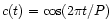 ,
the
instability tongues would emanate from
,
the
instability tongues would emanate from
 .
This is the well
known result for the classical Mathieu equation (see, for example, Broer &
Levi 1995 and references therein as well as Broer & Simó 1998
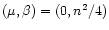
for the related unfoldings). However, in our case, the instability
tongues emanating from
(0,(2k+1)2/4) do not show up and only appear at
(0,n2).
.
This is the well
known result for the classical Mathieu equation (see, for example, Broer &
Levi 1995 and references therein as well as Broer & Simó 1998
for the related unfoldings). However, in our case, the instability
tongues emanating from
(0,(2k+1)2/4) do not show up and only appear at
(0,n2).
It is also worth to mention that the boundaries of the instability zones
(
 in the present case) correspond to values of
  for
which the second equation in (31) has a periodic solution with the
same period of the first in (31). This periodic solution performs n
full oscillations (i.e., it has exactly 2n changes of sign) for any point on
the boundary of the n-instability tongue, counted from the bottom. The
differences between the two boundaries are as follows: assume that the
first in (31) is started, at
for
which the second equation in (31) has a periodic solution with the
same period of the first in (31). This periodic solution performs n
full oscillations (i.e., it has exactly 2n changes of sign) for any point on
the boundary of the n-instability tongue, counted from the bottom. The
differences between the two boundaries are as follows: assume that the
first in (31) is started, at  with w=0 and
 .
Then, for the lower boundary, the
periodic solution of the variational equation is the first column of the
matrix A, the upper boundary is the second column. In an equivalent way,
the monodromy matrix, M, has in both cases 1 at the diagonal, and
for the lower boundary, M21=0,
.
Then, for the lower boundary, the
periodic solution of the variational equation is the first column of the
matrix A, the upper boundary is the second column. In an equivalent way,
the monodromy matrix, M, has in both cases 1 at the diagonal, and
for the lower boundary, M21=0,
 ,
while
,
while
 ,
M12= 0 for the upper one.
,
M12= 0 for the upper one.
As long as h increases, the unstable zones become wider. Note that the width
of these zones approaches asymptotically to a fixed value,
 (see Appendix for a proof of this claim). This is more evident for
 ,
where the stability regions are extremely narrow at high energies. The
convergence of
,
where the stability regions are extremely narrow at high energies. The
convergence of
 is the faster the smaller is n. For larger
values of ,
is the faster the smaller is n. For larger
values of ,
 ,
the stability zones (for the x-axis orbit)
become significant. Nevertheless almost all of them lie in the unphysical
domain. In Fig. 14b we restrict the parameter space to the physical
domain,
,
the stability zones (for the x-axis orbit)
become significant. Nevertheless almost all of them lie in the unphysical
domain. In Fig. 14b we restrict the parameter space to the physical
domain,
 ,
where we see that for large h(
,
where we see that for large h(
 ), the region is bounded by
 while for small
h (
while for small
h (
 ),
),
 .
In this figure
we plot in dark grey the unstable zones inside the physical region. We observe
that the y-axis periodic orbit (
.
In this figure
we plot in dark grey the unstable zones inside the physical region. We observe
that the y-axis periodic orbit ( )
is always unstable except in
some zone of the "harmonic oscillator regime'' (
)
is always unstable except in
some zone of the "harmonic oscillator regime'' ( ). In this regime and for
 the y-axis orbit is unstable if
 is close to 1,
due to the parametric resonance. On the other hand, the x-axis orbit
(
is close to 1,
due to the parametric resonance. On the other hand, the x-axis orbit
( )
appears to be always stable in the low energy regime. Only a very
narrow zone of instability is present, for
)
appears to be always stable in the low energy regime. Only a very
narrow zone of instability is present, for
 and
and
 (
(
 ). In the range
 ,
the x-axis orbit can be either
stable or unstable. The stability zone becomes very narrow when we approach
,
the x-axis orbit can be either
stable or unstable. The stability zone becomes very narrow when we approach
 ;
is confined to a small interval of the form
;
is confined to a small interval of the form
 ,
where
,
where
 as
as
 ,
,
 close to 1 and, for instance,
 ,
,
 ,
,
 for h=5, 15, 25, respectively. For large energies,
 ,
the x-axis orbit is unstable except for q extremely close to 1.
Note that for
,
the x-axis orbit is unstable except for q extremely close to 1.
Note that for
 ,
this orbit is stable in two different
intervals, one is that mentioned above and, the second one, starts just beyond
the physical region, at
,
this orbit is stable in two different
intervals, one is that mentioned above and, the second one, starts just beyond
the physical region, at
 (
(
 ). The latter
result confirms the conjecture given by MS89 about the border of this second
stability domain.
). The latter
result confirms the conjecture given by MS89 about the border of this second
stability domain.
To complete this section let us say a few words about the 1:1 periodic orbit.
As we have already mentioned in Sect. 2, this orbit is always stable
for any physical value of q. Using the formulation given in that section,
the
rotation period for this orbit can be approximated by
 .
This estimation is obtained using the fact that
if
.
This estimation is obtained using the fact that
if  is not too large, the 1:1 orbit is nearly circular and then
 ,
where a is the circular radius given
by (12) and
,
where a is the circular radius given
by (12) and  ,
the circular speed, is approximately p0.
From (33) and (35) for
,
we obtain
,
the circular speed, is approximately p0.
From (33) and (35) for
,
we obtain

 ,
that lead to loop
(1:1), pretzel (4:3), fish (3:2), banana (2:1) and other high order resonances
(5:4, 7:5, 5:3, for instance) - see MS89 for the terminology on the periodic
orbits and several illustrations. All of them are surrounded by a stochastic
layer where the associated unstable periodic orbits lie. It seems that, for
these particular values of h and q, all the layers are connected in a single
stochastic channel. For comparatively large energies, box orbits
disappear leading to boxlets. Certainly, within the loop domain, some
isolated chaotic zones should exist.
,
that lead to loop
(1:1), pretzel (4:3), fish (3:2), banana (2:1) and other high order resonances
(5:4, 7:5, 5:3, for instance) - see MS89 for the terminology on the periodic
orbits and several illustrations. All of them are surrounded by a stochastic
layer where the associated unstable periodic orbits lie. It seems that, for
these particular values of h and q, all the layers are connected in a single
stochastic channel. For comparatively large energies, box orbits
disappear leading to boxlets. Certainly, within the loop domain, some
isolated chaotic zones should exist.
An interesting aspect to investigate is the connection between different
stochastic regions. The results given in Sect. 4.2 for
 and q=0.7, show that the stochastic layer around the 1:1 resonance is not
connected with that of the 4:3. The same happens with the layers surrounding
the 4:3 and 3:2, 3:2 and 5:3, 5:3 and 2:1 resonances. It it clear that the
overlap would occur at higher energies. A formal way to investigate connections
between different resonances (heteroclinic connections) would be to follow the
evolution of any initial condition taken along the unstable manifold associated
to each resonance. However, in this case this approach is not so simple. The
periodic points associated to, for instance, the 4:3 and the 3:2 resonances
change their location and stability properties as h varies. For example, in
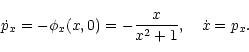
Fig. 15 the most relevant hyperbolic points lie on the px axis, but
for lower energies, some of them appear as elliptic on this axis.
So, to locate the unstable manifolds, we should look for the hyperbolic points
somewhere out of the px axis. While this is not a serious complication
we have taken a simpler approach.
and q=0.7, show that the stochastic layer around the 1:1 resonance is not
connected with that of the 4:3. The same happens with the layers surrounding
the 4:3 and 3:2, 3:2 and 5:3, 5:3 and 2:1 resonances. It it clear that the
overlap would occur at higher energies. A formal way to investigate connections
between different resonances (heteroclinic connections) would be to follow the
evolution of any initial condition taken along the unstable manifold associated
to each resonance. However, in this case this approach is not so simple. The
periodic points associated to, for instance, the 4:3 and the 3:2 resonances
change their location and stability properties as h varies. For example, in
Fig. 15 the most relevant hyperbolic points lie on the px axis, but
for lower energies, some of them appear as elliptic on this axis.
So, to locate the unstable manifolds, we should look for the hyperbolic points
somewhere out of the px axis. While this is not a serious complication
we have taken a simpler approach.
Therefore we consider the connection between the stochastic
layers surrounding the 1:1 and 2:1 resonances. That is, we deal with the problem
of finding h such that a point close to the origin at t=0 is close to the
border of the section at t=T. So, the derived critical energy,
 is an
upper bound to connections with other stochastic layers between them. We study
the energy range
[-0.4,7.6], about [2.1,6.1] in dimensionless units, with
step 0.1 and three representative values of q, 0.9, 0.8 and 0.71.
For each energy level we take two
orbits such that, at t=0 one is close to
(x,px)=(0,0) and the other close
to
(0,p*x(h)), where
is an
upper bound to connections with other stochastic layers between them. We study
the energy range
[-0.4,7.6], about [2.1,6.1] in dimensionless units, with
step 0.1 and three representative values of q, 0.9, 0.8 and 0.71.
For each energy level we take two
orbits such that, at t=0 one is close to
(x,px)=(0,0) and the other close
to
(0,p*x(h)), where
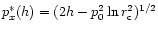 .
Typically we take
.
Typically we take
 and
and
 with
with
 The
reason to take
The
reason to take  so small is due to the structure of the stochastic
layer (if it exists, that is, if the orbit is unstable). The external part of
the layer, close to the border, is populated by many small resonances. If the
initial condition falls inside any of them, the orbit will be confined there forever.
On the other hand the central part of the layer, around the separatrix, looks
like ergodic and therefore it appears to be appropriate to take the initial
condition in this part (for details, see Chirikov 1979, Sect. 6).
so small is due to the structure of the stochastic
layer (if it exists, that is, if the orbit is unstable). The external part of
the layer, close to the border, is populated by many small resonances. If the
initial condition falls inside any of them, the orbit will be confined there forever.
On the other hand the central part of the layer, around the separatrix, looks
like ergodic and therefore it appears to be appropriate to take the initial
condition in this part (for details, see Chirikov 1979, Sect. 6).
Next, using the transformation given in Sect. 3, we pass to the
variables
(x1, x3) defined in (20). In this way
 .
Each point is followed during
.
Each point is followed during  consequents on the Poincaré
section y=x2=0. During the computation we
restrict the attention to a small x1 interval centered at the origin,
typically,
consequents on the Poincaré
section y=x2=0. During the computation we
restrict the attention to a small x1 interval centered at the origin,
typically,
 .
Within this interval we look for the maximum
distance between
.
Within this interval we look for the maximum
distance between
 and the points (0,0) and
(0,1). Then we define the width of the layer as
and the points (0,0) and
(0,1). Then we define the width of the layer as
 ;
;
 depending whether we start from
the neighbourhood of the short-axis or long-axis orbit, respectively. The
results are presented in Fig. 16 where we include the computed LCN,
depending whether we start from
the neighbourhood of the short-axis or long-axis orbit, respectively. The
results are presented in Fig. 16 where we include the computed LCN,
 ,
(actually,
,
(actually,
 using the MEGNO)
for the same orbits and for a motion time,
using the MEGNO)
for the same orbits and for a motion time,
 ,
with Tx(h) given by (33).
,
with Tx(h) given by (33).
The criterion to determine
 ,
for which the layers are connected, is
,
for which the layers are connected, is
 .
But W depends also on time:
.
But W depends also on time:  (resp.
  )
would
increase (resp. decrease) with T. The results shown in Fig. 16 are
for a given motion time,
)
would
increase (resp. decrease) with T. The results shown in Fig. 16 are
for a given motion time,
 ,
which appears to be large
enough for our purpose. A dependence with respect to the initial conditions has
to be expected too. Take, for instance, the plot for q=0.9. The layers are
clearly connected at very high energies, beyond
,
which appears to be large
enough for our purpose. A dependence with respect to the initial conditions has
to be expected too. Take, for instance, the plot for q=0.9. The layers are
clearly connected at very high energies, beyond
 .
The layer around
the 1:1 resonance increases its width discontinuously except in some energy
interval,
.
The layer around
the 1:1 resonance increases its width discontinuously except in some energy
interval,
 ,
where it decreases. This may be due, perhaps, to
the appearance of the 4:3 elliptic point on the px axis. The abrupt change in
the width observed at
,
where it decreases. This may be due, perhaps, to
the appearance of the 4:3 elliptic point on the px axis. The abrupt change in
the width observed at
 ,
4.6, 5.5 could be attributed to
connections with the layers of the 4:3, 3:2 and 5:3 resonances, respectively.
The LCN for the 1:1 stochastic layer decreases monotonically with h without
major deviations. This reduction of the LCN with h is due to the exponential
dependence of the period with h (see below).
,
4.6, 5.5 could be attributed to
connections with the layers of the 4:3, 3:2 and 5:3 resonances, respectively.
The LCN for the 1:1 stochastic layer decreases monotonically with h without
major deviations. This reduction of the LCN with h is due to the exponential
dependence of the period with h (see below).
The x-axis orbits look stable for small h, as the LCN indicate. For
 it turns unstable but the stochastic layer is rather thin,
is
very close to 1 for
it turns unstable but the stochastic layer is rather thin,
is
very close to 1 for
 The values of the LCN suggest that the layers
could be connected at
The values of the LCN suggest that the layers
could be connected at
 while
reaches
at
.
Along the range
while
reaches
at
.
Along the range
 ,
and
are close one another.
Therefore the critical value
,
and
are close one another.
Therefore the critical value
 lies somewhere between (5.6, 5.9).
A similar picture is observed for q=0.8 and 0.71, but the overlap of the
layers takes place for smaller h as q decreases. A simple inspection of the
figures suggests that
 and
and
 .
In the last
case (q=0.71) we observe a zone beyond
.
In the last
case (q=0.71) we observe a zone beyond  ,
,
where the
layers appear unconnected. It may occur that some KAM curve actually exists,
acting as a barrier to the diffusion or, perhaps, that a larger motion time
would be necessary. In this direction, a few surfaces of section performed for
these values of h and q, but for much larger motion times, do not provide
any definitive answer. Anyway, in this interval,
and
are very
similar. The main difference between the three figures is that, while for
q=0.9
reaches values close to 0.9, for q=0.8 and 0.71
does not
exceed 0.6.
,
,
where the
layers appear unconnected. It may occur that some KAM curve actually exists,
acting as a barrier to the diffusion or, perhaps, that a larger motion time
would be necessary. In this direction, a few surfaces of section performed for
these values of h and q, but for much larger motion times, do not provide
any definitive answer. Anyway, in this interval,
and
are very
similar. The main difference between the three figures is that, while for
q=0.9
reaches values close to 0.9, for q=0.8 and 0.71
does not
exceed 0.6.
An interesting point is that
 for the gross stochastic layer
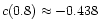
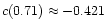
decreases linearly with h. We fit by least squares the function
for the gross stochastic layer
decreases linearly with h. We fit by least squares the function
 ,
,
 ,
,
 ;
;
 ,
,
 ,
,
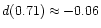 .
These estimations reveal that the LCN for the layer does not depend strongly on
q, being the latter number sensitive to just one parameter, h.
Nevertheless, in (36) we do not take into account the dependence of
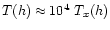
Tx on h. That is, Tx(h) was considered above only to make the
computation of the LCN over similar time-scales for different energy surfaces.
Therefore to obtain a meaningful result we should calculate
.
These estimations reveal that the LCN for the layer does not depend strongly on
q, being the latter number sensitive to just one parameter, h.
Nevertheless, in (36) we do not take into account the dependence of
Tx on h. That is, Tx(h) was considered above only to make the
computation of the LCN over similar time-scales for different energy surfaces.
Therefore to obtain a meaningful result we should calculate
 .
Assuming that the values -0.44, -0.08 are representative for c(q) and
d(q), respectively, then using (33) for Tx(h) and scaling
in (36)
.
Assuming that the values -0.44, -0.08 are representative for c(q) and
d(q), respectively, then using (33) for Tx(h) and scaling
in (36)
 with p02=2 and
,
it is
straightforward to get
with p02=2 and
,
it is
straightforward to get

 ,
which is consistent with the values obtained in Sect. 4.2.
This result is shown in Fig. 17 where we observe that
,
which is consistent with the values obtained in Sect. 4.2.
This result is shown in Fig. 17 where we observe that
 is
nearly constant, the smaller is q the larger is
.
In any case, the LCN is bounded by
is
nearly constant, the smaller is q the larger is
.
In any case, the LCN is bounded by
 .
.
![\begin{figure}
\par\includegraphics[height=78mm,angle=-90]{H1686f43.ps}\end{figure}](/articles/aas/full/2000/20/h1686/img513.gif) |
Figure 17:
Dependence of
on h for the 1:1 stochastic layer
and three different values of q. For the computation we use the values of the
LCN presented in Fig. 16 and Tx given by (33). See text |
The results presented in this section suggest that the motion in the
logarithmic potential is mainly regular. As the energy increases, irregular
motion appears confined to comparatively narrow stochastic layers. Connections
among them occur at moderate-to-large energies and through thin filaments.
An interesting fact is that the Lyapunov time, for the main stochastic zone, is
rather short and almost independent of h and q.
Note that, a similar calculation to that performed in Fig. 9 but
for
 would lead, for "boxes'', to a completely chaotic scenario.
But this is due to the choice of the one dimensional initial condition space
on the xpx-plane (the px axis). As mentioned in Sect. 4.2,
initial conditions taken along a maximum circle on the 2D sphere
(see Fig. 6) would provide a more realistic picture.
would lead, for "boxes'', to a completely chaotic scenario.
But this is due to the choice of the one dimensional initial condition space
on the xpx-plane (the px axis). As mentioned in Sect. 4.2,
initial conditions taken along a maximum circle on the 2D sphere
(see Fig. 6) would provide a more realistic picture.
Another point that should be mentioned is that for large energies, say
,
the dynamics becomes almost independent of h, being q the
relevant parameter. In this direction, Fig. 15 is representative of the
general structure of the phase space associated to the logarithmic potential at
different q levels. In fact, as h increases, the potential model approaches
to the singular logarithmic potential, where the relevant parameter
is only q (see Appendix).
Copyright The European Southern Observatory (ESO)
![\begin{figure}
{(a)~Stability diagram in the $h\beta$ -plane (b)~Restricted to t...
...m}
\includegraphics[height=88mm,angle=-90]{H1686f34.ps}\end{tabular}\end{figure}](/articles/aas/full/2000/20/h1686/img386.gif)





![\begin{figure}
\par {$h=15,\, q=0.95$\quad$h=7,\, q=0.75 $ } %
\par\includegraph...
...90]{H1686f35.ps}\includegraphics[height=85mm,angle=-90]{H1686f36.ps}\end{figure}](/articles/aas/full/2000/20/h1686/img437.gif)
 a:b) and their
associated stochastic layers (see text)
a:b) and their
associated stochastic layers (see text)
![\begin{figure}
\par {$q=0.9$\quad$q=0.8$\quad$q=0.71$ }
\par\includegraphics[wid...
...hspace*{2mm}
\includegraphics[width=24mm,angle=-90]{H1686f42.ps}\par\end{figure}](/articles/aas/full/2000/20/h1686/img469.gif)
 after
after
 for both layers. See text for details