

Levelling and reducing the contamination of the antenna temperature by ground
emission is an important requirement in survey experiments for mapping the
non-thermal component of the Galactic emission background. In the
zenith-centered 1-rpm circular scans of the GEM experiment this is achieved by
using a wire mesh fence around a rim-halo shielded antenna.
Without the fence, a prohibitive variable component
of ground contamination compromises the data taken with this portable 5.5-m
dish in the Southern Hemisphere at 1465MHz with a mean amplitude of
 þK above the level of a uniform azimuth-independent
component. With the fence, the level of a uniform component was obtained
by comparing differential measurements of the antenna temperature
toward selected regions of the sky with model predictions of the spillover and
diffraction sidelobes.
þK above the level of a uniform azimuth-independent
component. With the fence, the level of a uniform component was obtained
by comparing differential measurements of the antenna temperature
toward selected regions of the sky with model predictions of the spillover and
diffraction sidelobes.
First of all, the model allowed us to investigate the shielding performance of the
experiment using the fully measured beam patterns of the GEM backfire helical
feeds at 408MHz and 1465MHz. We concluded that far-field diffraction effects dominate a
weakly-diffracting and unshielded antenna scenario whereas near-field
effects dominate a stronger-diffracting and double-shielded scenario.
Furthermore, the shielding efficiency of the experiment could be quantified in terms
of the normalized cumulative ratio  of the spillover-induced transmission
to the overall sidelobe contamination in the zenith angle range
of the spillover-induced transmission
to the overall sidelobe contamination in the zenith angle range
 .
If the shielding is low enough, spillover sidelobe
suppression will ensue, since the ground temperature angular distribution can
introduce an upper cut-off in the relative power response of the feed. A critical
element in the analysis is introduced, however, by the need to account for the
asymmetric response of the feed and which seems, most likely, to result from
imperfect alignment of the feed axis on the measuring stand and along the optical
axis of the secondary. We used the near sidelobe pattern (out to some
.
If the shielding is low enough, spillover sidelobe
suppression will ensue, since the ground temperature angular distribution can
introduce an upper cut-off in the relative power response of the feed. A critical
element in the analysis is introduced, however, by the need to account for the
asymmetric response of the feed and which seems, most likely, to result from
imperfect alignment of the feed axis on the measuring stand and along the optical
axis of the secondary. We used the near sidelobe pattern (out to some
 from axis) of the radiotelescope to ressolve the issue.
Finally, we applied atmospheric and Galactic corrections to
the differential measurements before comparing the residual signal with the
model predictions for the level of ground contamination. The choice of sky
directions away from the Galactic Plane led to contributions from the sky between
 and
and
 which were as high, but not larger, than the ones
expected from the emission of the atmosphere. The former were derived from a
template sky with a sensitivity of 20þmK based on GEM data taken at 1465MHz in
the Southern sky with a
which were as high, but not larger, than the ones
expected from the emission of the atmosphere. The former were derived from a
template sky with a sensitivity of 20þmK based on GEM data taken at 1465MHz in
the Southern sky with a
 .
.
The corrected test measurements match the model predictions if we introduce
a screening efficiency factor  which shows strict and separate linear
correlations with the differential ground contamination and its diffraction
components generated at the shields.
Consequently, it suffices that the (total) differential ground contamination
be known, for its spillover and diffracted components to be identified uniquely.
With the refined model (
which shows strict and separate linear
correlations with the differential ground contamination and its diffraction
components generated at the shields.
Consequently, it suffices that the (total) differential ground contamination
be known, for its spillover and diffracted components to be identified uniquely.
With the refined model (
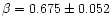 )
a uniform level of ground
contamination is estimated at
)
a uniform level of ground
contamination is estimated at
 þK with a spillover-to-diffraction
component ratio of
þK with a spillover-to-diffraction
component ratio of  .
This is a spillover dominated scenario with
.
This is a spillover dominated scenario with
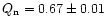 and decreasing diffraction sidelobes with increasing
Z.
and decreasing diffraction sidelobes with increasing
Z.
Acknowledgements
The authors are particularly in debt to A.M. Alves, L. Arantes, E.R. Rodrigues, A.P. da Silva and Rogério R. de Souza for technical and observational support. We are also grateful to the LIT-INPE Antennas Group for its collaboration during the feed pattern measurements. The GEM project in Brazil is presently being supported by FAPESP through grants 97/03861-2 and 97/06794-4. M. Bersanelli acknowledges the support of the NATO Collaborative Grant CRG960175.
Copyright The European Southern Observatory (ESO)