

Apparent bolometric magnitudes could be computed for 126 Henize S stars
by integrating the spectral energy distribution derived from the
Geneva U, B and V bands (
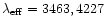 and
5488 Å, respectively) and
from the SAAO J, H, K and L bands
(
and
5488 Å, respectively) and
from the SAAO J, H, K and L bands
(
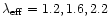 and 3.4
  m, respectively).
All the photometry was corrected from interstellar reddening
as described in Sects. 3.3 and 4.
The flux calibration for the SAAO photometry was kindly
provided by Dr. I. Glass (1999, priv. comm.);
for the Geneva photometry, it is taken from
Rufener & Nicolet (1988).
No correction has been applied for the contribution of
the flux longward of 3.4 m which is generally quite small (<
5% of the total energy distribution; Glass & Feast 1973).
These apparent bolometric magnitudes are listed in the column
m, respectively).
All the photometry was corrected from interstellar reddening
as described in Sects. 3.3 and 4.
The flux calibration for the SAAO photometry was kindly
provided by Dr. I. Glass (1999, priv. comm.);
for the Geneva photometry, it is taken from
Rufener & Nicolet (1988).
No correction has been applied for the contribution of
the flux longward of 3.4 m which is generally quite small (<
5% of the total energy distribution; Glass & Feast 1973).
These apparent bolometric magnitudes are listed in the column
 in Table 5.
Unfortunately these bolometric magnitudes are only available
for 126 stars.
A second estimate of the bolometric magnitudes has thus been performed;
it is less restrictive but also far less accurate.
Multivariate classification has been performed on the 205
S stars of the Henize sample (Sect. 8 and Paper III),
resulting in a classification of the stars in 6 well-defined and rather
homogeneous groups (Sect. 8 and Paper III).
For each group, a bolometric correction in the V band (BCV)
has been derived from the stars that have
a reliable apparent bolometric magnitude available from the
integration of the UBVJHKL fluxes.
Thanks to these average bolometric corrections, apparent
bolometric magnitudes could be computed for the 170 stars
with a V magnitude available.
These apparent bolometric magnitudes are listed in the column
 of Table 5.
Copyright The European Southern Observatory (ESO)