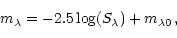
The work of Fouqué et al. ([1999]) focuses on the absolute photometric calibration of the DENIS data. This calibration, once completed after the termination of the survey, might induce a systematic shift on the photometry of the present catalogue.
 |
(1) |
 level are rejected in
the sum. The four I quadrants are treated separately. This is also
done for each of the 9 sub-images in the J and
level are rejected in
the sum. The four I quadrants are treated separately. This is also
done for each of the 9 sub-images in the J and  bands.
As a second step we select low-background images from the sunrise
sequence (180 in a normal strip) with a low background value.
To identify and
avoid crowded fields and fields affected by saturated stars
we combine measurements taken during different nights. We then
determine the flat Fi,j and the bias Bi,j by minimizing the
expression:
 ).
In the third step, we
applied the new values of the flat and the bias to the set of selected
images to obtain a new estimate of the background value, more
appropriate to the particular night. The quality of the determination
of the parameters involved is improved by iteration of the above
procedure.
).
In the third step, we
applied the new values of the flat and the bias to the set of selected
images to obtain a new estimate of the background value, more
appropriate to the particular night. The quality of the determination
of the parameters involved is improved by iteration of the above
procedure.
The bias so far determined is a mean value for the night. Because it
varies during the night, its value for a given strip is estimated to
be:
band and a higher
number of iterations is sometimes necessary.
The large number of available flat/bias-images (180) gives a quite high degree of statistical confidence to both determinations. This is not true in case of calibration sequences that involve only 8images. In this case, the bias determined for the strip nearest in time is applied.
channels is
 and the sampling is
 in both directions. The real width of any point source is
therefore potentially narrower than the pixel (
). In terms
of signal processing the sources are not under-sampled, but the width of
the filter is broader than the sampling. To estimate the width of the
signal the convolution of the signal profile (assumed to be
elliptical) and the pixel size has been taken into account. The
method of least squares has been applied to the projection of sources
onto RA, DEC and diagonal axes (Borsenberger [1997]). In the Iand the J bands there are enough sources to build a model that
describes the behaviour of the projected widths in each image. In the
band several images were stacked together prior to the
determination.
in both directions. The real width of any point source is
therefore potentially narrower than the pixel (
). In terms
of signal processing the sources are not under-sampled, but the width of
the filter is broader than the sampling. To estimate the width of the
signal the convolution of the signal profile (assumed to be
elliptical) and the pixel size has been taken into account. The
method of least squares has been applied to the projection of sources
onto RA, DEC and diagonal axes (Borsenberger [1997]). In the Iand the J bands there are enough sources to build a model that
describes the behaviour of the projected widths in each image. In the
band several images were stacked together prior to the
determination.
We refer to http://www-denis.iap.fr/docs/tenerife.html for more details on the PDAC data reduction.
.
An absolute calibration,
together with a definition of DENIS photometric bands is given by
Fouqué et al. ([1999]).
The standard position accuracy derived is RMS 0.001 arcsec with maximum excursions of 1.32 arcsec. This error is in addition to the RMS of 0.3 arcsec of the astrometric reference catalogue.
 in
diameter after a de-blending process, that determines which pixels
are within the aperture, and what fraction they contribute to each
individual source (Bertin & Arnouts [1996]). This aperture
collects
in
diameter after a de-blending process, that determines which pixels
are within the aperture, and what fraction they contribute to each
individual source (Bertin & Arnouts [1996]). This aperture
collects  of the light when considering a seeing of
 and the pixel size of
for the infrared wave bands. For
homogeneity we used the same aperture also for the I band. The
source magnitude (m) corresponding to the wavelength
and the pixel size of
for the infrared wave bands. For
homogeneity we used the same aperture also for the I band. The
source magnitude (m) corresponding to the wavelength  is
defined as:
is
defined as:
 is the observed flux and
 defines
the zero-point of the magnitude scale at the wavelength .
The determination of the instrumental quantity
to
correct the stellar magnitude for atmospheric effects is done on a
nightly basis. First, standard star measurements are matched with the
information stored in the standard star catalogue. Second the
instrumental zero-point (
)
is derived for each of the
eight measurements of the standard star assuming a fixed extinction
coefficient,
defines
the zero-point of the magnitude scale at the wavelength .
The determination of the instrumental quantity
to
correct the stellar magnitude for atmospheric effects is done on a
nightly basis. First, standard star measurements are matched with the
information stored in the standard star catalogue. Second the
instrumental zero-point (
)
is derived for each of the
eight measurements of the standard star assuming a fixed extinction
coefficient,  (Eq. 6). The adopted values of
are 0.05 for the I band and 0.1 for both the J and
bands. These values have been determined from the photometric
measurements performed during calibration nights (nights where only
standard stars were observed).
is the flux as measured at a
given air mass (z). Standard stars were selected near the
airmass limit of the strips and to be roughly of the same spectral
type; this simplifies the Taylor expression used to describe the
extinction law because colour terms (Guglielmo et al. [1996])
and the non-linear terms are of minor importance; in the infrared the
dependence of the extinction on z is almost linear for z<2.
In principle, both
and
can be determined
simultaneously and the non-linear terms can be incorporated as well
if a sufficient number of star measurements are available,
but for a single night there are not enough, in fact the
use of the approximated law (Eq. 6) gives a systematic offset between
the magnitude of the source in the overlap of two strips of
comparable, but different,
photometric conditions. After a considerable investigation
it turned out that this offset could be greatly reduced if a fixed
extinction coefficient is used.
Some differences are left when the observations have been
performed in different photometric conditions or when too few standard
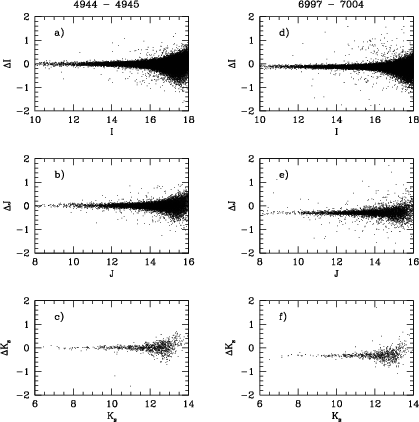
star measurements were done. Figure 1 shows the computed
differences between the magnitudes of the sources detected in the
overlapping region of two strips observed under comparable photometric
conditions ((a), (b), (c)) and of two strips observed with different
photometric conditions ((d), (e), (f)) in the I, J and bands, respectively. Faint sources give rise to a larger dispersion. The
systematic shift is clearly visible in Figs. 1d-f.
(Eq. 6). The adopted values of
are 0.05 for the I band and 0.1 for both the J and
bands. These values have been determined from the photometric
measurements performed during calibration nights (nights where only
standard stars were observed).
is the flux as measured at a
given air mass (z). Standard stars were selected near the
airmass limit of the strips and to be roughly of the same spectral
type; this simplifies the Taylor expression used to describe the
extinction law because colour terms (Guglielmo et al. [1996])
and the non-linear terms are of minor importance; in the infrared the
dependence of the extinction on z is almost linear for z<2.
In principle, both
and
can be determined
simultaneously and the non-linear terms can be incorporated as well
if a sufficient number of star measurements are available,
but for a single night there are not enough, in fact the
use of the approximated law (Eq. 6) gives a systematic offset between
the magnitude of the source in the overlap of two strips of
comparable, but different,
photometric conditions. After a considerable investigation
it turned out that this offset could be greatly reduced if a fixed
extinction coefficient is used.
Some differences are left when the observations have been
performed in different photometric conditions or when too few standard
star measurements were done. Figure 1 shows the computed
differences between the magnitudes of the sources detected in the
overlapping region of two strips observed under comparable photometric
conditions ((a), (b), (c)) and of two strips observed with different
photometric conditions ((d), (e), (f)) in the I, J and bands, respectively. Faint sources give rise to a larger dispersion. The
systematic shift is clearly visible in Figs. 1d-f.
The final nightly value of
,
for each wave
band, is calculated by averaging the single determinations for each
standard star and among all the standard stars observed during that
night, after removal of flagged (Sect. 4) measurements (this reduces
on average the number of measurements per star from 8 to 6). The
flagged measurements have a non-zero value for at least one of the
types of flag considered in the pipeline reduction. Only standards
fainter than I=10.5, J=8.0 and
= 6.5 mag are used. The
instrumental
and its standard deviation are listed for
each strip in the quality table (Table 8).
Mean values
(
 )
are:
)
are:
 (I),
(I),
 (J) and
 ().
().
Using the overlapping regions of adjacent strips to correct
for remaining differences we performed a
general photometric calibration, separately for the LMC and for the
SMC. We calculated the magnitude difference of cross-identified
sources between two adjacent strips of sources detected in three wave
bands. The histogram of these differences in magnitude shows when a
systematic shift is present between the two strips (Fig. 1).
In only a few cases is the average magnitude affected by more than
0.1 mag. If necessary we applied a systematic shift (Table 8).
Experience showed that if a strip is poorly
calibrated the magnitude difference in the overlap with the previous
strip has a sign opposite to the difference found in the overlap with
the next strip. Note that observing a strip in good photometric
conditions but having too few standard star measurements to perform the
calibration may induce alone this offset; the equal number of detected objects
as a function of magnitude per band
in both strips indicates, as just mentioned, a minor difference in the
photometric conditions
under which each strip was observed,
increasing the confidence we place in the correction procedure. Only
9 strips out of 108 for LMC observations and 3 strips out of
81 for SMC observations show this behaviour. Sources with corrected
magnitude are easily recognized from their strip number
associated to each detected band (Table 7).
Table 8
reports the amount of the
applied shift as a function of strip number.
In
some cases, the difference shows a dependence on declination, but the
effect on the averaged magnitude, in the area of the Magellanic
Clouds, is not significant (less than 0.1 mag), and can be ignored.
The internal statistical RMS error is between 0.001 and 0.4 mag
at the detection limit, faint sources have larger errors. For
completeness we included in the catalogue sources detected above and
below the reference saturation and detection limits, their
photometric errors (larger than 0.4 mag) show the confidence of the
detection. The standard deviation on
is in most of
the strips below 0.05 mag, but spreads from 0.01 to 0.2 mag. Larger values are detected in the strips where a photometric
shift was also applied, therefore the resulting accuracy is, for
these few cases, not better than 0.1 mag. In all other cases the
resulting accuracy has an RMS error better than 0.05 mag.
All extracted objects are matched on the basis of their geometrical
information assuming an elliptical shape (RA, DEC, a: semi-major
axis, b: semi-minor axis,  :
inclination angle) within one
wave band, among the three wave bands within a strip and among
different strips. The geometrical parameters of each object are
evaluated at the
level of the row image; a and b are the
second order moments of the pixel distribution within the size of the
photometric aperture. Typical values are
:
inclination angle) within one
wave band, among the three wave bands within a strip and among
different strips. The geometrical parameters of each object are
evaluated at the
level of the row image; a and b are the
second order moments of the pixel distribution within the size of the
photometric aperture. Typical values are
 ,
,
 and
and
 for the I, J and
band, respectively,
differences among the three wave bands mainly depend on the
differences
in sensitivity; the second order moments characterize the PSF. The
effective area used during the association procedure is 1.5 times
(tolerance) the area defined by the a and b values of
both object, when the association is performed within each band of a
strip. Sources previously de-blended are not
associated. When the association is done among different bands the
tolerance value increases to 2.5.
for the I, J and
band, respectively,
differences among the three wave bands mainly depend on the
differences
in sensitivity; the second order moments characterize the PSF. The
effective area used during the association procedure is 1.5 times
(tolerance) the area defined by the a and b values of
both object, when the association is performed within each band of a
strip. Sources previously de-blended are not
associated. When the association is done among different bands the
tolerance value increases to 2.5.
We associate two objects when the center position of one of them is
within the bounds of the ellipse of the other, even if the center of
the second is outside the ellipse of the first one, and vice versa.
For the coordinates, we always used a weighted average (based on the
signal to noise ratio and detection conditions as derived from
the source extraction program and the astrometric calibration). For
the magnitudes we decided not to average or to combine magnitudes from
different epochs (strips) because of the possible variability of a
large fraction of the detected objects. Objects associated within the
same strip are given with the average of
the magnitudes. When the association involves overlapping strips we
distinguish the following cases: (1) for objects detected in all three
wave bands in both strips we choose the entry from the strip with the
lowest value of
 ,
where N is the number of
sources detected in the overlap; (2) for objects detected in an
unequal number of wave bands, we chose the entry from the strip with
the highest number of detected wave bands; (3) for objects detected in
two different wave bands we choose the entry from the strip with the
lowest
,
including the third magnitude from
the other strip. When the strip numbers of the
detected wave bands differ the observations refer to different epochs. The
criteria given conserve the major property of the DENIS data:
simultaneousness.
,
where N is the number of
sources detected in the overlap; (2) for objects detected in an
unequal number of wave bands, we chose the entry from the strip with
the highest number of detected wave bands; (3) for objects detected in
two different wave bands we choose the entry from the strip with the
lowest
,
including the third magnitude from
the other strip. When the strip numbers of the
detected wave bands differ the observations refer to different epochs. The
criteria given conserve the major property of the DENIS data:
simultaneousness.
We refer to ftp.strw.leidenuniv.nl/pub/ldac/software/ pipeline.ps for more details on the LDAC data reduction.
Copyright The European Southern Observatory (ESO)
![\begin{displaymath}b(t)=\frac{\sum_{ij}^{N}[I_{i,j}(t)/F_{i,j}]}{N}\, ,
\end{displaymath}](/articles/aas/full/2000/11/ds1824/img37.gif)
![\begin{displaymath}\sum_{t=1}^{N} [I_{i,j} (t)- F_{i,j} b (t) - B_{i,j} ]^2\, ,
\end{displaymath}](/articles/aas/full/2000/11/ds1824/img39.gif)
![\begin{displaymath}B_{i,j} = \frac{\sum_{t=1}^{N}[I_{i,j} (t)- F_{i,j} b (t)]}{N}\, ,
\end{displaymath}](/articles/aas/full/2000/11/ds1824/img41.gif)