

We have tested the acceleration provided by OS-EM using some synthetic images generated by S. Correia and A. Richichi from Osservatorio Astrofisico di Arcetri. A complete description of these images is contained in Correia & Richichi (2000).
The first is a
 image of the spiral galaxy NGC 1288. We have
computed 4 sets of simulated observations, corresponding to 4,6,8 and
10 equispaced values of the parallactic angle
between
image of the spiral galaxy NGC 1288. We have
computed 4 sets of simulated observations, corresponding to 4,6,8 and
10 equispaced values of the parallactic angle
between  and
and  and to
an integration time of 1000 s per parallactic angle. For these
computations we have used ideal diffraction-limited PSF's, without taking into
account the rotation of the baseline during the integration time nor the
residual effect of the adaptive optics correction.
The FWHM of these PSF's in the direction of the baseline was about
4 pixels.
More realistic PSF models
will be considered in future work. Finally each image has been corrupted
by Poisson and read-out noise.
and to
an integration time of 1000 s per parallactic angle. For these
computations we have used ideal diffraction-limited PSF's, without taking into
account the rotation of the baseline during the integration time nor the
residual effect of the adaptive optics correction.
The FWHM of these PSF's in the direction of the baseline was about
4 pixels.
More realistic PSF models
will be considered in future work. Finally each image has been corrupted
by Poisson and read-out noise.
We have applied both LR/EM and OS-EM to each set of observations. The quality
of the restoration provided by the k-th iteration has been measured by
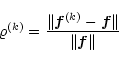
computing the relative RMS error defined as follows
 is the original image of the galaxy and the norm is the
Euclidean one.
is the original image of the galaxy and the norm is the
Euclidean one.
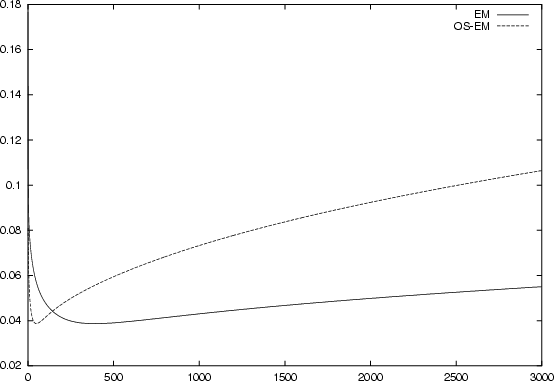
In Fig. 1 we plot the behaviour of
 as a function of k for
the two methods (full line for LR/EM, dotted line for OS-EM) when p=8.
In both cases we find a minimum of the restoration error. The number of
iterations corresponding to the minimum will be denoted by
as a function of k for
the two methods (full line for LR/EM, dotted line for OS-EM) when p=8.
In both cases we find a minimum of the restoration error. The number of
iterations corresponding to the minimum will be denoted by
 .
It is evident that
(OS-EM) is considerably smaller than
(LR/EM). The best restoration provided by
OS-EM, which practically coincides with that provided by LR/EM, is shown
in Fig. 2. All the results obtained in this example are summarized in
Table 1 where
.
It is evident that
(OS-EM) is considerably smaller than
(LR/EM). The best restoration provided by
OS-EM, which practically coincides with that provided by LR/EM, is shown
in Fig. 2. All the results obtained in this example are summarized in
Table 1 where
 denotes the minimum value of
.
Several interesting features of OS-EM result from this table.
denotes the minimum value of
.
Several interesting features of OS-EM result from this table.
| p |
|
|
|
|
| (LR/EM) | (LR/EM) | (OS-EM) | (OS-EM) | |
| 4 | 4.4% | 314 | 4.4% | 79 |
| 6 | 4.0% | 380 | 4.0% | 64 |
| 8 | 3.9% | 393 | 3.9% | 50 |
| 10 | 3.5% | 452 | 3.5% | 46 |
First we observe that OS-EM provides the same restoration error as LR/EM. This
restoration error is rather small, thanks to the high SNR assumed for the
LBT images (the peak SNR is 80). As it must be, it decreases for
increasing number of observations. Secondly the ratio between
(LR/EM) and
(OS-EM) is approximately p. As a result, while
(LR/EM) increases for increasing p,
(OS-EM) decreases.
Since the computational cost of each iteration is roughly proportional to p,
this result means that the computational cost of LR/EM rapidly increases for
increasing p, while the cost of OS-EM increases very slowly.
The second example refers to binary stars of different relative magnitude.
In the synthetic object each star is located in one pixel, with a separation
between stars of about 14 pixels, which is about 3.5 times the FWHM of
the PSF's in the direction of the baseline.
These examples confirm that OS-EM provides an acceleration of LR/EM by a factor of p. However the convergence is much slower than in the example of the galaxy; a number of iterations of the order of thousand is required by LR/EM and, of course, a number of iterations of the order of hundreds by OS-EM. Our simulations confirm a well known feature of LR/EM: extended objects are recovered with a number of iterations smaller than that required for point-like objects.
As concerns the RMS restoration errors, they are higher than in the case
of the galaxy, as a consequence of the smaller SNR: about 10% for
example 1) and about 25-30% for example 2). These RMS's are essentially
unchanged if they are computed not on the complete image but on two square
regions of  pixels centered on the positions of the two stars.
These simulations have also been used for comparing the astrometric and
photometric performances of the two methods.
Astrometric position is fully retrieved by both methods also in the case of
the faint companion. Analogously both methods provide essentially the
same photometric results. Indeed we performed
aperture photometry on the restored images using
pixels regions centered on the brightest pixel of the reconstructed stars.
In Fig. 3 we plot, as a function of the number of iterations, the relative
magnitude for the restoration of the binary with
 (Fig. 3a)
and of that with
(Fig. 3a)
and of that with
 (Fig. 3b), both
in the case of LR/EM (full-line) and in the case of OS-EM (dotted-line). The
computations are performed using 8 images. The figures show that both
methods provide essentially the same results after about 100 iterations.
A more detailed discussion of photometry and of its dependence on the
number of iterations and noise can be found in Correia & Richichi (1999).
(Fig. 3b), both
in the case of LR/EM (full-line) and in the case of OS-EM (dotted-line). The
computations are performed using 8 images. The figures show that both
methods provide essentially the same results after about 100 iterations.
A more detailed discussion of photometry and of its dependence on the
number of iterations and noise can be found in Correia & Richichi (1999).
Copyright The European Southern Observatory (ESO)
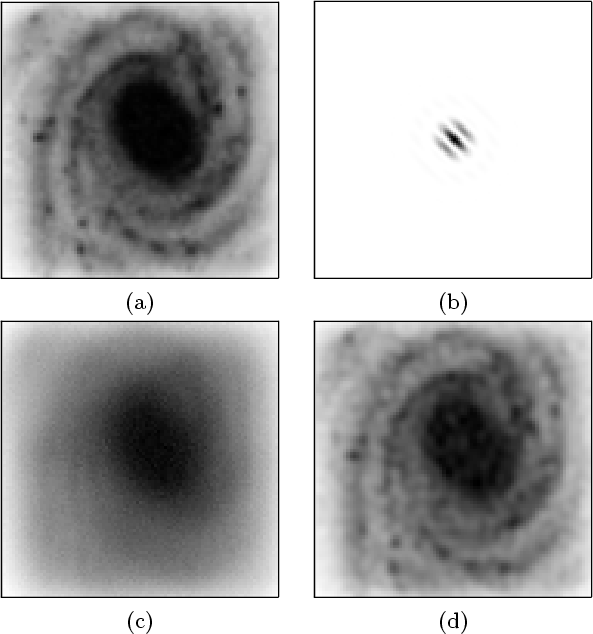
 ).
c) One of the simulated LBT images (parallactic angle =
).
c) One of the simulated LBT images (parallactic angle = 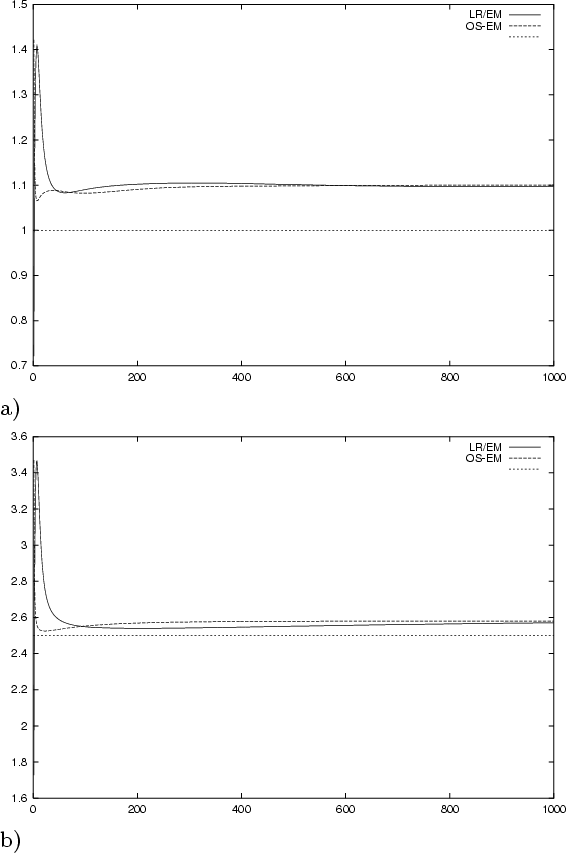
 as
a function of the number of iterations both in the case of the LR/EM-method
(full line) and in the case of the OS-EM method (dotted line).
All the computations are performed using 8 different baselines.
a) the case of binary
stars with
as
a function of the number of iterations both in the case of the LR/EM-method
(full line) and in the case of the OS-EM method (dotted line).
All the computations are performed using 8 different baselines.
a) the case of binary
stars with