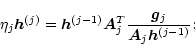
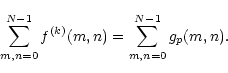
In the case of CT the modification of EM provided by OS-EM consists first in grouping the projections in ordered subsets and then in applying the standard EM algorithm to each subset, an iteration of OS-EM being a single pass through all the specified subsets. The application of OS-EM to LBT is obtained by replacing the projections with the images corresponding to different orientations of the baseline.
As we pointed out in the Introduction, we assume to have one image for each orientation angle and a small number of orientations. In such a case a quite natural choice is to take subsets consisting of one image, ordered, for instance, for increasing values of the parallactic angle corresponding to increasing values of the index j. Then the OS-EM method is as follows:
 positive (for instance a uniform image);
 set
set
 =
and, for
j = 1,2,...,p, compute
=
and, for
j = 1,2,...,p, compute
 =
=
 .
.
Again each iteration provides a nonnegative estimate of the unknown object,
which, in the case of the normalizations
 satisfies the
condition
satisfies the
condition
As concerns the
behaviour of the likelihood function
 ,
it has been observed by Hudson & Larkin
(1994), in the case of numerical simulations, that it is in general an increasing
function of k, so that also OS-EM should converge to a maximum point of
,
it has been observed by Hudson & Larkin
(1994), in the case of numerical simulations, that it is in general an increasing
function of k, so that also OS-EM should converge to a maximum point of
 ,
at least when the images are normalized in the way indicated
above.
,
at least when the images are normalized in the way indicated
above.
However the gain which can be obtained by means of OS-EM becomes evident only if one takes into account the semiconvergence property mentioned at the end of the previous section. Both EM and OS-EM have this property (as concerns OS-EM, see Hudson & Larkin 1994, where the RMS error is given as a function of the chi-square) but OS-EM reaches the best approximation of the unknown object after a number of iterations much smaller than that required by EM. As remarked by Hudson & Larkin (1994), in the case of nonoverlapping subsets the gain is by a factor of the order of the number of subsets. Therefore in our case the gain should be by a factor p, the number of images corresponding to different orientations of the baseline and this result is confirmed by the numerical simulations presented in the next section.
In order to appreciate the gain in computational time for the
restoration of LBT images, it is important to
remark that the computational cost of one LR/EM and one OS-EM iteration is
approximately the same. As follows from Eq. (9), one OS-EM
iteration consists of a cycle through all LBT images and
therefore it requires the computation of the FFT's of the p arrays
 in order to compute the denominators
 .
On the other hand one LR/EM iteration requires the
computation of the FFT of the array
for computing
the denominators
.
On the other hand one LR/EM iteration requires the
computation of the FFT of the array
for computing
the denominators
 .
It follows that one LR/EM
iteration requires the computation of 3p + 1 FFT's while one OS-EM
iteration requires the computation of 4p FFT's. Therefore, if we assume that
the computation time is dominated by the number of FFT's, it follows that
the time required by one OS-EM iteration is about 25% greater than the
time required by one LR/EM iteration. For examples our IDL codes,
running on a Pentium-200 MHz, requires 0.31 s per LR/EM iteration and
0.38 s per OS-EM iteration in the case of four
.
It follows that one LR/EM
iteration requires the computation of 3p + 1 FFT's while one OS-EM
iteration requires the computation of 4p FFT's. Therefore, if we assume that
the computation time is dominated by the number of FFT's, it follows that
the time required by one OS-EM iteration is about 25% greater than the
time required by one LR/EM iteration. For examples our IDL codes,
running on a Pentium-200 MHz, requires 0.31 s per LR/EM iteration and
0.38 s per OS-EM iteration in the case of four
 images.
Copyright The European Southern Observatory (ESO)