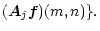
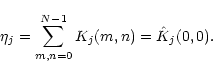
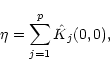
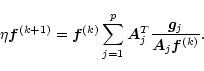
We assume that p images of the same astronomical object, corresponding
to p different orientations of the baseline, are available and that each
image consists of  pixels, characterized by the indices m,n.
We denote by f(m,n) and gj(m,n)
(m,n = 0,1,...,N-1; j = 1,2,...,p)
the values, at the pixel m,n, of the brightness distribution of the
unknown object and of its j-th image, respectively. Moreover we denote
by
pixels, characterized by the indices m,n.
We denote by f(m,n) and gj(m,n)
(m,n = 0,1,...,N-1; j = 1,2,...,p)
the values, at the pixel m,n, of the brightness distribution of the
unknown object and of its j-th image, respectively. Moreover we denote
by  and
and
 the arrays formed by these values.
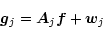
In the case of space-invariant PSF's the mathematical model of image
formation is given by
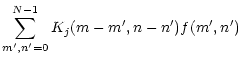
 being, in general, a block-Toeplitz matrix which, as usual,
can be approximated by a block-circulant matrix in order to easily compute
matrix-vector products by means of FFT. This approximation is sufficiently
good in many circumstances, and precisely when the size of the main lobe of
the PSF is much smaller than the size of the image.
being, in general, a block-Toeplitz matrix which, as usual,
can be approximated by a block-circulant matrix in order to easily compute
matrix-vector products by means of FFT. This approximation is sufficiently
good in many circumstances, and precisely when the size of the main lobe of
the PSF is much smaller than the size of the image.
When the approximation
of a periodic PSF is used, by computing the FFT of both sides of
Eq. (2) we obtain the usual relationship
 ,
is the
transfer function of the system, corresponding to the j-th orientation
of the baseline.
,
is the
transfer function of the system, corresponding to the j-th orientation
of the baseline.
In order to formulate the LR/EM method for the restoration of LBT images
in a compact form, let us define the
product of two arrays  and
and  ,
denoted by
,
denoted by
 ,
as the array which is obtained by multiplying each component of by the corresponding component of ,
i.e.
,
as the array which is obtained by multiplying each component of by the corresponding component of ,
i.e.
 .
Analogously the quotient
.
Analogously the quotient
 is defined by
 ,
provided that h(m,n) is different
from zero everywhere.
,
provided that h(m,n) is different
from zero everywhere.
LR/EM is an iterative algorithm for approximating the solutions of the
maximum likelihood problem in the case where images are corrupted by
Poisson noise (Shepp & Vardi 1982). In such
a case, if we assume that the images
are statistically
independent and that their values at distinct pixels are also statistically
independent Poisson
processes, then the log-likelihood function is given by (except for a constant
term depending on the images )
By means of the arguments developed by Shepp & Vardi (1982) it is easy to derive
the LR/EM algorithm in the present case. The parameters related to the
normalization of the columns of the imaging matrix, in the case of
block-circulant matrices, are given by
 ,
the
most simple choice being that of a uniform image.
,
the
most simple choice being that of a uniform image.
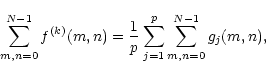
It may be convenient to normalize the PSF's in such a way that
 .
Then we get
.
Then we get  .
As follows from Eq. (3), this
normalization implies that all quantities
.
As follows from Eq. (3), this
normalization implies that all quantities
 are equal, except for noise fluctuations, so that it can be
consistently used if all images have essentially the same number of counts.
are equal, except for noise fluctuations, so that it can be
consistently used if all images have essentially the same number of counts.
The usual properties of the EM algorithm can be easily extended to
the present case:
the result
 of the k-th iteration is a non-negative estimate
of the unknown object; in the case
it satisfies the condition
of the k-th iteration is a non-negative estimate
of the unknown object; in the case
it satisfies the condition
;
 is an increasing function of k, so that, thanks to an
argument due to Vardi et al. (1985), the iterates
converge to a
maximum point of
is an increasing function of k, so that, thanks to an
argument due to Vardi et al. (1985), the iterates
converge to a
maximum point of
 .
.
However it is important to remark that, as it is well-known,
it is not convenient to push the algorithm to full convergence:
too many iterations generate artifacts, mainly due to noise amplification,
which reduce the quality of the restoration.
In other words the maximum points of
do not provide sensible
solutions.
These can be obtained by a suitable stopping of the iterations since, as it
may be shown by means numerical simulations, the number of iterations acts
as a regularization parameter, in the sense that the method as a property which is
often denoted as semiconvergence: the RMS error representing the
discrepancy between
and (the known object in the case of simulated images) first decreases for
increasing k, remains approximately constant for a certain number of
iterations and then grows again (Bertero & Boccacci 1998).
An example of this behaviour will be given in Fig. 1.
This property implies that, for any given image, there exists an optimum
number of iterations. In the case of real images it may be difficult
to find this optimum number and this is the main shortcoming of the
LR/EM method.
This problem is even more important for the method we present in the next
section because convergence (or semiconvergence) is faster. Indeed, in
the case of LR/EM the minimum of the RMS error is, in general, rather
flat and this property implies that, in the case of real images, one
can stop the iterations when no significant modification is observed in
the restoration. Another stopping rule may be provided by the so called
discrepancy principle: the iterations are stopped when the RMS error
representing the discrepancy between
 and the
observed image
becomes smaller than some estimated noise level.
and the
observed image
becomes smaller than some estimated noise level.
Copyright The European Southern Observatory (ESO)


![$\displaystyle \sum_{j=1}^p\sum_{m,n=0}^{N-1}\{ g_j(m,n)
\ln[(\vec{A}_j\vec{f})(m,n)]-$](/articles/aas/full/2000/10/h1802/img22.gif)