

In order to analyze and to compare the radial and vertical disk structure of a large sample of highly-inclined/edge-on spiral galaxies, it is necessary to apply a disk model that enables both a good quantitative and very flexible description of the 3-dimensional luminosity distribution. Although mathematical simplicity is also a desired property of disk models, there should be a firm physical basis.
Therefore, a disk modelling- and fitting procedure was developed based on the results
of a fundamental study of edge-on spiral galaxies by van der Kruit & Searle
([1981a],[b]; [1982a],[b]) as well as
on other observational studies thereafter (e.g. van der Kruit [1988];
Barteldrees & Dettmar [1994]; de Grijs & van der Kruit [1996];
Just et al. [1996]). The disk model presented here also considers the effects
of an inclined disk (
 )
as well as 3 different vertical luminosity
distributions.
)
as well as 3 different vertical luminosity
distributions.
Using the following notation for disk model parameters
L0
central luminosity density
i
h

(1 for;0 for
)
the 3-dimensional luminosity distribution Ln (n=1,2,3) of the disk can be described in cylindrical coordinates by
 |
(1) |
A set of 3 functions
with the same asymptotic behaviour for
 - proposed by van der Kruit ([1988]); Wainscoat et al. ([1989],
[1990]); Burkert & Yoshii ([1996]) - is used to describe the
vertical luminosity distribution L(z):
- proposed by van der Kruit ([1988]); Wainscoat et al. ([1989],
[1990]); Burkert & Yoshii ([1996]) - is used to describe the
vertical luminosity distribution L(z):
 |
(2) |
 |
(3) |
 |
(4) |
Thus, for large z, a comparison between different scale heights is possible via
 |
(5) |
The use of this combination of 3 different vertical luminosity distributions meets the mentioned specifications and allows also very flexible description of a large variety of vertical profiles of galactic disks.
In order to obtain a final disk model, i.e. a two-dimensional intensity distribution,
integration of (1) along the line-of-sight through the disk is required. But there
exist only two possible disk models - the projection face-on (
 )
and edge-on
(
)
and edge-on
(
 ), combined with the isothermal disk model (4) - which would allow an
analytical solution of (1) using a modified Bessel function (van der Kruit & Searle
[1981a]). Therefore, integration of (1) must be calculated numerically.
Hence, the intensity I(Y,Z) of one point (pixel) of the disk - as it can be seen by an
observer at the projected coordinates Y and Z on the CCD - can be written in cartesian
coordinates in the following form (for example, only the double exponential disk model (2)
is given here in its explicit form, for
), combined with the isothermal disk model (4) - which would allow an
analytical solution of (1) using a modified Bessel function (van der Kruit & Searle
[1981a]). Therefore, integration of (1) must be calculated numerically.
Hence, the intensity I(Y,Z) of one point (pixel) of the disk - as it can be seen by an
observer at the projected coordinates Y and Z on the CCD - can be written in cartesian
coordinates in the following form (for example, only the double exponential disk model (2)
is given here in its explicit form, for  ;
integration of models (3) and (4) is
analogous):
;
integration of models (3) and (4) is
analogous):
 |
|||
 |
(6) |
The integration limits are, in a direction of the line-of-sight, given by the geometry of the "galaxy-cylinder'':
 |
(7) |
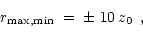
and can be approximated for
 by
by
 |
(8) |
i.e. by a cylinder with a height of about 10 scale heights. At larger distances above the disk plane the contribution of luminosity, acc. to (2)-(4), becomes negligibly. The integration of (6) along the line-of-sight through the disk-"cylinder'' is realized by a modified Newton-Cotes rule.
According to (1), (6), and (7) the intensity In of any disk model can be described by an integral of a family of 3 different density laws Ln, depending on 5 free parameters each:
 |
(9) |
In practice, this is still a large parameter space. It therefore requires a further, step-by-step restriction, realized in the following disk fitting procedure.
In order to derive relible disk parameters we developed two independent disk fitting procedures that were designed to comply the special tasks proposed for the first (Papers I+II) and second (Paper III) part of this study (see Sect. 1).
The first fitting procedure was realized semi-automatically. It uses different graphs enabling a direct comparison by eye of a set of radial and vertical profiles within a preselected disk area with those of an underlying disk model. To take advantage of symmetrical light distribution of galactic disks the profiles used for modelling are averaged over two quadrants. They are usually displayed equidistantly and cover the whole fitting area. The size of the fitting area vastly depends on the properties of the individual image, i.e. on both the image quality and some special features of the galaxy disk itself. Therefore the program allows - after a first inspection of the profiles - an interactive selection of a qualified fitting area. Depending on the S/N ratio and the spatial resolution of the images it is also possible to use a desired pixel binning for both image and model (as an example Fig. 2 shows one of the sets of radial and vertical disk profiles). This kind of modelling allows fast and flexible, but reliable disk fitting of a large number of galaxies - in particular of interacting/merging galaxies - whose disk profiles do often show considerable deviations from the simple model. Such galaxies are therefore difficult to handle with conventional least squares fitting methods.
The second fitting procedure uses the same set of disk models as described before but a least square fitting in order to fit the scale height as a function of the galactocentric distance. The properties of the program will be described in detail in Paper III. To ensure homogenity of the fitting results the fit quality reached with this method was compared with that of the above described semi-automated disk modelling (for this purpose the data of non-disturbed disk profiles of galaxies in the non-interacting sample were used). It was found that both methods give consistent results with errors on (or below) a 10%-level. The errors found for the fits of the scale height only are even smaller than 5%. The remaining discrepancies are not due to the individual method itself but rather to the following two reasons: first, the fitting areas are slightly different (i.e. they are usually more restricted for the least square method as a result of its sensibility against the error sources described in the following). Second, the scale height of a large fraction of galaxy disks investigated shows variations of different absolute size (both irregularly and systematically, i.e. gradients) along the galactocentric distance. Therefore this point will be discussed in detail in Paper III. A detailed comparison of the semi-automated disk modelling with another, independent developed least square fitting routine will be given in Pohlen et al. ([2000]).
After comparison of both fitting methods we choose to use the semi-automated disk modelling for this part of the study because it combines the advantages of fast and flexible fitting with a high accuracy. In view of the existing data the point of flexible fitting is very important since - despite all structural similarities - the radial and vertical profiles of induvidual (disk) galaxies are unique. The profiles investigated here are often heavily contaminated by light from, e.g., a bulge and/or a bar, a nearby companion, other disk components, foreground stars or reflections from bright stars. In addition, the modelling may be complicated by strong dust extinction along the galactic plane, by a low S/N ratio, or a considerably warped disk (mainly interacting/merging galaxies). Since most of the foregoing deviations can not be easily quantified their complete consideration by an automated fitting procedure thus seems almost impossible and would cause unpredictably errors.
In the following step-by-step procedure the disk parameters of the semi-automated disk
fitting procedure are reduced systematically:
as a first step, the inclination is determined by using the axis ratio of the dust lane in
the disk plane of optical images. Given a relatively sharp dust lane, an accuracy of less
than
 can be reached. The central luminosity density, L0, is calculated
automatically by the fitting program for each new parameter set by using a number of
preselected reference points along the disk (outside the bulge- or bar-light contaminated
regions).
can be reached. The central luminosity density, L0, is calculated
automatically by the fitting program for each new parameter set by using a number of
preselected reference points along the disk (outside the bulge- or bar-light contaminated
regions).
Given a sufficient S/N ratio, the cut-off radius
can be fitted to the major axes
profiles with an accuracy between  .
The cut-off is determined by a significant
decrease of the intensity extrapolated to I=0 (left panels in Fig. 2). For highly-inclined
disks such as the ones studied here, the effect of a variation of
on the slope of
radial disk profiles is negligible.
.
The cut-off is determined by a significant
decrease of the intensity extrapolated to I=0 (left panels in Fig. 2). For highly-inclined
disks such as the ones studied here, the effect of a variation of
on the slope of
radial disk profiles is negligible.
Thus, the remaining "real'' fitting parameters are the disk scale length and height, h and
,
as well as the set of 3 functions fn(z). Within the following procedure both the
scale length and the scale height are fitted in an iterative process until a first good
convergence of the "global'' fit is achieved. During this process, the quality of the
corresponding fits can be checked simultaneously using a small set of radial and vertical
disk profiles (usually 3 profiles each, see Fig. 2 as an example). For further small
corrections, if necessary, both parameters can be considered as independent and thus
separated without any loss of accuracy. For this "fine tuning'' a set with more disk
profiles (usually 6-8) is used for both parameters.
During the iterative process of modelling the scale length is fitted to a set of averaged
major axes profiles in a radial region typically between
(0.7 - 2.8)h and vertically
outside strong dust extinction (left panels in Fig. 2). The fit quality of the vertical
profiles along the disk can be used as a cross-check for the scale length (right panels
in Fig. 2). As a result of the error sources mentioned at the beginning the disk scale
length of a galaxy can be reproduced (with the same method) with an accuracy of .
In contrast to this, the scale lengths derived with different methods can in some cases
differ by  .
.
The disk scale height
is estimated by fitting the z-profiles inside the previously
selected radial regions, which are outside the bulge- or bar contamination (right panels in
Fig. 2). The vertical region used for the fits is typically between
 ,
but
depends strongly on the individual characteristic of the dust lane. If the disk inclination
is known precisely, this fitting method works reliably. Otherwise, additional errors may be
introduced (see next section).
,
but
depends strongly on the individual characteristic of the dust lane. If the disk inclination
is known precisely, this fitting method works reliably. Otherwise, additional errors may be
introduced (see next section).
The vertical disk profiles of most of the galaxies investigated in optical passbands enable a reliable choice of the quantitatively best fitting function fn(z). This is because deviations between different models become visible at vertical distances larger than that of the most sharply-peaked dust regions. For those disks that are affected by strong dust extinction, the choice was made easier by using a combination of both optical and near infrared profiles. For these cases profiles of both passbands were, if available, used for fitting.
If a large sample of disk galaxies is investigated statistically - as is the case in this
study - moderate deviations from edge-on orientation of the order of
 are common
(Sect. 2). It was found in this study and in Schwarzkopf & Dettmar ([1998])
that, if reliable values for the scale height are desired, deviations from
are common
(Sect. 2). It was found in this study and in Schwarzkopf & Dettmar ([1998])
that, if reliable values for the scale height are desired, deviations from
 larger
than
larger
than
 can not be neglegted. Therefore in this section the influence of small
changes of inclination on vertical disk profiles and on the resulting parameters will be
investigated in detail.
can not be neglegted. Therefore in this section the influence of small
changes of inclination on vertical disk profiles and on the resulting parameters will be
investigated in detail.
For that purpose we selected 3 r-band images of galaxies in the non-interacting sample with
well known disk parameters, but with different vertical profiles:
 exp (IC 2531);
sech (NGC 1886); and
exp (IC 2531);
sech (NGC 1886); and
 (ESO 187-G08). At 3 different
inclinations (
;
(ESO 187-G08). At 3 different
inclinations (
;
 ;
and
;
and
 )
the vertical profiles of each model
were best-fitted to the observed disk profiles (see left, middle, and right panels of Fig. 3).
To compensate for the effect of inclination, both the disk scale height,
,
and the
central luminosity density, L0, must be changed. As can be seen in the disk parameters
(middle raw in Fig. 3 and Table 3) the effect for
is, at
)
the vertical profiles of each model
were best-fitted to the observed disk profiles (see left, middle, and right panels of Fig. 3).
To compensate for the effect of inclination, both the disk scale height,
,
and the
central luminosity density, L0, must be changed. As can be seen in the disk parameters
(middle raw in Fig. 3 and Table 3) the effect for
is, at
 ,
around the
,
around the  -level for all vertical models, whereas for
 (Fig. 3 bottom) the
error amounts to
(Fig. 3 bottom) the
error amounts to
 for the exp-model and, after all, to
 for
the
for
the
 and sech-models. At smaller inclinations the quality of all vertical fits decreases
rapidly and allows no more qualitative good fits.
As expected, the effect of slight changes of inclination on both the scale height and the
shape of vertical profiles near the disk plane is the strongest for the exp-model
(left panels in Fig. 3).
and sech-models. At smaller inclinations the quality of all vertical fits decreases
rapidly and allows no more qualitative good fits.
As expected, the effect of slight changes of inclination on both the scale height and the
shape of vertical profiles near the disk plane is the strongest for the exp-model
(left panels in Fig. 3).
The effect shown above is due to the fact that the slope of the vertical disk profiles - in
a region that is relevant for fitting (previous section) - remains nearly unchanged in the
range between
 ,
whereas this is not true for the width of
the vertical profiles. Hence, to obtain reliable disk parameters for
and L0 it is
required that both
,
whereas this is not true for the width of
the vertical profiles. Hence, to obtain reliable disk parameters for
and L0 it is
required that both
 )
and
)
and
Otherwise, substantial errors for
and L0 are introduced (Table 3
lists averaged errors
 and
and
 ,
obtained by fitting 5 galaxies with
3 different vertical disk models each).
,
obtained by fitting 5 galaxies with
3 different vertical disk models each).
1.2mm
| Disk |
 |
 |
|
||||||
| inclination |
|
|
|
|
|
|
|||
| (1) | (2) | (3) | (4) | (5) | (6) | (7) | |||
|
|
 |
|
|
|
|
 |
|||
|
|
 |
 |
 |
|
 |
|
|||
Copyright The European Southern Observatory (ESO)

![\begin{figure}
\includegraphics[angle=90,height=6.5cm]{e461_06l.ps}
\end{figure}](/articles/aas/full/2000/10/h1677/img82.gif)
 (further explanation see text)
![\begin{figure}
{\begin{tabular}{ccc}
\includegraphics[angle=0,clip,width=62mm]{i...
...} &
\includegraphics[angle=0,width=62mm]{e187_3p.ps}\end{tabular}}\end{figure}](/articles/aas/full/2000/10/h1677/img84.gif)
 ,
for each of
the vertical profiles a quantitative good fit can be found by changing only the scale
height
,
for each of
the vertical profiles a quantitative good fit can be found by changing only the scale
height