In Fig. 1 we plot the Gunn r and Johnson B total apparent magnitude histograms of the UCM Survey
galaxies. They were arranged in 0.5 magnitude bins. Both
distributions cover a range of about seven magnitudes and
present a rather symmetric shape around 16.5 in the B bandpass and 16.0
in the r filter. The average of the
Johnson B distribution is 16.1
in the B bandpass and 16.0
in the r filter. The average of the
Johnson B distribution is 16.1  1.1. In the Gunn r filter the average is 15.5
1.0. These values are plotted
at the top of the diagram. Both histograms show a sharp bright
magnitude cutoff (around 14.5-15.0 in the B-band and
13.75-14.25 in the r band) due to detection problems (the
objective-prism spectra of very bright objects are saturated,
not allowing the detection of the emission lines); there is
also a faint magnitude limit around 19 magnitudes in the blue
filter and 18 in the red one.
1.1. In the Gunn r filter the average is 15.5
1.0. These values are plotted
at the top of the diagram. Both histograms show a sharp bright
magnitude cutoff (around 14.5-15.0 in the B-band and
13.75-14.25 in the r band) due to detection problems (the
objective-prism spectra of very bright objects are saturated,
not allowing the detection of the emission lines); there is
also a faint magnitude limit around 19 magnitudes in the blue
filter and 18 in the red one.
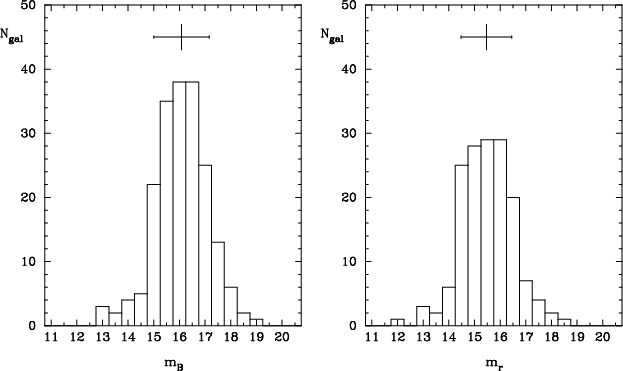 |
Figure 1: Johnson B and Gunn r histograms of the UCM Survey. The top error bar shows the average and the standard deviation of the data (see text). The average colour results 0.71 magnitudes. The Gunn rdata have been extracted from Vitores et al. ([1996a]) |
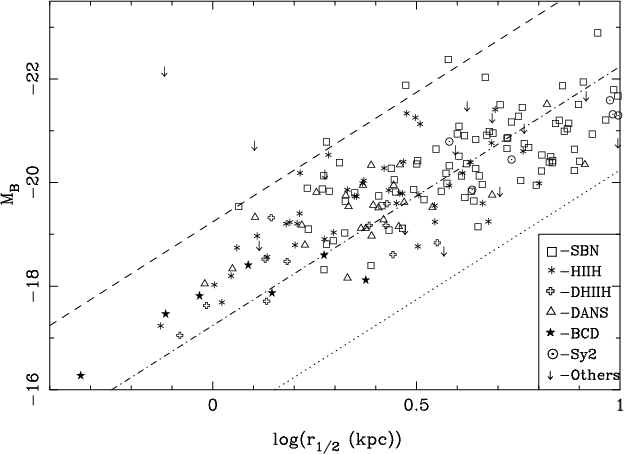
We plot the absolute total magnitudes versus the effective radii of the UCM galaxies in Fig. 2. Galaxies were labelled depending of their spectroscopic type (see Gallego et al. [1996] for details):
SBN --Starburst Nuclei--
Originally defined by Balzano ([1983]), they show high
extinction values, with very low [NII]/H ratios and
faint [OIII]
ratios and
faint [OIII] 5007 emission. Their H
luminosities are always higher than 108
5007 emission. Their H
luminosities are always higher than 108
 .
.
DANS --Dwarf Amorphous Nuclear
Starburst-- Introduced by Salzer et al.
([1989]), they show very similar spectroscopic properties
to SBN objects, but with H
luminosities lower than
 .
.
HIIH --HII Hotspot-- The HII
Hotspot class shows similar H
luminosities to those
measured in SBN galaxies but with large
[OIII]5007/H ratios, that is, higher
ionization.
ratios, that is, higher
ionization.
DHIIH --Dwarf HII Hotspot--
This is an HIIH subclass with identical spectroscopic
properties but H
luminosities lower than
5 107
.
107
.
BCD --Blue Compact Dwarf--
The lowest luminosity and highest ionization objects
have been classified as Blue Compact Dwarf galaxies, showing
in all cases H
luminosities lower than
5107
.
They also show large
[OIII]5007/H
and H/[NII]6584
line ratios and intense [OII]3727 emission.
All these spectroscopic classes are usually collapsed in two main categories: starburst disk-like (SB hereafter) and HII-like galaxies (see Guzmán et al. [1997]; Gallego [1998]). The SB-like class includes SBN and DANS spectroscopic types, whereas the HII-like includes HIIH, DHIIH and BCD type galaxies.
The UCM Survey does not contain objects brighter than an absolute magnitude of -22.9 or fainter than -16.3. Despite the considerable scatter, we observe a correlation between MB, r1/2 and the spectroscopic type in Fig. 2. BCD galaxies appear as small and faint objects in the bottom left corner of the plot. SBN galaxies are more concentrated in the largest effective radius and luminosity zone of the diagram. This should be the place for normal grand-design spirals. The existence of a bright starburst in the nucleus of SBN objects turns them into objects redder than those with the starburst located out of the nucleus (see below the discussion of Figs. 4 and 6). Only UCM 1612+1308 shows the typical small size of nucleated compact dwarfs. Most of the DANS and HIIH galaxies are also located in the small effective radii zone, below 5 kpc.
As reference, we have plotted the constant surface brightness
lines corresponding to -14, -16 and -18 magkpc-2 in
Fig. 2.
In Fig. 3 we plot the histograms of
 colours of UCM galaxies corrected from Galactic extinction
according to their morphological (Vitores et
al. [1996a]) and spectroscopic classification (Gallego
et al. [1996]). The averaged colours of each Hubble type
are listed in Table 4, jointly with the mean colours
calculated by Fukugita et al. ([1995]). The vertical
ticks in these diagrams show Fukugita et al. ([1995])
colours and averaged colours for each spectroscopic type.
colours of UCM galaxies corrected from Galactic extinction
according to their morphological (Vitores et
al. [1996a]) and spectroscopic classification (Gallego
et al. [1996]). The averaged colours of each Hubble type
are listed in Table 4, jointly with the mean colours
calculated by Fukugita et al. ([1995]). The vertical
ticks in these diagrams show Fukugita et al. ([1995])
colours and averaged colours for each spectroscopic type.
Overall, early-type spirals show a bluer colour than those of
Fukugita et al. ([1995]), probably related to the presence
of the star-forming process. On the other hand, irregulars and
BCDs do show redder B-r colours than Fukugita's sample; this
could be a selection effect, given that very blue objects
would not show up at the original objective-prism plates as
they were taken in the H
region.
Although the spectroscopic histograms show a great dispersion
we observe that SBN galaxies are redder than other types. The
bluest objects appear to be BCDs and DHIIHs. These two facts
could be explained in two different ways: SBNs could be
affected by larger dust reddening or the starburst could be
more relevant in BCD and DHIIH galaxies, making them bluer. In
fact, Gallego et al. ([1997]) showed that the mean
B-V colour excess for SBN galaxies is 0.2
higher than
for HII-like galaxies.
Both kind of data are mixed in Fig. 4. SBN galaxies
dominate the spiral zone (from T=1 -Sa- to T=6 -Sc-), adding a
great colour dispersion to our sample. There are also 7 very
blue objects, all of them late-type spirals (Sc+) or
irregulars. some of these objects are low metallicity galaxies,
for example UCM 2304+1640 (
=-0.18, metallicity
 )
or UCM 0049+0017 (
=-0.33,
metallicity
)
or UCM 0049+0017 (
=-0.33,
metallicity
 ).
).
|
|
|||
| Hubble type |
 |
 |
 |
| (1) | (2) | (3) | (4) |
| Sa | 0.74 | 0.97 (Sab) | 40 |
| Sb | 0.75 | 0.73 (Sbc) | 44 |
| Sc+ | 0.72 | 0.65 (Scd) | 45 |
| Irr | 0.42 | 0.24 (Irr) | 8 |
| BCD | 0.34 | 0.24 (Irr) | 4 |
Table 4:
(1) Hubble type. (2) Mean total B-r colours of the UCM sample. (3)
Mean total B-r colours tabulated in Fukugita et
al. ([1995]). (4) Number of galaxies used in the calculated mean
colours.
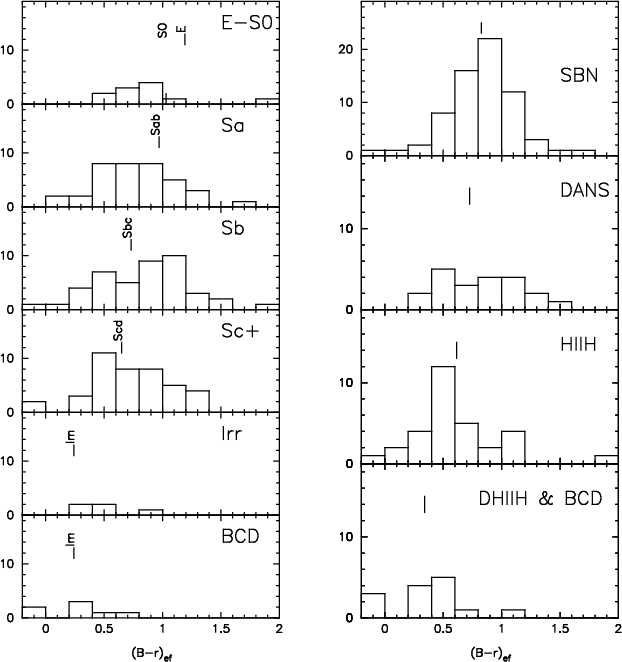 |
Figure 3:
Histograms of the
colours of the UCM galaxies corrected
from Galactic extinction according to their morphological and
spectroscopic classification as established in Vitores et
al. ([1996a]) and Gallego et al. ([1996]), respectively. The
vertical marks in the left diagram are the typical colours of each
morphological type as tabulated in Fukugita et al. ([1995]); mean
colours are listed in Table 4. In the right diagram we have marked the
averaged colour of each spectroscopic type. The values are: 0.83 for
SBN type, 0.73 for DANS, 0.62 for HIIH, 0.34 for DHIIH & BCD |
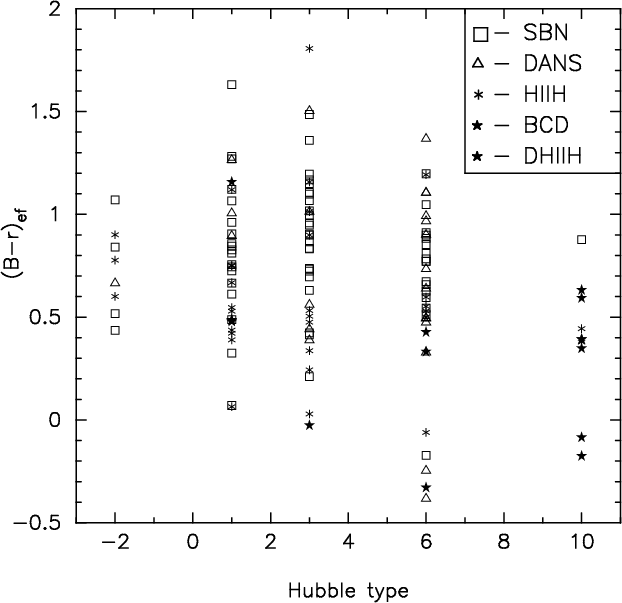 |
Figure 4:
Relation between spectroscopic and morphological types and
colour. We have selected the main spectroscopic types of
our sample: SBN, DANS, HIIH and BCD & DHIIH, as classified in Gallego
et al. ([1996]) and morphological types from S0 to Irr; the
galaxies classified as Sc+ by Vitores et al. ([1996a]) are
included in T=6 -corresponding to a Sc galaxy |
The B-r histogram for the whole sample is plotted in Fig. 5.
The averaged effective colour of the UCM sample is
 .
The distribution is rather flat, being dominated
by galaxies with a colour corresponding to a typical spiral.
.
The distribution is rather flat, being dominated
by galaxies with a colour corresponding to a typical spiral.
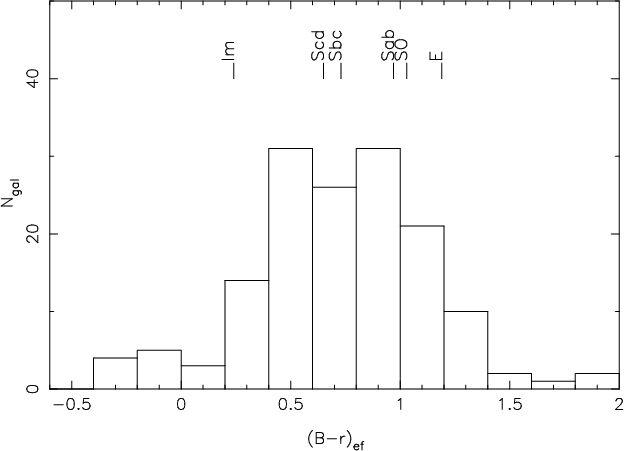 |
Figure 5: B-r histogram of the UCM Survey Lists I and II. The averaged colours of Fukugita et al. ([1995]) have been marked at the top |
In Fig. 6 we plot the B absolute magnitude MB versus the effective colour
.
Labels correspond to
the spectroscopic type of each object. An extinction vector of
0.4 magnitudes in the B band has been drawn. SBN galaxies
are located in the most luminous and reddest part of the plot,
jointly with Sy2 galaxies. In the other hand, BCDs appear to
be the bluest and faintest objects in our sample. UCM objects
are compared with a normal sample of galaxies from the
literature in Fig. 7; we have selected common
galaxies in the Nearby Universe from the NGC, IC and Mrk
catalogs extracted from the NED database![[*]](/icons/foot_motif.gif) . The BCD data have been extracted from
Doublier et al. ([1997]). Both sets of reference data are
drawn lightened.
. The BCD data have been extracted from
Doublier et al. ([1997]). Both sets of reference data are
drawn lightened.
In the top panel we have compared our colours with those of
spirals. As expected, most of the UCM sample is located in the
region where normal spiral galaxies are found in this
colour-magnitude diagram; some of our galaxies have similar
colours to those of early-type galaxies though this could be
due to internal reddening. The BCD galaxies in our sample seem
to be about 0.7
brighter and 0.2
bluer than the
Doublier et al. ([1997]) sample.
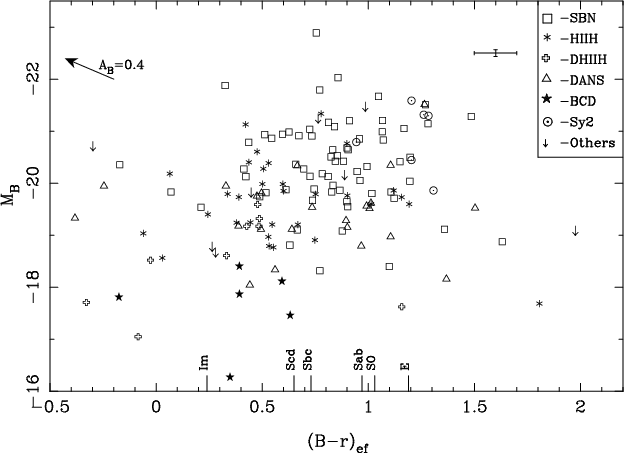 |
Figure 6:
Absolute B magnitude MB corrected from Galactic extinction versus
(effective colour). Bottom marks are B-r colours from
Fukugita et al. ([1995]). An extinction vector corresponding to
0.4 magnitudes in the Johnson B band is given and also the averaged
error bars of both sets of data |
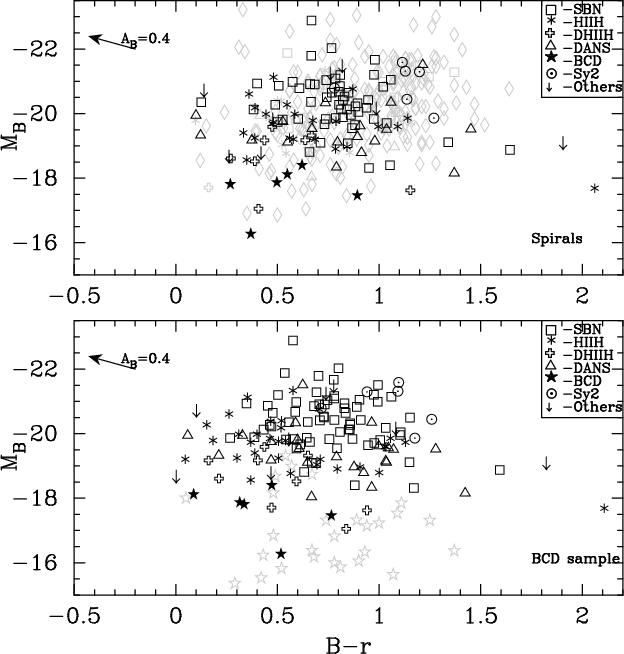 |
Figure 7:
Colour-magnitude diagram of the UCM survey galaxies compared with
other galaxies in the Nearby Universe (drawn lightened as diamonds
-spirals- and five-points stars -BCD's-). In the top panel we
have used isophote 25 colours while in the second panel we have
represented total colours (extracted from the
 aperture). All absolute magnitudes are integrated total
magnitudes. Typical error is that shown in Fig. 6 aperture). All absolute magnitudes are integrated total
magnitudes. Typical error is that shown in Fig. 6 |
Copyright The European Southern Observatory (ESO)