

In Sect. 2 of this paper we have shown that the solution of the system of Eqs. (8) leads to instantaneous estimates of the burst radio source extent and its position. The determination that the burst extent is small compared to the HPBW is a necessary condition to determine their position. This technique has been applied to the flare of December 30 1990, 18:28:00 UT, observed at 48 GHz with the Itapetinga multibeam system.
The time structure A of the December 30 1990 event (Figs. 7
and 8 peaks 1 to 8) has already been studied assuming
that the radio emission was produced by a point source
(Costa et al. 1995).
We compared the position
calculations by the two methods which are displayed in Fig. 12.
We have plotted the positions for peaks 1-8 computed using the previous method and
positions determined using the present method. The disagreement in
position for the two methods are less than about 5 arcsec, for the most
intense peaks, 3, 4 and 5. It becomes more pronounced for the less intense
peaks, 1, 7 and 8, being about 15 arcsec. These discrepancies result
from the fact that the previous method assume
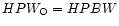 and constant
throughout all the event duration; while the present method computes
and constant
throughout all the event duration; while the present method computes
 at each time.
Finally the time variations of the burst angular extent, as shown in Fig. 4 for Gaussian equivalence, might deserve further studies as for its validity as inputs for physical interpretation which is beyond the scope of the present work.
Copyright The European Southern Observatory (ESO)