

Data obtained from only three beams are not sufficient to determine unambiguously the radio burst position, unless the assumption of a small (compared to beam) emitting source is made.
A qualitative method was developed based on the idea that the source
angular extent should be related to antenna temperature ratios obtained
with different beams. These ratios lead to a contrast criterion, which
should increase for smaller sources. That is to say: if an emitting source
is small compared to the HPBW, the contrast should be higher than for an
extended emitting region at the same location. For three beams
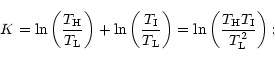
observations, we can define a contrast parameter K as:
 ,
,
 ,
and
,
and  are the high, intermediate and
low observed antenna temperatures respectively.
are the high, intermediate and
low observed antenna temperatures respectively.
We have computed the expected contrast K for different positions within
three beams (Fig. 10a) and different source sizes,
assuming Gaussian source shapes. The source locations (dotted area in
Fig. 10a) have been chosen such that, at each location
the antenna temperatures ,
,
and
satisfy the
condition:
 in the range
 ,
corresponding to a point
emitting source and an emitting source of extension
,
corresponding to a point
emitting source and an emitting source of extension
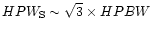 ,
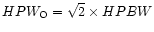
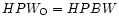
respectively. Here we have assumed that the beam size is 1.9 arcmin (see
Sect. 2). The results are shown in Fig. 10b. Each
curve shows, for a given emitting source location, the evolution of K versus
(in units of HPBW). The limiting curve (thick line in the plot)
corresponds to the highest K for each source size and was computed analytically
for the actual geometry. The condition
,
respectively. Here we have assumed that the beam size is 1.9 arcmin (see
Sect. 2). The results are shown in Fig. 10b. Each
curve shows, for a given emitting source location, the evolution of K versus
(in units of HPBW). The limiting curve (thick line in the plot)
corresponds to the highest K for each source size and was computed analytically
for the actual geometry. The condition
 (
(
 ), represented by the vertical line, defines a minimum value
  above which the size of the emitting source is necessarily smaller than the HPBW.
Figure 10b shows clearly that if
above which the size of the emitting source is necessarily smaller than the HPBW.
Figure 10b shows clearly that if
 ,
there is an
ambiguity in comparing the source size with the HPBW. The bottom left
quadrant shows small (compared to HPBW) emitting sources located near the
origin 0, where the contrast is below the limit
which does not
allow to distinguish between small (compared to HPBW) and extended
emitting sources. In this case, source positions using three beams
observations will not be computed.
,
there is an
ambiguity in comparing the source size with the HPBW. The bottom left
quadrant shows small (compared to HPBW) emitting sources located near the
origin 0, where the contrast is below the limit
which does not
allow to distinguish between small (compared to HPBW) and extended
emitting sources. In this case, source positions using three beams
observations will not be computed.
In summary, the qualitative method should be used as follows with three
beams observations: i) compute a contrast value
 ,
ii)
refer to Fig. 10b to compare
and HPBW (same as
comparing
to ), iii) if
,
ii)
refer to Fig. 10b to compare
and HPBW (same as
comparing
to ), iii) if
 the position of the burst is computed, if not the position of the
burst is not estimated. Our uncertainty in the half power width observed
is the range defined by
the position of the burst is computed, if not the position of the
burst is not estimated. Our uncertainty in the half power width observed
is the range defined by
 and the
which corresponds to
and the
which corresponds to
 in the limiting curve. In Fig. 10b we
show, for a given
,
the range of uncertainty. In order to compute
positions we adopt
equals to the mean value of this range.
in the limiting curve. In Fig. 10b we
show, for a given
,
the range of uncertainty. In order to compute
positions we adopt
equals to the mean value of this range.
![\begin{figure}
\par\includegraphics[width=8.8cm,clip]{ds1582f11.eps}\end{figure}](/articles/aas/full/1999/21/ds1582/img64.gif) |
Figure 11: Discrepancies measured as angular distances between the positions computed with 4 beams and with beams 2-3-5 ( qualitative method) for the time structures showed in Fig. 7) of the burst on 30 December 1990 in terms of mean contrast K. Dots are the absolute discrepancies. Vertical bars show the uncertainties |
![\begin{figure}
\par\includegraphics[width=8.8cm,clip]{ds1582f12.eps}\end{figure}](/articles/aas/full/1999/21/ds1582/img65.gif) |
Figure 12:
Discrepancies measured as angular distances between
positions computed by
Costa et al. (1995)
and the new method using
four beams for the time structures labeled in Fig. 8
of the burst on 30 December 1990 in terms of mean
.
Larger discrepancies
are found for larger source angular extents
|
As an illustration we have applied the qualitative method to the 30
December 1990 event, which has been observed with four beams (see previous
section), allowing an unambiguous determination of the burst position as
well as its instantaneous angular extent. For the qualitative test we used
the antenna temperatures observed with beams 2, 3, and 5.
Figure 11 shows the absolute discrepancies as large dots,
computed as angular distances, between positions computed with the method described
in Sect. 2 and the qualitative method for the time periods A, B, C
(Fig. 7). Angular positions for peaks 1, 12, 13, 14 and 16 are not
computed because have contrast lower than
 ;
while angular position for
peak 15 is not considered because the condition given by the Eq. (10)
is not fulfilled. In all the computed cases, discrepancies are less than 5 arcsec
and the general trend is: for larger contrast K the discrepancy becomes
smaller. In Fig. 11 vertical bars show the uncertainties due to the
range in
allowed by each
.
Here also the general trend
is an inverse relation between contrast and uncertainty.
;
while angular position for
peak 15 is not considered because the condition given by the Eq. (10)
is not fulfilled. In all the computed cases, discrepancies are less than 5 arcsec
and the general trend is: for larger contrast K the discrepancy becomes
smaller. In Fig. 11 vertical bars show the uncertainties due to the
range in
allowed by each
.
Here also the general trend
is an inverse relation between contrast and uncertainty.
Copyright The European Southern Observatory (ESO)
![\begin{figure}
\par\includegraphics[width=8.8cm,clip]{ds1582f10.eps}\end{figure}](/articles/aas/full/1999/21/ds1582/img53.gif)
 defines 2 regions of contrast values. Only K belonging to the
upper part indicates a small source, compared to the HPBW. The thick horizontal
line represents the range of uncertainty in
defines 2 regions of contrast values. Only K belonging to the
upper part indicates a small source, compared to the HPBW. The thick horizontal
line represents the range of uncertainty in
