

The observed antenna temperature is the convolution between the
brightness-temperature distribution of the source ( )
and the beam
pattern (
)
and the beam
pattern ( ). Rewriting Eq. (1) in one dimension (for the
sake of simplicity)
). Rewriting Eq. (1) in one dimension (for the
sake of simplicity)
 |
(2) |
 and
and  is a factor taking into account various system losses, such as the beam and aperture
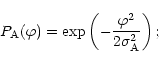
efficiencies and the radome transmission. The main lobe of the beam
pattern can be sufficiently well approximated by means of a Gaussian
function,
is a factor taking into account various system losses, such as the beam and aperture
efficiencies and the radome transmission. The main lobe of the beam
pattern can be sufficiently well approximated by means of a Gaussian
function,
 |
(3) |
 as
as
 .
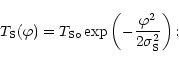
Assuming for the source brightness temperature distribution also a
Gaussian function,
.
Assuming for the source brightness temperature distribution also a
Gaussian function,
 |
(4) |
 ,
the convolution of this two functions is
straightforward and yields
,
the convolution of this two functions is
straightforward and yields
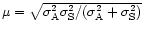 .
This result means that a scan over a Gaussian source
generates a Gaussian observed brightness temperature
distribution with a
.
This result means that a scan over a Gaussian source
generates a Gaussian observed brightness temperature
distribution with a
 ,
,
with an observed half power
width
,
,
with an observed half power
width
Instead of scanning, the multiple beams of the Itapetinga 13.7-m radio telescope are fixed with respect to the source and obtain brightness temperatures pointing to up to five different directions at the same time in order to achieve both a high temporal resolution (1 ms) and a high precision localization of the direction of emission.
Assuming that the beams transmission coefficients and HPBW are equal for
the five receivers, we can write the 2-dimensional Eq. (5)
for each beam
 is the displacement in RA and declination between the
antenna axis reference direction and the source and
is the displacement in RA and declination between the
antenna axis reference direction and the source and
 is the displacement between each beam and the antenna axis.
Expression (8) is a system of five equations with four unknowns,
namely:
is the displacement between each beam and the antenna axis.
Expression (8) is a system of five equations with four unknowns,
namely:
 ,
,
,
,
 and
and
 .
In
order to solve it we take four out of the five equations, e.g.:
i=1, 2, 3 and 4 and create a reduced system of four equations with four
unknowns which is easily solved. We can draw five such reduced set of
equations changing the beams used, which can be useful to determine the
uncertainties in the solution.
.
In
order to solve it we take four out of the five equations, e.g.:
i=1, 2, 3 and 4 and create a reduced system of four equations with four
unknowns which is easily solved. We can draw five such reduced set of
equations changing the beams used, which can be useful to determine the
uncertainties in the solution.
While the interpretation of bursts positions for emission centroids was
largely discussed in previous works
(e.g.
Costa et al. 1995;
Correia et al. 1995;
Herrmann et al. 1992, 1997)
we want
here to stress the importance in the determination of
 related to both,
the HPBW and the
related to both,
the HPBW and the
 by the Eq. (7). The convolution of a
very extended source with a beam should result in a big value for
,
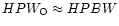
contrary to the case of a point source, for which we can assume a
by the Eq. (7). The convolution of a
very extended source with a beam should result in a big value for
,
contrary to the case of a point source, for which we can assume a
 ,
resulting in
,
resulting in
 .
.
![\begin{figure}
\par\includegraphics[width=7cm,clip]{ds1582f3.eps}\end{figure}](/articles/aas/full/1999/21/ds1582/img38.gif) |
Figure 3: Example of a longitudinal view of one of the "cigar-like'' sources. At half power points it has a length of about 25 arcsec, and a width of 4 arcsec |
We stress that the method finds the instantaneous (1 ms) burst center
position, for an isolated source, or the center of an equivalent extended
source containing multiple sources emitting simultaneously. In order to
assess the accuracy of the position determination, we have carried out some
simulations. In these simulations the antenna beams are represented by
axially symmetric Gaussians. To simulate different sources and sizes, we
have used a set of 8 contiguous axially symmetric Gaussians, overlapping
each other in a
 level. This overlapping creates an extended
constant region and produces a "cigar'' shape source, with a fixed
quotient between principal axes of about 6 (see Fig. 3).
Such shapes could be also obtained using other geometrical compositions,
with the same final results. We prefer compose Gaussians because of the
simplicity in the calculations. It is clear that these "cigars'' are no
longer the axially symmetric Gaussian sources assumed by the inversion
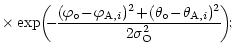
method. In Fig. 4 we show the antenna five beam
disposition. In the center of the beams 2-3-4-5, we show one of the
"cigars'', build up from the 8 small circles. This is the longest source
used for the simulations, extending for almost 2.5 arcmin.
level. This overlapping creates an extended
constant region and produces a "cigar'' shape source, with a fixed
quotient between principal axes of about 6 (see Fig. 3).
Such shapes could be also obtained using other geometrical compositions,
with the same final results. We prefer compose Gaussians because of the
simplicity in the calculations. It is clear that these "cigars'' are no
longer the axially symmetric Gaussian sources assumed by the inversion
method. In Fig. 4 we show the antenna five beam
disposition. In the center of the beams 2-3-4-5, we show one of the
"cigars'', build up from the 8 small circles. This is the longest source
used for the simulations, extending for almost 2.5 arcmin.
In Fig. 5 we show the discrepancy between the real position of the source center of brightness and the computed one in terms of the source length. The discrepancy is computed as the geometrical distance between these two points. The difference, for the longest source (2.5 arcmin) is about 6 arcsec, which is of the same order of the observational uncertainties (Costa et al. 1995); while for a source of 1 arcmin long is reduced to about 1 arcsec. We performed different simulations changing the orientation of the source. In all of them, the results remained in the same range, sometimes, even better.
![\begin{figure}
\par\includegraphics[width=7cm,clip]{ds1582f5.eps}\end{figure}](/articles/aas/full/1999/21/ds1582/img41.gif) |
Figure 5: Discrepancy as a function of source length. Discrepancy is calculated as the geometrical distance between the computed solution and the center of brightness of the "cigar'' shaped sources |
In another simulation, we took a 1 arcmin  6 arcsec
"cigar-like'' source and changed its position over the field of view of
channels 2-3-4-5. In Fig. 6 we show the difference in
azimuth and elevation between the computed and the real position.
Continuous bars indicate position discrepancies. The maximum error in
elevation is almost 24 arcsec, while the minimum is near 0 arcsec.
In azimuth, the discrepancies are negligible over all locations.
6 arcsec
"cigar-like'' source and changed its position over the field of view of
channels 2-3-4-5. In Fig. 6 we show the difference in
azimuth and elevation between the computed and the real position.
Continuous bars indicate position discrepancies. The maximum error in
elevation is almost 24 arcsec, while the minimum is near 0 arcsec.
In azimuth, the discrepancies are negligible over all locations.
Side lobes may influence the position determination by incrementing the antenna temperature in some channels, where side lobe contribution might be added. This increment could be of the order of 3% of a main beam level (Herrmann et al. 1992). It is easy to simulate this excess by artificially incrementing the level to some channels. We have carried one simulation where we exceeded that level and applied up to 10% increment to 1, 2, and 3 out of the 4 channels used to compute positions. The discrepancy in the worst case (3 artificially incremented channels), for a 2.5 arcmin long source in the center of the four beams, is 12 arcsec. For a 1 arcmin source length the discrepancy falls to about 3 arcsec.
The assumed Gaussian beam mimetize the central part of the main beam down
to the level of 3% (-15 db) of the peak. Directions outside of this 3%
level on both sides of the main lobe (including its wings) are considered
unknown and may contain comma or side lobes with a maximum gain of 3% of
the main beam. A condition to be fulfilled if we want to have
non-contradictory solutions, is to have the sources inside the main lobe
over the 3% level. We can check this condition taking quotients between
antenna temperatures and assuming the worst situation. This is when one
beam observes the source near its 3% level and, at the same time, the beam
which has the highest antenna temperature observes the same source at the
farthest point respect to its beam center. In that case the highest
antenna temperature beam will be near its 50% level. The quotient between
these two antenna temperatures will be
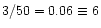 %. Thus, our
sufficient condition is that 4 out of the 5 beams, have simultaneously
antenna temperature quotients, respect to the highest one, bigger than 6%.
In Fig. 6 we show the area where this condition is
fulfilled, which matches the area where the uncertainties of the method are
smaller compared with the observational uncertainties described in
Costa et al. (1995).
%. Thus, our
sufficient condition is that 4 out of the 5 beams, have simultaneously
antenna temperature quotients, respect to the highest one, bigger than 6%.
In Fig. 6 we show the area where this condition is
fulfilled, which matches the area where the uncertainties of the method are
smaller compared with the observational uncertainties described in
Costa et al. (1995).
In summary, we have shown with simulations that, as far as the condition of the above mentioned 6% ratio is fulfilled, the position determination is very precise (below or similar to the observational uncertainties) and very robust when considering side lobe effects. In practice we have shown that the influence of side lobes on position determination is negligible even for extreme cases of long asymmetric sources. Better knowledge of beam shapes and side lobes will not improve considerably the accuracy of the method in comparison to the observational uncertainties.
Finally, we conclude that, for a source of up to 1 arcmin long, irrespectively of the shape and provided that the above described 6% criterion is fulfilled, the uncertainty in position determination is smaller than or of the same order of the observational uncertainties (i.e. around or below 5 arcsec).
Copyright The European Southern Observatory (ESO)





![\begin{figure}
\par\includegraphics[width=7cm]{ds1582f4.eps}\end{figure}](/articles/aas/full/1999/21/ds1582/img40.gif)
![\begin{figure}
\par\includegraphics[width=7cm,clip]{ds1582f6.eps}\end{figure}](/articles/aas/full/1999/21/ds1582/img43.gif)