

 (emitted uniformly over the solid angle
  , and in a
bandwidth
, and in a
bandwidth  where
where  is the
duration of the emission process) the corresponding
is the
duration of the emission process) the corresponding  is given by
(for the best orientation and at the resonant frequency
is given by
(for the best orientation and at the resonant frequency  )
)
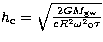 .For the SN 1998bw, using the known source location
(RA = 19 h 35 min 03.34 s, dec.
.For the SN 1998bw, using the known source location
(RA = 19 h 35 min 03.34 s, dec.
 50' 44.8''), an estimated distance R from the Earth
of 38 Mpc
(Kulkarni et al. 1998b; Galama et al. 1998), and
50' 44.8''), an estimated distance R from the Earth
of 38 Mpc
(Kulkarni et al. 1998b; Galama et al. 1998), and  , we have
 , while the sensitivity of Explorer detector
is 8 10-19 (with
, while the sensitivity of Explorer detector
is 8 10-19 (with  ), two orders of magnitude lower
(The noise peak of 144 mK would correspond to an emission
in g.w. of
), two orders of magnitude lower
(The noise peak of 144 mK would correspond to an emission
in g.w. of  ).
During that period two other
g.w. detectors were in operation
with a strain sensitivity close
to Explorer within a factor
1.5: Auriga
(Cerdonio et al. 1995)
and Allegro
(Mauceli et al. 1996). We are planning to do a
concidence analysis between the three antennas, both for
a short period, and for four days around the GRB 980425.
This analysis will allow to give an upper limit for a g.w.
pulse in the hypothesis that the
SN 1998bw and the GRB 980425 occur simultaneously or not.
Acknowledgements
).
During that period two other
g.w. detectors were in operation
with a strain sensitivity close
to Explorer within a factor
1.5: Auriga
(Cerdonio et al. 1995)
and Allegro
(Mauceli et al. 1996). We are planning to do a
concidence analysis between the three antennas, both for
a short period, and for four days around the GRB 980425.
This analysis will allow to give an upper limit for a g.w.
pulse in the hypothesis that the
SN 1998bw and the GRB 980425 occur simultaneously or not.
AcknowledgementsOne of the authors (P.B.) wishes to thank Daniele Fargion for a stimulating talk that triggered this work.
Copyright The European Southern Observatory (ESO)