

In Fig. 1 we present the up-to-date radio light curve of SN1998bw. The radio luminosity of SN1998bw is unusually high but what really sets it apart from other radio SN is the emergence of copious radio emission at early times. Supernovae expand and thus their size increases with time. Thus the parameter which best distinguishes SN1998bw from other radio SN is the specific intensity (i.e. the ratio of flux to the solid angle of the source). It is conventional in radio astronomy to express specific intensity in units of brightness temperature and the conversion is done using the Rayleigh-Jeans formula.
We assume that the radio emission originates from the same region as
the optical emission in which case the expansion speed is 60000 km s-1.
The predicted angular expansion is then  arcsec per day. Such a source would
be compact enough, particularly in the first two weeks, to suffer from strong
scattering due to density inhomogeities in the Galactic interstellar medium. In
contrast to GRB970508
(Frail et al. 1997),
only a smooth rise
to a maximum was seen for the radio emission from SN1998bw.
This strongly suggests that the expansion of the radio photopshere
greatly exceeds that of the optical.
Kulkarni et al. (1998)
inferred
arcsec per day. Such a source would
be compact enough, particularly in the first two weeks, to suffer from strong
scattering due to density inhomogeities in the Galactic interstellar medium. In
contrast to GRB970508
(Frail et al. 1997),
only a smooth rise
to a maximum was seen for the radio emission from SN1998bw.
This strongly suggests that the expansion of the radio photopshere
greatly exceeds that of the optical.
Kulkarni et al. (1998)
inferred
 from the absence of refractive scintillation at 20 and
13 cm.
from the absence of refractive scintillation at 20 and
13 cm.
As noted in
Kulkarni et al. (1998)
the peak brightness temperature of
SN1998bw is 1013 K. This is two orders of magnitude higher than that
inferred for previously studied radio SN
(Chevalier 1998).
The inferred brightness temperature is also in excess of the well known
inverse Compton limit  K for a
source radiating via the incoherent synchrotron mechanism
(Kellermann & Pauliny-Toth 1968;
Readhead 1994).
K for a
source radiating via the incoherent synchrotron mechanism
(Kellermann & Pauliny-Toth 1968;
Readhead 1994).
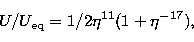
As pointed out by Readhead (1994), high brightness temperatures also result in exceedingly large estimates of minimum energy. The total energy of a synchrotron source is
 and
and  is
referred to as the equipartition angular radius and
is
referred to as the equipartition angular radius and  is the
equipartition energy which is also (approximately) the minimum energy.
The strong dependence of U on
is the
equipartition energy which is also (approximately) the minimum energy.
The strong dependence of U on  consequently means that a high
price must be paid in U for sources smaller than, or larger than
. As noted by
Kulkarni et al. (1998),
if the angular size
used is consistent with
consequently means that a high
price must be paid in U for sources smaller than, or larger than
. As noted by
Kulkarni et al. (1998),
if the angular size
used is consistent with  km s-1 then
 , and therefore the source energy would be
dominated by relativistic electrons
, and therefore the source energy would be
dominated by relativistic electrons  erg - much larger
than the total energy release in a typical supernova. Therefore, the
only reasonable hypothesis is to assume
erg - much larger
than the total energy release in a typical supernova. Therefore, the
only reasonable hypothesis is to assume  ,leading to
  ,
,  erg,
and
erg,
and 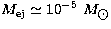 .
.
Copyright The European Southern Observatory (ESO)