

The saturated Compton cooling (SCC) model interprets the spectral break as the Wien
peak caused by multiple Compton upscattering of soft photons. In this case  corresponds roughly to the average lepton energy <E>. At very high Thomson depths
 the Band index
  is >0. But as the Thomson depth
decreases decreases to <0
(Rybicki & Lightman 1979;
Liang et al. 1997).
However for pure nonthermal power-law lepton distributions is always in
the hundreds of keVs in the emitter frame. To bring it down to keVs in the emitter
frame of a relativistic shell of bulk Lorentz factor
is >0. But as the Thomson depth
decreases decreases to <0
(Rybicki & Lightman 1979;
Liang et al. 1997).
However for pure nonthermal power-law lepton distributions is always in
the hundreds of keVs in the emitter frame. To bring it down to keVs in the emitter
frame of a relativistic shell of bulk Lorentz factor  hundreds, we need to
invoke a hybrid thermal-nonthermal lepton distribution with most of the particles in
the thermal population with
comoving kT = keVs and only a few percent of the leptions in the nonthermal power-law
tail. For typical magnetic fields and lepton densities discussed below, most of the
soft photons are still produced by the nonthermal leptons via the synchrotron
mechanism. Since the bulk of the leptons are keV thermal particles, the shock
conversion efficiency from bulk kinetic energy to internal energy is likely low since
the impulsive energization will be concentrated in the small number of nonthermal
leptons. These and other physics issues of the SCC model need further investigation.
hundreds, we need to
invoke a hybrid thermal-nonthermal lepton distribution with most of the particles in
the thermal population with
comoving kT = keVs and only a few percent of the leptions in the nonthermal power-law
tail. For typical magnetic fields and lepton densities discussed below, most of the
soft photons are still produced by the nonthermal leptons via the synchrotron
mechanism. Since the bulk of the leptons are keV thermal particles, the shock
conversion efficiency from bulk kinetic energy to internal energy is likely low since
the impulsive energization will be concentrated in the small number of nonthermal
leptons. These and other physics issues of the SCC model need further investigation.
Since 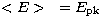 in this model the
Liang-Kargatis (1996)
decay law is a natural consequence of radiative cooling plus energy conservation in the
comoving frame, and the LK decay constant
in this model the
Liang-Kargatis (1996)
decay law is a natural consequence of radiative cooling plus energy conservation in the
comoving frame, and the LK decay constant  is simply a measure of the
total number of emitting particles modulo
is simply a measure of the
total number of emitting particles modulo  (the solid angle filling factor of
the ejecta shell) times the distance squared, independent of the bulk Lorentz factor
(the solid angle filling factor of
the ejecta shell) times the distance squared, independent of the bulk Lorentz factor
 .
Liang (1997)
then showed that the ratio of source distance d to the relativistic shell curvature
radius R becomes
.
Liang (1997)
then showed that the ratio of source distance d to the relativistic shell curvature
radius R becomes 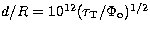 . Since both
 and are directly extractable from spectral fitting, we
can deduce all relevant physical parameters of the shell once we know the distance. For
example, consider a hypothetical shell at a distance of 1 Gpc, with
and are directly extractable from spectral fitting, we
can deduce all relevant physical parameters of the shell once we know the distance. For
example, consider a hypothetical shell at a distance of 1 Gpc, with  and a pulse rise time of 1 s. This rise time, if interpreted as the
time delay caused by the curvature of the forward visible patch, limits the bulk
Lorentz factor to
and a pulse rise time of 1 s. This rise time, if interpreted as the
time delay caused by the curvature of the forward visible patch, limits the bulk
Lorentz factor to  (Liang 1997).
We find that the shell has very large aspect ratio,
(Liang 1997).
We find that the shell has very large aspect ratio, 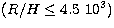 , high density
(comving lepton density
, high density
(comving lepton density 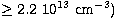 , comoving magnetic field
B=1-100 G, and is matter-dominated
, comoving magnetic field
B=1-100 G, and is matter-dominated 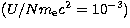 where U is the total
internal energy. The total number of leptons
where U is the total
internal energy. The total number of leptons 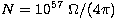 and the total
lepton kinetic energy
and the total
lepton kinetic energy  .Due to the high comoving density such shells are likely associated with internal shocks
of ejecta material (rather than external shocks).
.Due to the high comoving density such shells are likely associated with internal shocks
of ejecta material (rather than external shocks).
Copyright The European Southern Observatory (ESO)