

Recent optical afterglow observations have convincingly shown that most GRBs are likely at cosmological distances (Djorgovski et al. 1997; Feroci et al. 1998). But their true nature remains a mystery. Though afterglow studies will shed important light on the energetics, progenitor and environment of GRBs, progress towards the origin of GRB itself still depends on the ultimate understanding of the gamma-ray emission mechanism. To address the physics of this early phase GRB emission we must decipher the complex information contained in the spectral and temporal evolution of the gamma-ray pulses.
Recent high-time-resolution studies of GRB spectra show that the typical hard-to-soft
evolution can be characterized, using the
Band et al. (1993)
function, as the downward movement of the spectral break energy  (Liang & Kargatis 1996),
plus a softening of the low energy photon slope
(Liang & Kargatis 1996),
plus a softening of the low energy photon slope  (Crider et al. 1997;
Crider et al. 1998).
The Band et al. often is very hard at the beginning of a pulse, with
(Crider et al. 1997;
Crider et al. 1998).
The Band et al. often is very hard at the beginning of a pulse, with
 in over 2/3 of pulses analyzed
(Crider et al. 1997;
Preece et al. 1998).
This contradicts directly the upper limit on optically thin synchrotron
in over 2/3 of pulses analyzed
(Crider et al. 1997;
Preece et al. 1998).
This contradicts directly the upper limit on optically thin synchrotron
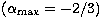 (Meszaros & Rees 1993;
Katz 1994).
Hence a synchrotron emission model requires additional absorption mechanism to turnover
the low-energy spectral slope ("X-ray deficiency problem"). Also the decay of follows the
Liang-Kargatis (1996)
decay law in most pulses:
(Meszaros & Rees 1993;
Katz 1994).
Hence a synchrotron emission model requires additional absorption mechanism to turnover
the low-energy spectral slope ("X-ray deficiency problem"). Also the decay of follows the
Liang-Kargatis (1996)
decay law in most pulses:
 where
where  is the running photon fluence,
and
is the running photon fluence,
and  and
and  are constants. This behavior must be satisfied by
any emission and cooling model.
are constants. This behavior must be satisfied by
any emission and cooling model.
Copyright The European Southern Observatory (ESO)