

 d after trigger,
the break frequencies are
d after trigger,
the break frequencies are 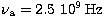 ,
,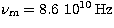 , and
, and 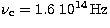 (Galama et al. 1998a).
The peak flux is
(Galama et al. 1998a).
The peak flux is  mJy and the
electron index p=2.2. After the first 500s electrons no longer
cooled efficiently and the afterglow must evolve adiabatically. We use
a redshift of z=0.835 for GRB970508
(Bloom et al. 1998) and
mJy and the
electron index p=2.2. After the first 500s electrons no longer
cooled efficiently and the afterglow must evolve adiabatically. We use
a redshift of z=0.835 for GRB970508
(Bloom et al. 1998) and
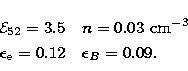
 . Finally, we adopt X=0.7
for the composition of the ambient medium. Using further that
x2.2=0.580,
. Finally, we adopt X=0.7
for the composition of the ambient medium. Using further that
x2.2=0.580,  , we find
 |
||
| (9) |
![\begin{figure}
\includegraphics [angle=-90,width=8.5cm]{FIG1.ps}\end{figure}](/articles/aas/full/1999/15/r26/img33.gif) |
Figure:1
The X-ray to radio spectrum of GRB 970508 on May 21.0 UT
(12.1 days after the event) from
Galama et al. (1998a). Indicated are
the inferred values of the break frequencies  , ,  and and  for May 21.0 UT for May 21.0 UT |
Copyright The European Southern Observatory (ESO)