

Some  of GRBs show the FRED (Fast Rise/ Exponential Decay)
behavior. For a simple
FRED-type GRB, or for well-defined peaks within a burst light curve,
hard-to-soft evolution is usually measured (e.g.,
Norris et al. 1986). A hardness-intensity correlation is also generally observed for
well-defined pulses within a GRB
(Golenetskii et al. 1983). Both of
these viewpoints are probably correct insofar as each well-defined
pulse in a GRB time profile is accompanied by a spectral hardening and
subsequent softening (Ford et al. 1995). When
of GRBs show the FRED (Fast Rise/ Exponential Decay)
behavior. For a simple
FRED-type GRB, or for well-defined peaks within a burst light curve,
hard-to-soft evolution is usually measured (e.g.,
Norris et al. 1986). A hardness-intensity correlation is also generally observed for
well-defined pulses within a GRB
(Golenetskii et al. 1983). Both of
these viewpoints are probably correct insofar as each well-defined
pulse in a GRB time profile is accompanied by a spectral hardening and
subsequent softening (Ford et al. 1995). When  is plotted against photon or energy fluence, then decays as a power-law or a broken power law
(Liang & Kargatis 1996;
Crider et al. 1998). We
(Dermer
et al. 1999b) have recently shown how this behavior can
be understood in terms of the analytic function described above.
is plotted against photon or energy fluence, then decays as a power-law or a broken power law
(Liang & Kargatis 1996;
Crider et al. 1998). We
(Dermer
et al. 1999b) have recently shown how this behavior can
be understood in terms of the analytic function described above.
Our model spectrum makes definite predictions if one assumes that
the FRED-type profile of GRB peaks is a consequence of a smooth CBM that is
reasonably well-described by a density  . At
early times
. At
early times  , where the deceleration time scale
 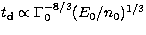 ,
the temporal profile of the rising flux
(
,
the temporal profile of the rising flux
( ) of a decelerating blast wave exhibits
temporal indices
) of a decelerating blast wave exhibits
temporal indices 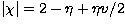 at low energies
 and
and 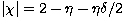 at high
energies
at high
energies  . Here
  . Because
  ,
,  , and
, and
 can all be measured, fast timing over a broad energy band
should give shifts in the temporal indices of the rising portion of
the GRB time profiles approaching these limits. We also predict
(Dermer
et al. 1999b)
that the time of the peak flux of a well-defined
GRB pulse measured at different photon energies
(
can all be measured, fast timing over a broad energy band
should give shifts in the temporal indices of the rising portion of
the GRB time profiles approaching these limits. We also predict
(Dermer
et al. 1999b)
that the time of the peak flux of a well-defined
GRB pulse measured at different photon energies
( ) should follow the relation
![\begin{eqnarray}
t_{\rm p}(\epsilon) =
\frac{t_{\rm d}}{
2g+1}\; \left[ 2g + \left({\epsilon\over {\cal E}_0}\right)^{-(2g+1)/(4g+\eta/2)}\right].\end{eqnarray}](/articles/aas/full/1999/15/r22/img27.gif) |
(1) |
 keV energies, but the character of peak alignment and
lagging is less well-studied at
keV energies, but the character of peak alignment and
lagging is less well-studied at
 keV (see, however,
Piro et al. 1998;
Connors &
Hueter 1998).
keV (see, however,
Piro et al. 1998;
Connors &
Hueter 1998).
Perhaps the most crucial test for a model of GRBs is to explain the
overall GRB duration distribution, including the strong evidence for
bimodality
(Kouveliotou et al. 1996). In our recent work
(Böttcher & Dermer 1999) we show
that the GRB duration distribution
measured with BATSE and other instruments is a consequence of
the emission properties of blast waves, the triggering
criteria of GRB detectors, and the range of values of  and E0.
Copyright The European Southern Observatory (ESO)