Two weeks after the explosion the size of G970508, estimated from
the observed scintillation (Frail et al. 1997b), was 0.003 mas.
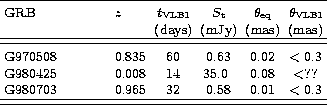
G970508 reached a peak of 0.7 mJy (with considerable variability) 60
days after the gamma-ray burst. At this time we can estimate a size
of  mas from equipartition arguments, unresolvable by VLBI
observations (see Table 2). A similar GRB at a redshift of 0.2 would
be
mas from equipartition arguments, unresolvable by VLBI
observations (see Table 2). A similar GRB at a redshift of 0.2 would
be  40 mJy, and have a size of 0.07 mas 60 days after the burst.
With an easily achievable dynamic range image of 300:1, such a burst
would be resolved by the VLBA. Unfortunately, if GRBs are
homogeneously distributed out to z=4, or trace the star formation in
the universe, then our chances of observing a GRB at z < 0.2
are
less than 1 in 104 (assuming
40 mJy, and have a size of 0.07 mas 60 days after the burst.
With an easily achievable dynamic range image of 300:1, such a burst
would be resolved by the VLBA. Unfortunately, if GRBs are
homogeneously distributed out to z=4, or trace the star formation in
the universe, then our chances of observing a GRB at z < 0.2
are
less than 1 in 104 (assuming  ). Belying that simple
picture, one GRB, G980425, has already been found at z=0.0083. This
has been explained as either a separate class of GRBs
(Bloom et al. 1998), or the result of beaming such that only a small fraction of
distant GRBs are detected (Wang & Wheeler 1998). By day 60 the
predicted size of G980425 was 0.4 mas. Such an object in the northern
sky would be easy to study with the VLBA.
). Belying that simple
picture, one GRB, G980425, has already been found at z=0.0083. This
has been explained as either a separate class of GRBs
(Bloom et al. 1998), or the result of beaming such that only a small fraction of
distant GRBs are detected (Wang & Wheeler 1998). By day 60 the
predicted size of G980425 was 0.4 mas. Such an object in the northern
sky would be easy to study with the VLBA.
Granot et al. (1998) have recently computed images of what the relativistically expanding fireball showing a disk-like, limb brightened geometry. If GRBs are substantially beamed (as is often invoked to reduce the energy requirements), then we expect substantial deviations from these predictions. Estimates of the rate of expansion also differ greatly (Waxman 1997 vs. Sari et al. 1998). By resolving the explosion the VLBA could play a crucial role in understanding the physics of these energetic events.
Combined VLA and VLBA observations can rule out significant gravitational lensing on scales of 10 mas - 300 arcsec in G970508 and G980703. This covers the range of lenses discussed in the literature, and rules out any substantial flux magnification of the gamma-ray burst by gravitational lensing.
The location of the GRB within the host galaxy is also a subject of
interest. VLBA observations can pinpoint the location to within 1 mas
(or a few parsecs at  ). Future optical or IR instruments
capable of high resolution and absolute astrometry could use the VLBA
position to shed light on the environment of the progenitor object.
). Future optical or IR instruments
capable of high resolution and absolute astrometry could use the VLBA
position to shed light on the environment of the progenitor object.
Acknowledgements
The NRAO is a facility of the National Science Foundation operated under cooperative agreement by Associated Universities, Inc.
Copyright The European Southern Observatory (ESO)